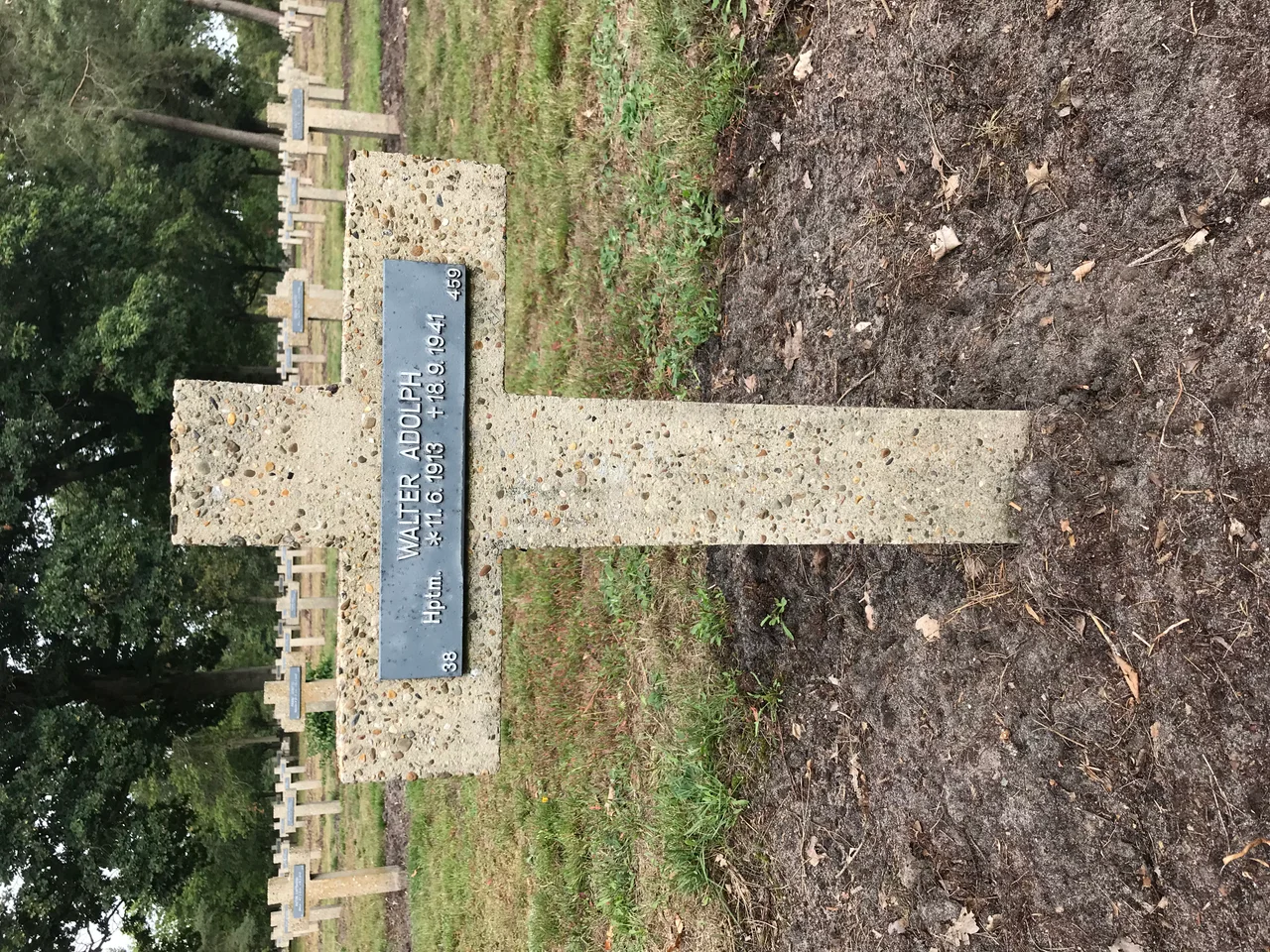

Walter Adolph
On the morning of 18 September 1941, Walter Adolph took off from Moorsele Airfield in West Flanders at the head of a flight of eight Focke-Wulf 190 fighters, escorting a German tanker through the English Channel near Blankenberge. He was 28 years old. He had been awarded the Knight's Cross of the Iron Cross less than a year before. He had been a fighter pilot in the Condor Legion during the Spanish Civil War, was credited at the time of his death with around 25 aerial victories over French, British, and Spanish Republican aircraft, and was the commander of II. Gruppe of Jagdgeschwader 26 Schlageter. He did not come back from that flight. His body was washed ashore on a Belgian beach near Knokke on 12 October. He is now buried at the Lommel German war cemetery in Belgian Limburg.
From a Romanian Village to the Luftwaffe
He was born on 11 June 1913 at Fantanele, a village in Bacau County in what was then Austro-Hungarian-administered Romania. After the empire collapsed in 1918, his family moved to Germany, and Adolph grew up among the generation of young German men who would come of age just as Adolf Hitler came to power. By late 1937 he was in Spain, flying Messerschmitt Bf 109 B-2 fighters with 1. Staffel of Jagdgruppe 88 of the Condor Legion - the German air contingent fighting on Franco's side in the Spanish Civil War. On 30 December 1937 he shot down a Republican Polikarpov I-15. It was his first aerial victory. He came home with the Spanish Cross in Gold with Swords, one of the many young Luftwaffe officers whose first combat experience had been in someone else's war.
Phoney War to Battle of Britain
When the Second World War began in September 1939, Adolph was a squadron leader - Staffelkapitan of 2. Staffel of Jagdgeschwader 1, soon redesignated 8. Staffel of Jagdgeschwader 27. The unit spent the Phoney War patrolling the German-Dutch border. He claimed his first aerial victory of the war on 1 October 1939, a Bristol Blenheim of No. 139 Squadron over Osnabruck. When Germany invaded France and the Low Countries on 10 May 1940, his Gruppe was thrown into the fighting over Venlo, Liege, and Maastricht. On 12 May, in defense of the bridges over the Meuse and Albert Canal, he shot down three Blenheim bombers of No. 139 Squadron in a single morning. By the time the French campaign ended in late June, he had claimed five victories. Through the summer and autumn of 1940 - the Battle of Britain - he flew escort missions over the Channel and southern England, claiming a Hurricane over the Isle of Wight on 19 July, a Blenheim near Cherbourg on 1 August, a Spitfire south of Stanford in Kent during the opening day of the Blitz on 7 September.
Group Commander
On 4 October 1940 he was promoted to Gruppenkommandeur of II. Gruppe of JG 26 Schlageter. The unit was named after Albert Leo Schlageter, a Freikorps fighter executed by the French in 1923 and turned by the Nazi Party into a propaganda martyr - the kind of unit naming that tells you something uncomfortable about the political climate in which Adolph rose. He led from the front. Between 11 October and 8 November 1940 he claimed five Spitfires and a Hurricane over Kent, near Maidstone and Tonbridge. One of his victims that autumn was Pilot Officer Ludwik Martel of No. 603 Squadron, whose Spitfire P7350 was hit on 25 October. Martel was wounded by shrapnel, force-landed wheels-up in a field near Hastings, and was trapped in the cockpit for half an hour before Home Guard soldiers pulled him out. P7350 itself survived to fly again, and today is the oldest airworthy Spitfire in the world. On 13 November 1940 Adolph was awarded the Knight's Cross of the Iron Cross, partly in recognition of having sharpened II. Gruppe's combat performance.
Circus Missions and a New Aircraft
Through the summer of 1941, his unit, now flying out of bases in northern France and Belgium, was committed to defending against the RAF's Circus offensive - bomber raids escorted by waves of fighters, designed to draw the Luftwaffe up to fight. Adolph claimed a Hurricane on 17 June while defending the Etabs Kuhlmann chemical works at Chocques. A Spitfire on 26 June over a raid on the Comines power station. A No. 74 Squadron Spitfire on 6 July near Lille. A Blenheim from No. 21 Squadron on 23 July, off the Scheldt Estuary near Ostend. Two No. 602 Squadron Spitfires on 16 August, his 23rd and 24th claimed victories. In July, his unit had relocated to Moorsele Airfield and begun transitioning to a new aircraft: the Focke-Wulf Fw 190, just then entering service and significantly faster and more powerful than the Bf 109s the Luftwaffe had been flying.
The First Fw 190 Lost in Combat
On 18 September 1941 the tanker he was escorting near Blankenberge came under attack from three Blenheim bombers, themselves escorted by Spitfires of No. 41 Squadron and Hurricanes of No. 615 Squadron. The German pilots claimed one of the Blenheims shot down. Adolph circled to look at the wreck. Flying Officer Cyril Babbage of No. 41 Squadron - a British ace himself - is believed to have caught him from above. Adolph's Focke-Wulf Fw 190 A-1, Werknummer 0028, went down thirty kilometers north-west of Ostend. It was the first Fw 190 ever lost in aerial combat. His successor in command of II. Gruppe, Hauptmann Joachim Muncheberg, took over the next day. Adolph's body drifted on the Channel currents for almost four weeks before washing ashore near Knokke on 12 October. He was eventually interred at the Lommel German war cemetery a few kilometers from the Dutch border, in a region of pine and heath he had probably flown over many times. He left behind a wife, no surviving children, and the same questions that hang over every young man who flew with skill and courage for a regime that did not deserve him.
From the Air
Walter Adolph is buried at the Lommel German war cemetery, 51.19 N, 5.31 E, in northern Belgian Limburg. The grave site lies in 16 hectares of pine forest near the Dutch border. His final combat took place 30 km north-west of Ostend over the English Channel, near 51.32 N, 2.66 E. Nearby airports for visiting the grave: Kleine Brogel military base (EBBL) 15 km south, Eindhoven (EHEH) 25 km north, Brussels (EBBR) 80 km south-west. Cruise at 2,500 to 3,500 feet for the cemetery; the symmetry of the rows and the central crypt are visible from the air.
Nearby Stories
- Genk 3.9 km away
- Hillenraad Castle 4.6 km away
- Nicky Verstappen: Twenty Years on the Brunssummerheide 5.5 km away
- Sint-Oedenrode 6.7 km away
- Kempische Vaart 11 km away
- Breda 13 km away
- Rotselaar 15 km away
- Weeze 20 km away