.jpg)
West End Gasworks
Before electricity, light came from coal. At a bend in the Brisbane River at West End, a company spent over a century turning black coal into the gas that lit South Brisbane's lamps and warmed its bedroom fireplaces - and the great riveted drum it left behind, rising on its spiral guide rails, is the last gasholder of its type surviving in Brisbane, and probably in all of Queensland. Round structures are rare among the angular warehouses of West End, and even empty, this one has a strange elegance: a cylinder of riveted steel crowned with a shallow dome, a relic of the age that lit the city by flame.
Lighting the South Side
Commercial gas reached Brisbane in 1865, supplied from a works at Petrie Bight on the river's northern side. But the city was growing fast - its population had more than doubled in the early 1860s - and the booming southern suburbs needed their own supply. The South Brisbane Gas and Light Company was registered in mid-1885, and within eighteen months its West End works was complete and delivering gas. The two companies promptly fell into a price-cutting war, which they settled in 1889 not through competition but by simply carving the city in two: one would have the north bank, the other the south. Gas meant streetlights, gas stoves and the coke that filled coal scuttles across the estates springing up around West End.
The River's Revenge
Building a gasworks on a riverbank floodplain was a gamble, and the river collected. A flood in 1890 reached the works but spared it serious harm. The great flood of 1893 was merciless: it destroyed one of the gasholders, swept away engineering drawings stored on linen, and wrecked much of the plant. Worse for the company, it destroyed its customers - many of the new houses on the nearby Orleigh Estate, most of them less than fifteen years old, were ruined. The South Brisbane city engineer drew the obvious lesson and advised his council to light its streets with electricity instead. The gasworks rebuilt and carried on, but the river had served notice that this was borrowed ground.
An Engineer's Craft
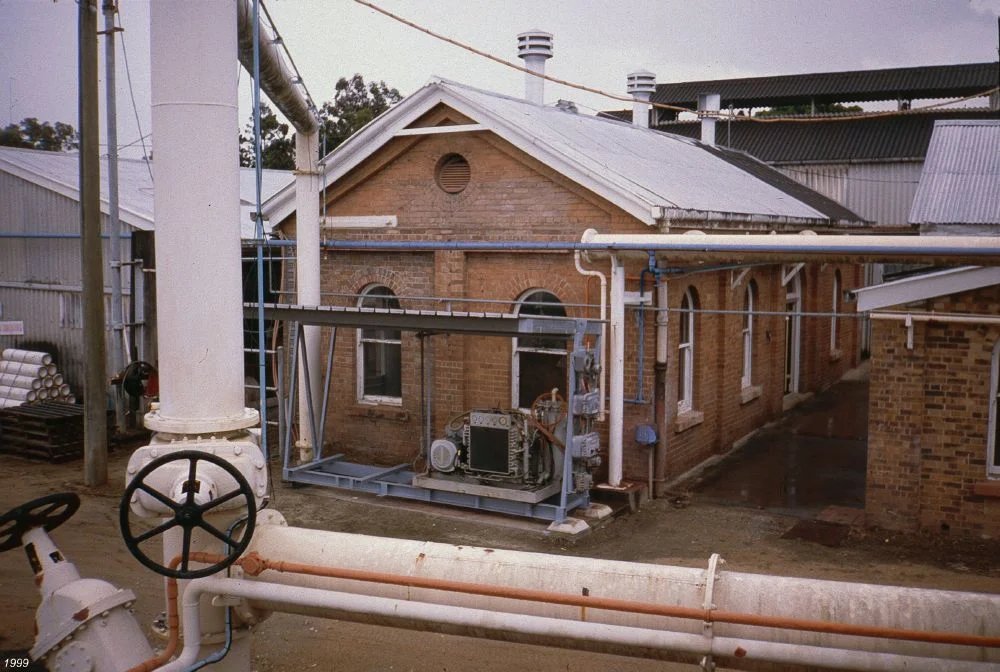
Running a gasworks was demanding, precise work, and it attracted serious engineers. William Summers Moore, a second-generation gas man who had worked plants across Victoria, New South Wales and Townsville, took charge in the early 1900s and lifted the works' efficiency by some sixty per cent across the following years, travelling back to England to keep abreast of the trade. His successor, W. H. Shedden, pushed through another modernisation around 1930 and championed high-pressure distribution that let the gas reach further suburbs. The compressors that survive on the site trace this whole arc of progress, from steam power to electric motors - sturdy machines from Huddersfield and Chesterfield, some of them still standing in the brick compressor house decades after the last gas flowed.
The Last Gasholder
Natural gas ended the old way of doing things. In December 1969 the plant that made gas from coal was shut down, and the retort house was demolished in 1974; that same year another great flood swept the low-lying works again. Through the 1970s most of the manufacturing and purification plant came down, until little remained but the gasholders, the compressors and a scatter of brick buildings. The works was added to the Queensland Heritage Register in 2000, and in 2003 the heritage council approved demolition of what was left - on the condition that the gates, fence and a London-made gas governor be kept and folded into whatever rose in its place. The surviving spiral-guide gasholder endures as the last of its kind, a round steel ghost of the century when this stretch of the river kept Brisbane's south side in light.
From the Air
The West End Gasworks site sits on the Brisbane River at West End, an inner-southern suburb, at approximately 27.481°S, 153.004°E - on a tight bend of the river about 2 to 3 km south-west of the CBD. From the air the distinctive circular footprint of the gasholder tank stands out among the angular warehouses and newer residential development of the Montague Road industrial strip; the sharp loop of the river around West End and Orleigh Park, and the green of Davies Park, are the clearest navigational markers. Brisbane Airport (YBBN) lies about 14 km to the north-east, and Archerfield (YBAF) roughly 8 km to the south. Best seen at lower altitudes over the inner-south river bends in clear conditions.
Nearby Stories
- Redcliffe Peninsula 2.7 km away
- Tamborine National Park 12 km away
- Cressbrook Homestead 27 km away
- Main Range National Park 31 km away
- 2010-2011 Queensland Floods 38 km away
- Cape Byron 96 km away
- Cape Byron Light 126 km away
- HMS Porpoise (1799) 588 km away