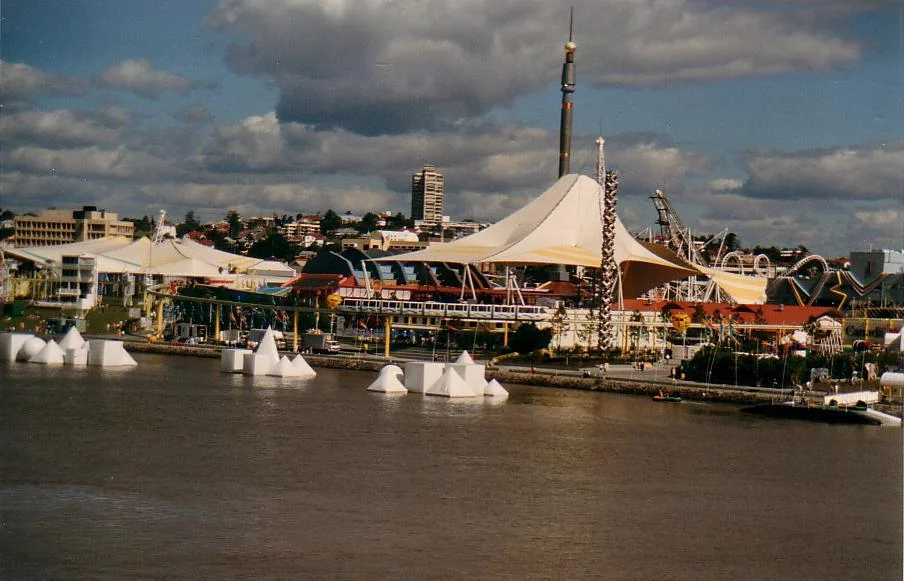

World Expo 88
Brisbane spent the 1980s living down a reputation. To the rest of Australia it was a slow, conservative northern town, the kind of place people flew over on the way to somewhere else. Then, on 30 April 1988, Queen Elizabeth II declared World Expo 88 open on a 40-hectare strip of the South Bank, and roughly 100,000 people poured through the gates on the very first day. By the time the carnival closed six months later, more than 15.7 million tickets had been sold and the city had quietly decided it was somebody after all.
The Backwater Throws a Party
The numbers still seem improbable. Planners had projected 7.8 million visitors; the fair drew over 18 million when staff and VIPs are counted, more than double the forecast, in a state whose entire population was under three million. The theme was "Leisure in the Age of Technology," and the mascot was Expo Oz, a cheerful platypus designed by Disney's Imagineering division. But the real draw was simply being there. Brisbane had hosted the Commonwealth Games in 1982 and acquitted itself well; Expo was the encore that turned a moment into a mood. For half a year the South Bank hummed from ten in the morning until ten at night, and Queenslanders who had never thought of their capital as exciting found themselves, somewhat to their own surprise, having the time of their lives.
A Spire Eighty-Eight Metres Tall
Above it all rose the Skyneedle, an 88-metre spire engineered by Charles Sutherland from a sculpture by artist Robert Owen. At the time it was reckoned the largest art commission ever made in Australia, and at night its beam reached far across the city, a lighthouse for a fair built on the water's edge. Beneath it stretched great fabric sun sails, strung up to blunt the Queensland heat, which became so identified with the event that they ended up in the official logo. There were two thousand kilometres of telecommunication cable laid underground, around a hundred sculptures commissioned or borrowed, a monorail threading between the pavilions, and the gentle absurdity of a Swiss pavilion offering artificial snow to a subtropical crowd in shorts.
The World, Pavilion by Pavilion
The pavilions were the heart of it. New Zealand drew the longest queues with an animated Footrot Flats show and a glow-worm cave. Australia's own pavilion, shaped and coloured like Uluru, ran a special-effects Dreamtime Theatre, while artist Ken Done wrapped the place in giant, joyful letters spelling AUSTRALIA that became the most photographed backdrop of the fair. Japan brought a tranquil pond and garden; Nepal hand-carved a three-level Peace Pagoda; Queensland built a 180-metre people-mover ride into an imagined future. Not every voice celebrated. Singer Judith Durham declined to perform at the closing because of how the event handled Aboriginal history, and that absence is part of the story too: a national party staged during the Bicentenary, in a country still reckoning with what 1788 had meant for its first peoples.
The Carnival That Wouldn't End
On the final night, 30 October 1988, the entertainers gathered on the River Stage and The Seekers closed the show with "The Carnival Is Over." Sir Llewellyn Edwards, who had chaired the whole enterprise, told the crowd he hoped the light of Expo would never really fade. Improbably, it didn't. Brisbane had grown so fond of its riverside that the city refused to hand the land back to industry. The site became the South Bank Parklands, 17.5 hectares of beaches, gardens and promenades that opened in 1992 and now draw around 16 million visitors a year. Pieces of Expo scattered across the state survive too, from the Nepalese pagoda to Ken Done's restored letters at Caboolture. The party never quite stopped; it just moved outdoors and stayed.
From the Air
World Expo 88 occupied the South Bank of the Brisbane River at approximately 27.477 degrees S, 153.022 degrees E, directly opposite the Brisbane CBD, now the South Bank Parklands. The site sits on the south bank of a sharp river bend, with the high-rise core of the city and the Brisbane River loop as the dominant visual landmarks; the Story Bridge stands a short way downstream to the northeast. Brisbane Airport (ICAO YBBN) lies about 13 km to the northeast, and Archerfield Airport (ICAO YBAF) about 9 km to the southwest. Best viewed from 1,500 to 4,000 feet in the typically clear subtropical air; afternoon sea breezes and occasional summer thunderstorms can reduce visibility.
Nearby Stories
- Redcliffe Peninsula 2.7 km away
- Tamborine National Park 12 km away
- Cressbrook Homestead 27 km away
- Main Range National Park 31 km away
- 2010-2011 Queensland Floods 38 km away
- Cape Byron 96 km away
- Cape Byron Light 126 km away
- HMS Porpoise (1799) 588 km away