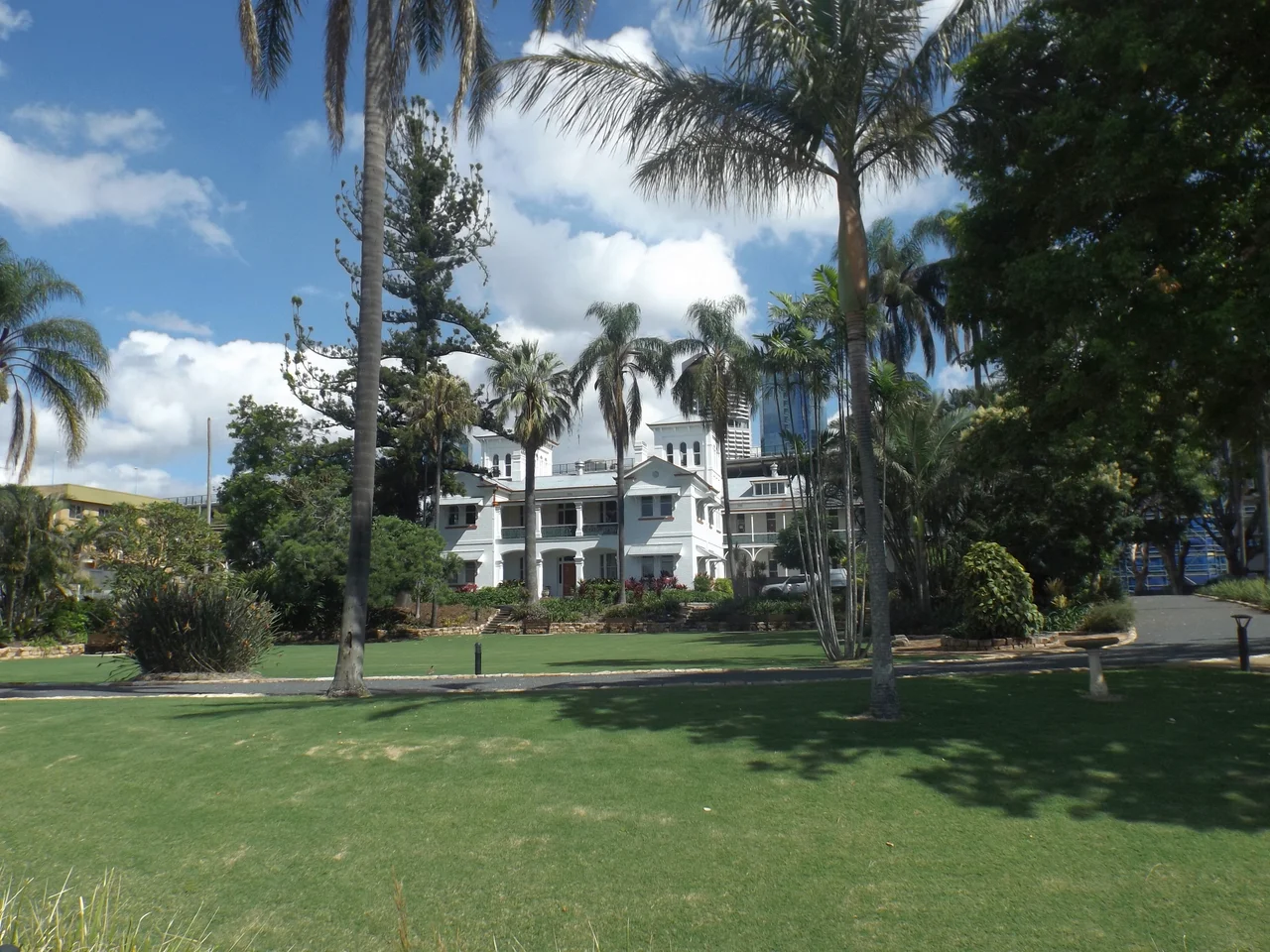

Yungaba Immigration Centre
On 6 December 1887, the migrant ship Duke of Buccleuch tied up at Brisbane and disgorged its passengers, tired, seasick and a long way from anything they knew. Their first night in Australia was spent in a brand-new brick building on a bluff at Kangaroo Point, where the river makes its slow turn around Petrie Bight. The building had a name borrowed from an Aboriginal word: Yungaba, "place of sunshine." For the better part of a century, it was where Queensland said its first hello to the people it had asked to come.
The Immigration Colony
Nineteenth-century Queensland wanted people, and it wanted them badly. The young colony ran the most aggressive assisted-immigration scheme in the country, drawing migrants at a rate no other Australian colony matched, and it built Yungaba to receive them in style. The depot was designed in 1885 by John James Clark, the colonial architect, an elegant two-storey brick building with a symmetrical cruciform plan, twin three-storey towers, and broad verandahs trimmed in decorative cast iron. The grandeur was deliberate. A government that staked its future on newcomers wanted their first impression of Queensland to be one of welcome, not of a grim barracks. The riverfront approach, the views, the careful ornamentation, all of it said: you are wanted here.
First Nights in a New Country
Inside, the arrangement told its own story about the era's anxieties. Single men and single women slept in separate dormitories at opposite ends of the building; families were given small private rooms; everyone shared the washing facilities. It was a Victorian idea of order, privacy and propriety made out of timber and brick, and the building's hierarchy of decoration, plainer here, more ornamented there, quietly marked who belonged where. Picture the scene that played out across these verandahs thousands of times over the decades. A family steps off a months-long voyage, sea-legs still swaying, children clutching at skirts, a few words of English among them if they were lucky, sorting out which door was theirs. Outside, the unfamiliar light and the wide brown river; inside, a borrowed bed for a night or two. Most stayed only a short while before scattering into Brisbane and out to the bush to begin again. Yungaba was never meant to be home. It was the threshold you crossed on the way to making one.
Not Everyone Came Freely
The building's history holds harder chapters too, and they deserve to be told plainly. In the early 1900s, after Federation, Yungaba became a holding point for South Sea Islanders, Pacific people, many of whom had been brought to Queensland to cut cane, often under coercion. Now the new Commonwealth's White Australia laws were deporting them. For these men and women, the "place of sunshine" was not a welcome but a farewell, the last Queensland ground under their feet before a forced passage back to islands some had not seen in decades. The same verandahs that greeted hopeful European migrants watched others being sent away. To honour Yungaba's full story is to hold both truths at once: a doorway in for some, a door closing on others.
The Many Lives of a Landmark
Yungaba kept reinventing itself. It served as No. 6 Australian General Hospital, welcoming soldiers and their families home from three wars. In the 1930s it housed the labourers building the Story Bridge, whose great steel span now rises just beside it. In 1992 it was added to the Queensland Heritage Register, recognised as a building that helped shape the state itself. When developers bought the site in 2008, they restored the old depot and converted it into apartments, with a multicultural centre and auditorium alongside, taking care that nothing new blocked the view between Yungaba and the river. The building that received generations of newcomers now looks out, as it always has, over the water that carried them in.
From the Air
Yungaba stands at roughly 27.467 degrees S, 153.037 degrees E on the Kangaroo Point peninsula, on the south bank of the Brisbane River beside the Story Bridge. From the air the most obvious landmark is the Story Bridge's steel cantilever span immediately to the north, with the river horseshoe of Petrie Bight curling around the CBD just across the water. Brisbane Airport (ICAO YBBN) lies about 11 km to the northeast; Archerfield Airport (ICAO YBAF) about 11 km to the southwest. The site is best appreciated from 1,500 to 3,500 feet; haze from the river and afternoon sea breezes off Moreton Bay can soften the light, and summer storms occasionally reduce visibility sharply.
Nearby Stories
- Redcliffe Peninsula 2.7 km away
- Tamborine National Park 12 km away
- Cressbrook Homestead 27 km away
- Main Range National Park 31 km away
- 2010-2011 Queensland Floods 38 km away
- Cape Byron 96 km away
- Cape Byron Light 126 km away
- HMS Porpoise (1799) 588 km away