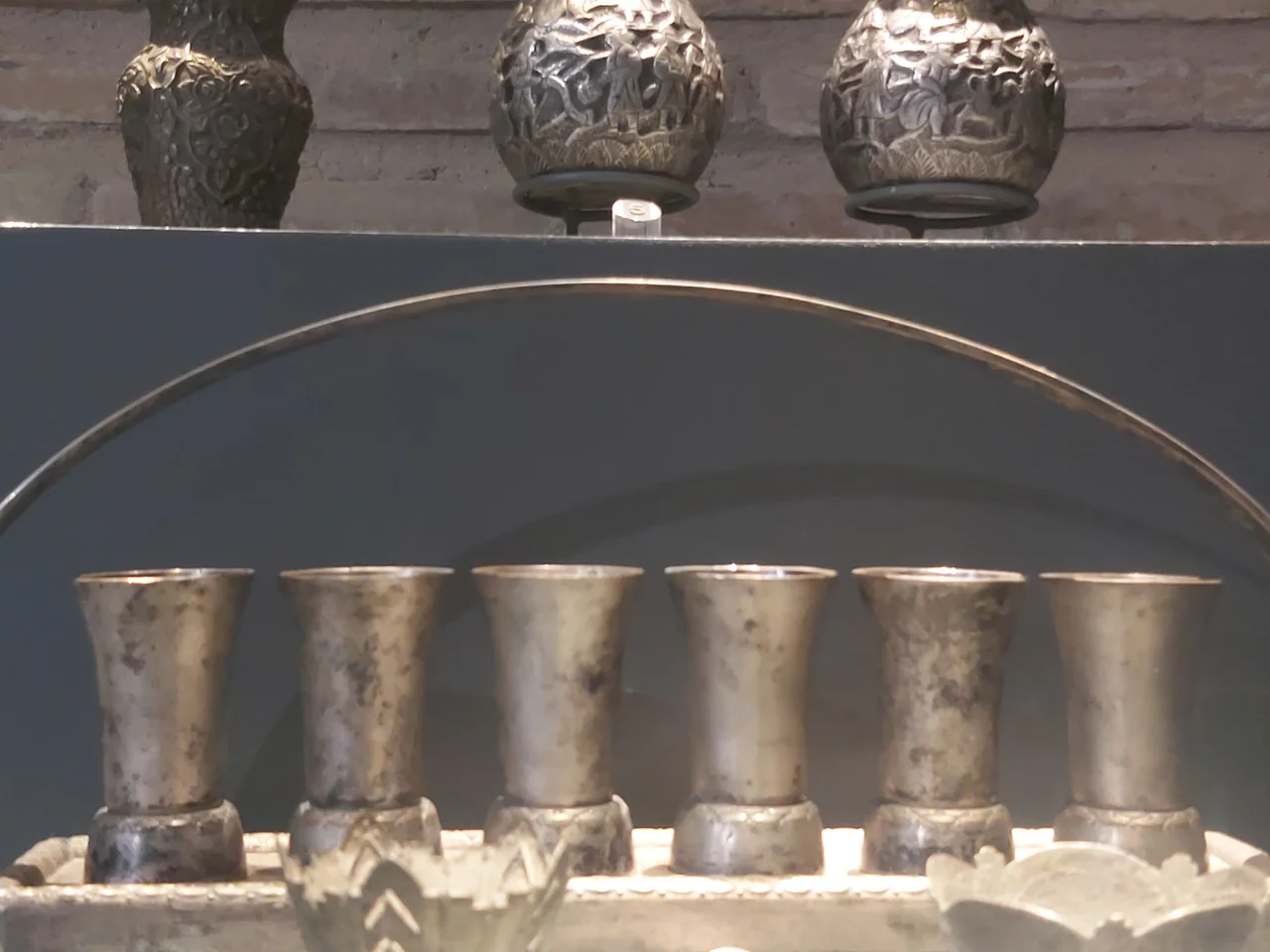

Zamzam Well
Hagar runs between two hills. Her infant son Ismail is lying in the sand, dying of thirst, and she is looking for any sign of water in a place that should not have any. According to Islamic tradition, she ran seven times between the hills of Safa and Marwah, and when she returned to the child, water had come up from the ground. Some versions say Ismail scraped the earth with his feet and the spring opened beneath them. Others say the angel Gabriel struck the ground. Either way, the well they call Zamzam has been there ever since. Pilgrims who complete the Hajj still walk the course between Safa and Marwah today, seven laps, in memory of Hagar's desperate search.
Inside the Masjid al-Haram
The Zamzam Well sits twenty meters east of the Ka'ba, within the Masjid al-Haram, the sacred mosque at the center of Mecca. This is the holiest place in Islam, the point toward which every Muslim turns five times a day in prayer. The well itself was renovated in 2017 and 2018 and is no longer visible to pilgrims as an open shaft. Modern infrastructure delivers Zamzam water to dispensers throughout the mosque complex. A hundred water samples are tested every day to monitor its quality. Approximately 15,000 liters per hour can be drawn at peak demand during Hajj, when millions of pilgrims pass through and many wish to carry bottles of Zamzam water home. Saudi authorities, in 2025, simplified the process for pilgrims to bring Zamzam water through airports, a recognition of how important the ritual is and how bureaucratic obstacles had built up around it.
The Name That Echoes
The origin of the name is uncertain. The historian Jacqueline Chabbi argues the word is an onomatopoeia, a sound-word. It may describe the distant roll of thunder, a guttural murmur made with a closed mouth, or, applied to water, an abundant supply that does not dry up. Early Islamic sources used related onomatopoeic terms for Zoroastrian prayer, which Arab observers heard as an indistinct, droning recitation. Medieval writers like al-Masudi and al-Ayni offered various etymologies, including one account tracing the name to bridles donated by Sasan, the Zoroastrian progenitor of the Sasanian Empire. Thomas Hughes catalogued yet another tradition that derives the name from an exclamation by Hagar herself, meaning stop, stop, in either an early Semitic or an Egyptian form. That the holiest well in Islam carries a name whose meaning is genuinely unclear is itself a kind of answer about how deep its history runs.
The Jurhum and the Rediscovery
After the time of Hagar and Ismail, Islamic tradition holds that the well was used by the Jurhum tribe that settled in the Mecca valley. At some point, accounts differ on when and why, the well dried up or was deliberately buried. For centuries it was lost. Its rediscovery is attributed to Abd al-Muttalib, the grandfather of the Prophet Muhammad, in the sixth century CE. Abd al-Muttalib is said to have received a vision directing him to excavate at a particular spot near the Ka'ba. He dug with his son al-Harith and uncovered the well. The story matters because it links the well not only to the Abrahamic prehistory Muslims share with Jews and Christians, but specifically to Muhammad's own family, who would become the custodians of Zamzam and of the Ka'ba before and after the rise of Islam.
A Well That Drew the World
Medieval Arabic writers noted that Zoroastrians regularly made pilgrimages to Mecca to pray at the well, based on what they called their kinship with Abraham. The practice indicates something important: Zamzam was a pan-religious pilgrimage site long before it became specifically Islamic. Ottoman pilgrims brought elaborate flasks, decorated with the Sultan's tughra, to carry Zamzam water home. European travelers like the Swiss Johann Burckhardt and the Englishman Richard Burton wrote about their experiences drinking from the well. In 1885, the Dictionary of Islam documented traditions, rituals, and theology surrounding Zamzam in extensive detail. The water is not simply a symbol. For many pilgrims, drinking Zamzam, carrying bottles home, sharing it with the sick, and being buried with a sip of it is a continuous spiritual practice woven through every stage of Muslim life.
A Mother's Search, Still Retraced
The ritual of Sa'i, the walking seven times between Safa and Marwah, remains one of the core components of the Umrah and Hajj. Pilgrims retrace the path Hagar ran, recognizing a woman's desperate search for water for her child as fundamental to the sacred geography of Islam. Zamzam is usually framed in grand theological terms, Abraham, Ishmael, divine provision. But at the heart of the story is a mother. A woman with a dying baby. Centuries of devotion have grown around what she did next. The well where the water came up is still, 1,400 years after the Hijra and many centuries longer in tradition, providing water to millions of people every year. The chemistry of the water, the quality testing, the airport procedures, are modern. The story is not.
From the Air
The Zamzam Well is located at 21.42 N, 39.83 E, within the Masjid al-Haram at the center of Mecca. Twenty meters east of the Ka'ba. From altitude the mosque complex is visible as the distinctive large oval structure at the heart of Mecca. Nearest airport: King Abdulaziz International (OEJN) at Jeddah, about 65 km west. Non-Muslims are not permitted to enter Mecca under Saudi law.
Nearby Stories
- Al-Balad, Jeddah 23 km away
- Jeddah Tower 33 km away
- Battle of Turubah 123 km away
- Red Sea Rift 143 km away
- Ghadir Khumm 159 km away
- Al-Baha 162 km away
- Thee Ain 206 km away
- Hejaz 214 km away