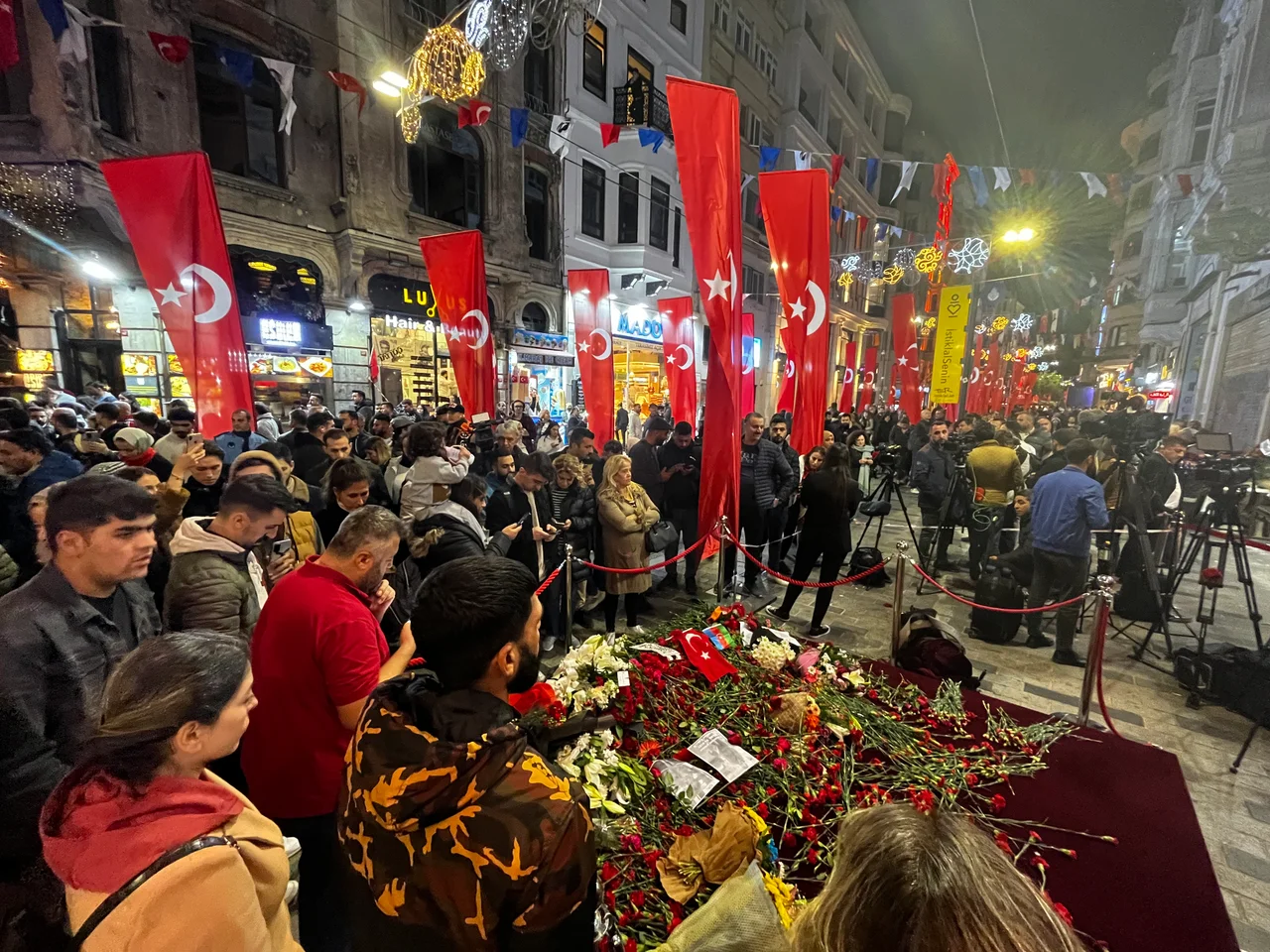

2022 Istanbul Bombing
It was a Sunday afternoon, and İstiklal Avenue was doing what it always does: drawing people in. Families strolled the broad pedestrian boulevard in the heart of Beyoğlu, the European side of Istanbul. Couples paused at café windows. A man walked with his nine-year-old daughter. At 4:13 p.m. on 13 November 2022, an improvised explosive device detonated on the avenue. Six people were killed. Eighty-one were injured. The six who died were all Turkish citizens — among them a father and his young daughter, a mother and her teenage daughter, and a married couple. Three families, each torn apart in the same instant, on the same crowded street.
The Street Where It Happened
İstiklal Avenue — whose name means Independence — is one of Istanbul's defining places. Running nearly 1.5 kilometers through the Beyoğlu district, it connects the old city's energy to the modern neighborhoods of Taksim Square. Millions of people walk it every year. On weekends, its tram line runs through shoulder-to-shoulder crowds. It is lined with bookshops, restaurants, historic churches, and 19th-century European-style apartment buildings. It is, by any measure, the heart of public life in the European city. The March 2016 bombing had already struck here — a suicide attack that killed five people near the same stretch of road. But the avenue had endured, remained open, remained full. By 2022, it was as vibrant as ever.
The Investigation and Its Disputes
Within a day of the explosion, police announced the arrest of the main suspect: Ahlam Albashir, a Syrian national. Turkish authorities attributed the attack to the Kurdistan Workers' Party (PKK) and the Syrian Democratic Forces (SDF), both of which formally denied any involvement. The PKK, the SDF, and the autonomous Kurdish-led administration of northeastern Syria all issued denials. The disputed question of responsibility became deeply entangled with Turkish domestic politics: the country was approaching a major general election in 2023, and accusations linking the attack to Kurdish groups carried significant political weight. Some analysts and observers disputed the official narrative, pointing to the absence of a formal claim of responsibility and the complex regional context. On 26 April 2024, Ahlam Albashir was convicted by a Turkish court and sentenced to seven consecutive life sentences for her role in the bombing.
Silence, Then Airstrikes
Within roughly an hour of the explosion, Turkish authorities imposed a broadcast ban on visual and audio coverage of the incident. Internet speeds and access to social media platforms including Facebook, Twitter, Instagram, and YouTube were significantly throttled across Turkey. Seven days later, on 20 November 2022, the Turkish Air Force launched Operation Claw-Sword, striking approximately 500 targets in northern Syria and Iraq. The Turkish government cited the bombing as part of its justification. Kurdish-led authorities denied the connection and accused Turkey of using the attack as a pretext. The linkage between the single explosion on İstiklal Avenue and a military operation on that scale remained deeply contested.
A City That Has Known Loss
Istanbul has absorbed terrible shocks before. The 2003 truck bombings struck two synagogues, the British consulate, and the HSBC headquarters in a single week, killing dozens. A 2016 suicide bombing near Taksim Square's tourist center killed five. A 2017 attack at an Ortaköy nightclub on New Year's Eve killed 39 people celebrating the holiday. The city has repeatedly mourned and reopened. İstiklal Avenue itself, after November 2022, did not close. Mourners left flowers. The mayor of Istanbul, Ekrem İmamoğlu, came to inspect the scene and urged calm. The Kurdish HDP party expressed grief and condolences. Governments and international organizations from across the world offered their sympathies. What the avenue could not so easily absorb was the specific grief — three families, six people, one afternoon — that left behind something no reopening fully erases.
What Remains
The dead are remembered not as symbols of geopolitics but as the people they were: ordinary residents of Istanbul who had gone out on a November Sunday. A father and his daughter. A mother and her teenager. A married couple. Of the 81 injured, 61 were eventually discharged from hospital. Twenty remained hospitalized as of 15 November 2022. İstiklal Avenue still draws its millions. The tram still runs its route. The bookshops and restaurants still open their doors each morning. But the date holds its weight, and the six names behind it hold theirs.
From the Air
İstiklal Avenue lies at approximately 41.035°N, 28.981°E in the Beyoğlu district of Istanbul, on the European shore of the Bosphorus. The nearest major airport is Istanbul Airport (LTFM), roughly 35 km to the northwest. At a cruising altitude of around 10,000 feet on approach to LTFM, the Galata Tower — standing just west of İstiklal — is one of the most recognizable landmarks in the city below. Taksim Square, at the avenue's northern end, is visible as a large open plaza. The Bosphorus strait itself gleams to the east, separating the European and Asian sides of Istanbul.
Nearby Stories
- Kocaeli Peninsula 7.6 km away
- Second Battle of Çatalca 11 km away
- Istanbul's Rural Outskirts 14 km away
- MV Struma 20 km away
- HMAS AE2 36 km away
- Bursa 66 km away
- Sangarius Bridge 71 km away
- Januarius MacGahan 101 km away