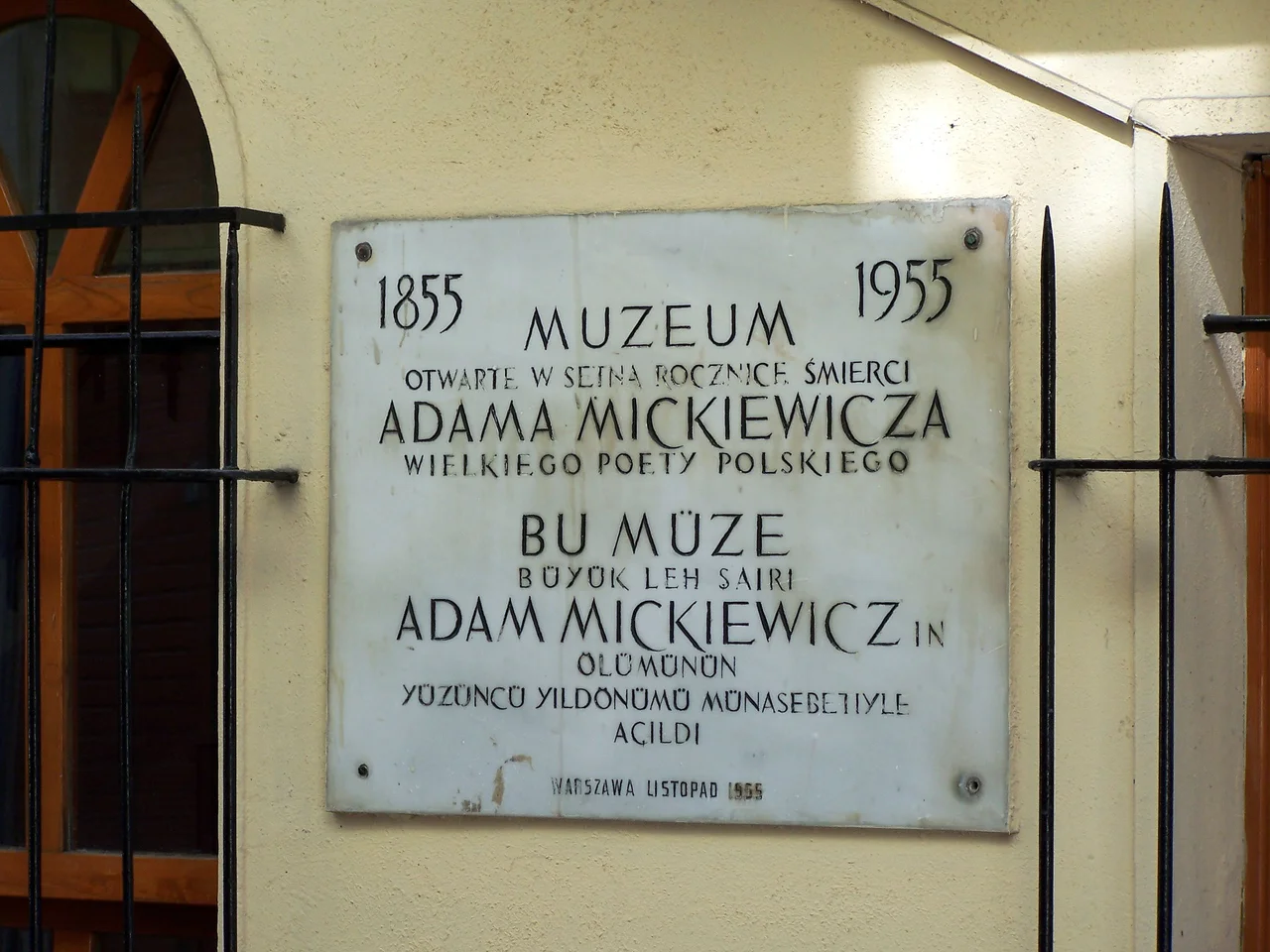

Adam Mickiewicz Museum, Istanbul
Adam Mickiewicz did not come to Istanbul to die. He came in September 1855 with a mission: to help organize Polish legions fighting under the Ottoman Army during the Crimean War. He was 56 years old and still carried the fire that had made him the defining voice of Polish national identity — the poet whose epic verses had sustained a people through partition and exile. He befriended Michał Czajkowski, a Polish nobleman who had converted to Islam and commanded Ottoman forces under the name Sadık Paşa. Within weeks, Mickiewicz fell ill. On 26 November 1855, he died in the house in Beyoğlu where he had been staying. He never saw a free Poland. He had spent most of his adult life in exile, and he died in exile still.
The Poet Who Shaped a Nation
To understand what the Mickiewicz Museum holds, it helps to understand what Adam Mickiewicz meant — and still means — to Poland. Born in 1798 in what is now Lithuania, then part of the Russian-controlled former Polish-Lithuanian Commonwealth, he grew up under occupation and wrote his way into something larger. His epic poem Pan Tadeusz, published in 1834, became the closest thing Poland had to a national scripture: a long, nostalgic vision of Lithuanian manor life and the landscape of a homeland many Poles could no longer visit. His dramatic poem Dziady explored the border between the living and the dead in ways that spoke directly to a nation that felt itself in a kind of cultural death. For generations of Poles living under foreign rule, Mickiewicz was not just a poet. He was proof that Poland existed.
The Last Chapter, In Istanbul
The house in Beyoğlu where Mickiewicz died was renovated after a fire damaged it in 1870. For nearly a century it stood without formal recognition. Then, in 1955 — exactly one hundred years after Mickiewicz's death — the museum was opened, with the support of the Museum of Literature in Warsaw. The centenary timing was deliberate: a way of marking the loss and claiming the location as Polish cultural ground. The museum is small. It occupies the house itself. In its basement is the crypt where Mickiewicz's remains were temporarily interred for one month before being transported back to Poland — first to Paris, and eventually to Kraków's Wawel Cathedral, where he rests among Polish kings and national heroes. The basement crypt is one of the more affecting spaces in the building: a plain stone room that briefly held the poet's body before the long journey home.
What the Rooms Hold
The museum's collection is intimate rather than grand. It houses manuscripts by Mickiewicz, historical documents from the period of his stay in Istanbul, and paintings. These are not the overwhelming holdings of a national literary archive but the carefully preserved remnants of a few weeks at the end of a life. Visitors who make the trip to Beyoğlu to find the museum — it is small enough to be easy to miss — are typically people with a reason to seek it out: Poles in Istanbul, scholars of Romantic poetry, or travelers drawn by the strangeness of the address. A Polish national poet, in a Turkish city, in a room that is still trying to hold something of who he was.
A Polish Memory in a Turkish Neighborhood
Beyoğlu has long been Istanbul's most cosmopolitan district — a neighborhood of Genoese towers, Greek Orthodox churches, Armenian apostolic communities, Jewish synagogues, and European embassies, all layered over centuries of Ottoman urban life. In this context, a small Polish museum does not feel entirely out of place. It belongs to the long history of Istanbul as a city where foreigners arrived, stayed, and left something of themselves behind. Mickiewicz was one of many European exiles who moved through the city during the 19th century. He left more than most: a museum, a crypt that briefly held his remains, and the particular weight of being the place where Poland's greatest poet breathed his last, far from home, still working for a Poland that would not be free for another sixty years.
From the Air
The Adam Mickiewicz Museum is located at approximately 41.039°N, 28.977°E in the Beyoğlu district of Istanbul, on the European shore of the Bosphorus. Istanbul Airport (LTFM) lies approximately 35 km to the northwest. From the air, the Beyoğlu hillside — crowned by the medieval Galata Tower — is one of Istanbul's most recognizable features. İstiklal Avenue runs through the same neighborhood. Approaching LTFM from the east at 10,000–12,000 feet, the Golden Horn inlet and the Galata district are clearly visible, with the narrow streets of Beyoğlu climbing the ridge above the waterfront.
Nearby Stories
- Kocaeli Peninsula 7.6 km away
- Second Battle of Çatalca 11 km away
- Istanbul's Rural Outskirts 14 km away
- MV Struma 20 km away
- HMAS AE2 36 km away
- Bursa 66 km away
- Sangarius Bridge 71 km away
- Januarius MacGahan 101 km away