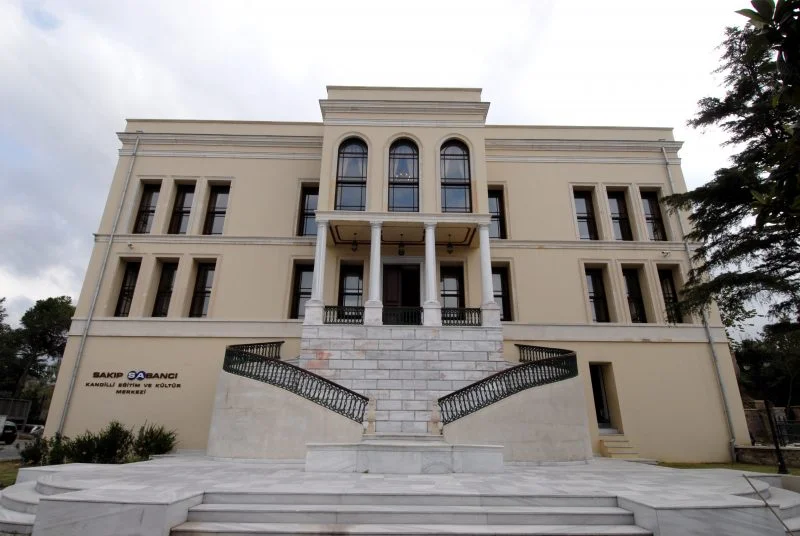

Adile Sultan Palace
From most of Istanbul, you look across the Bosphorus and see the Asian shore as a smudge of hills and minarets. From the Adile Sultan Palace, you see the whole picture — the strait threading south toward the Sea of Marmara, north toward the Black Sea, the European skyline unfolding across the water. The palace sits on a headland in the Kandilli neighborhood, at what its builders recognized as one of the most commanding positions in the city. It was designed by court architect Sarkis Balyan and built in 1861 for Princess Adile Sultan — daughter of Sultan Mahmud II, sister of two sultans, and something the Ottoman court had not often produced: a genuine poet.
A Princess Who Wrote
Adile Sultan was born in 1826, the daughter of Sultan Mahmud II and the sister of Sultans Abdülmecid I and Abdülaziz. She was educated in the literary traditions of the Ottoman court and composed poetry with enough seriousness and skill to produce a Diwan — the classical form of collected verse in Ottoman and Persian literary tradition. She is regarded as the only Ottoman royal woman to have composed one. Her poetry engaged themes of faith, nature, and longing in ways that reflected both her training and the world she moved through. She lived in the palace on the Bosphorus headland until the death of her husband, Damat Mehmed Ali Pasha, in 1868. After that, she appears to have continued managing her affairs and her philanthropic intentions with considerable clarity. When she died in February 1899, the palace passed not to heirs but to the state — because that is what she had arranged.
The Gift and Its Journey
Adile Sultan's will specified that her Kandilli residence be used as a school for girls. It was a forward-looking bequest from a woman of the late Ottoman period: real estate of considerable value, redirected toward female education. The palace briefly came under control of the Ministry of War during World War I before the original intention was honored. In 1916, it became the Adile Sultan İnas Mekteb-i Sultanisi — the Adile Sultan Imperial Girls School — and its first graduates left in 1920. The school eventually became the Kandilli High School for Girls, a well-regarded institution that continued operating from the palace's 55 rooms and its 17,000-square-meter grounds through the mid-20th century. In 1969, the school's classes moved to a newer building. The old palace became student dormitories, serving in that role until 1986, when an electrical short-circuit sparked a fire that gutted it and left only the outer walls standing.
The Restoration
What remained after 1986 was a ruin: four walls, a view, and a legacy. Alumni of Kandilli High School formed a foundation and began fundraising. The scale of the work required exceeded what alumni could raise alone. The billionaire philanthropist Sakıp Sabancı — whose family name is attached to one of Turkey's largest conglomerates and a celebrated Istanbul museum — stepped in with major financial support. The restoration was painstaking and long; it ran for a decade. Three days before his death in 2004, Sakıp Sabancı donated the final funds needed to complete the work from his sickbed. On 28 June 2006, the palace reopened. The total cost came to 9.5 million YTL. The building now bears the name Sakıp Sabancı Kandilli Education and Culture Center.
What It Holds Now
The restored palace is a working event and cultural venue. Within its 5,625-square-meter footprint, it houses an oval hall for gatherings of up to 500 people, two additional meeting halls for 200 each, a 1,300-square-meter exhibition space, 20 seminar rooms, a museum, a dining hall, and a cafeteria. The palace garden can accommodate 2,000 people. The panoramic view from the headland — Bosphorus visible on three sides, reaching from Marmara to the Black Sea — has not changed. The water below is the same water that Adile Sultan looked out at while composing verse in the 1860s. The rooms have been rebuilt. The light through the windows on the strait is older than all of it: older than the palace, older than the Sultans, older than the name Istanbul itself.
From the Air
The Adile Sultan Palace is located at approximately 41.072°N, 29.058°E in the Kandilli neighborhood of Üsküdar, on the Asian shore of the Bosphorus in Istanbul. Istanbul Airport (LTFM) lies roughly 40 km to the northwest, across the strait. The palace's headland position makes it distinctive from the air: look for the promontory on the Asian shore midway along the Bosphorus, where the strait curves. On a clear day at 8,000–12,000 feet, the full length of the Bosphorus is visible, with the Fatih Sultan Mehmet Bridge (the second Bosphorus bridge) to the north and the first Bosphorus Bridge to the south. The palace sits between them, on the Asian bank.
Nearby Stories
- Kocaeli Peninsula 7.6 km away
- Second Battle of Çatalca 11 km away
- Istanbul's Rural Outskirts 14 km away
- MV Struma 20 km away
- HMAS AE2 36 km away
- Bursa 66 km away
- Sangarius Bridge 71 km away
- Januarius MacGahan 101 km away