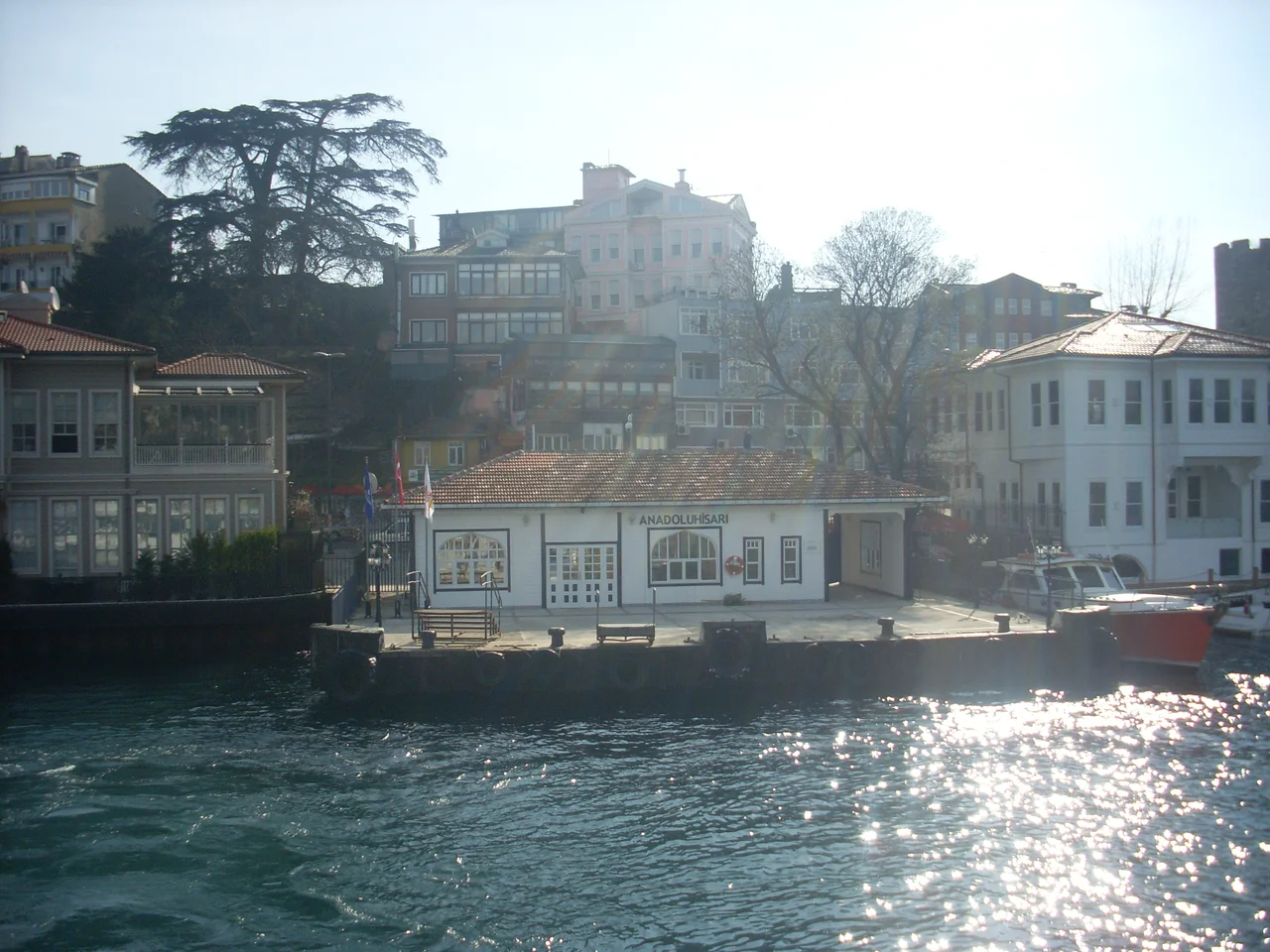

Anadoluhisarı, Beykoz
The Bosphorus has two speeds: the relentless churn of tankers and container ships cutting through its narrowest points, and the stillness of the old waterfront villages that have watched all that traffic for centuries. Anadoluhisarı belongs to the second speed. This small neighborhood in the Beykoz district sits on the Asian shore at one of the strait's most historic bends, with a population of just 2,612 as of 2022 — modest for Istanbul, which sprawls for millions on every side. It takes its name from the Anadolu Hisarı fortress that defines its waterfront, a 14th-century Ottoman military structure that Bayezid I built as a stepping stone toward the conquest of Constantinople. The village grew up around that fortress, and has lived in its shadow — literally and historically — ever since.
Where Two Streams Meet the Strait
Geography shaped Anadoluhisarı before history did. The Göksu Stream flows into the Bosphorus right alongside the fortress, and to the south, the Küçüksu Stream reaches the sea at the edge of what was once a broad meadow. That meadow — the Küçüksu Meadow, stretched between the two streams — became one of the most celebrated picnic grounds in Ottoman and early Republican Istanbul. Sultans came here. Poets wrote about it. The meadow still has a name, though the city has encroached on its edges. On the Bosphorus, the narrowest point of the strait is just here — a mere 660 meters separating the Asian shore from the European. Standing at the waterfront, you can hear traffic on the far bank. The intimacy of that crossing, the sense of two continents almost touching, defines the neighborhood's character.
The Küçüksu Pavilion and Its Fountain
Anadoluhisarı's most ornate landmark is not the fortress but the Küçüksu Pavilion, a 19th-century imperial summer lodge commissioned by Sultan Abdulmejid I and designed by Nikoğos Balyan — a member of the same Armenian architectural family that shaped so much of Istanbul's Ottoman-era building. The pavilion stands at the meadow's edge, its white marble facade catching the light off the water. Beside it, the Mihrişah Valide Sultan Fountain — also known as the Küçüksu Fountain — provides a more intimate counterpoint: a carved stone fountain that was once a practical amenity for travelers and now stands as a piece of outdoor sculpture. These two structures, palace and fountain, give the neighborhood's waterfront an elegance that its modest scale might not otherwise suggest. Both are within easy walking distance of the fortress that gave the village its name.
Old Houses Along Old Lanes
Beyond the waterfront landmarks, Anadoluhisarı is a neighborhood of old streets and surviving Ottoman-era domestic architecture. The Amcazade Mansion and the Zarif Mustafa Pasha Mansion are among the notable historic buildings tucked into the residential fabric — the kind of large, timber-framed structures that once lined the Bosphorus shores in much greater numbers. The yalı tradition — waterside mansions built by Ottoman aristocrats and wealthy families — is visible here, though the Bosphorus coast has lost many of its yalılar to fire, neglect, and demolition over the 20th century. Those that remain command extraordinary prices and attention. Anadoluhisarı retains more of this texture than many Bosphorus villages, partly because its small size has protected it from the most aggressive waves of development.
Living on the Asian Shore
To live in Anadoluhisarı today is to inhabit a place that feels, at times, genuinely removed from the megacity surrounding it. The Fatih Sultan Mehmet Bridge — the second of Istanbul's Bosphorus crossings — is visible to the north, connecting the Asian and European banks a few kilometers upstream. Kanlıca, famous for its yogurt, lies just beyond the bridge on the same shore. To the south is Kandilli. The neighborhood is accessible by ferry from the European side and by the shore road that traces the Bosphorus on the Asian bank. Its 2,612 residents live between the water and the hills, with the fortress as their most distinctive address marker. The Göksu Stream still runs, as it always has, into the strait beside the old walls.
From the Air
The Anadoluhisarı neighborhood is centered at approximately 41.086°N, 29.071°E on the Asian shore of the Bosphorus, in the Beykoz district. Viewing altitude of 2,000–4,000 feet provides a clear perspective on the strait's narrowest point and the relationship between the Anadolu Hisarı fortress, the Küçüksu Pavilion, and the village. The Fatih Sultan Mehmet Bridge is visible to the north. The nearest major airport is Sabiha Gökçen International (LTFJ), approximately 20 km to the southeast. From the air, the Bosphorus strait is the defining landmark — look for the fortress at the waterline where the Göksu Stream enters the strait.
Nearby Stories
- Kocaeli Peninsula 7.6 km away
- Second Battle of Çatalca 11 km away
- Istanbul's Rural Outskirts 14 km away
- MV Struma 20 km away
- HMAS AE2 36 km away
- Bursa 66 km away
- Sangarius Bridge 71 km away
- Januarius MacGahan 101 km away