
Arap Mosque
The bell tower never came down. When Sultan Mehmed II converted this Genoese Dominican church into a mosque between 1475 and 1478, the builders simply capped the Gothic belfry with a conical roof, and a minaret appeared. Seven centuries of conquest, displacement, and survival are pressed into that single architectural decision: the lancet windows below still arch in the northern European manner; the şadırvan in the courtyard north of the building reflects an Ottoman sensibility; and the name on the door — Arap Camii, Arab Mosque — remembers refugees from a continent an ocean away. Standing in the Karaköy quarter today, amid artisan shops not far from the Golden Horn, the building refuses to belong to any single story.
Stone on Stone: The Earliest Layers
Before the Dominicans, before the Genoese, possibly before the Crusaders, there was a Byzantine church on this ground — perhaps dedicated to Saint Irene, perhaps to some other purpose now impossible to recover. The Latin Empire of Constantinople, established after the Fourth Crusade shattered Byzantine rule in 1204, brought new religious orders westward. In 1233, on or near that earlier foundation, a small chapel rose in honor of Saint Paul. Then, in 1299, the Dominican Friar Guillaume Bernard de Sévérac bought property adjacent to the chapel and established a monastery with twelve friars. By 1307, Byzantine Emperor Andronikos II Palaiologos had relocated the Constantinople Dominicans to the Genoese suburb of Pera — today's Beyoğlu — and the church was officially rededicated to San Domenico, though residents kept calling it San Paolo. These naming overlaps were typical of Galata: a neighborhood where Genoese merchants, Byzantine subjects, and Latin clergy lived in a dense, contentious proximity that the city somehow absorbed.
The Conversion and Its Pragmatics
After the Ottoman conquest of 1453, the church stood within the protective terms of the Capitulations that Mehmed II extended to the Republic of Genoa. The building, known to Turks as Mesa Domenico, remained technically in Genoese hands for another generation. But between 1475 and 1478 — a quarter century after the city fell — Mehmed II claimed it and transformed it into the Galata Camii, the Great Mosque of Galata. The friars transferred to the friary of San Pietro; the altar cloths had already been shipped back to Genoa, and the archives dispatched to Caffa, a Genoese colony on the Black Sea. The conversion was, by the standards of the era, relatively light-handed. The lancet windows remained. The belfry remained. The Italian Gothic portal held its shape for centuries more. What changed was orientation, function, and ownership — the essential things.
A Refuge Named in Exile
The mosque's present name arrives from a tragedy unfolding simultaneously in Spain. In 1492, the same year Columbus crossed the Atlantic, Ferdinand and Isabella expelled the Jews from the Iberian Peninsula and tightened the apparatus of persecution against Muslims who had converted to Christianity, the people known as Moriscos. Sultan Bayezid II, Mehmed's successor, welcomed these refugees — seeing their skills and capital as an asset — and settled many in Galata. He assigned the mosque to this community, and so Galata Camii became Arap Camii: the Arab Mosque, the name misidentifying Andalusian Muslims as Arabs but fixing their presence permanently in the building's identity. Here the Moriscos prayed in a Gothic church-shaped mosque, in a city that was neither theirs nor entirely strange.
Maintenance, Fire, and the Stubborn Gothic Shell
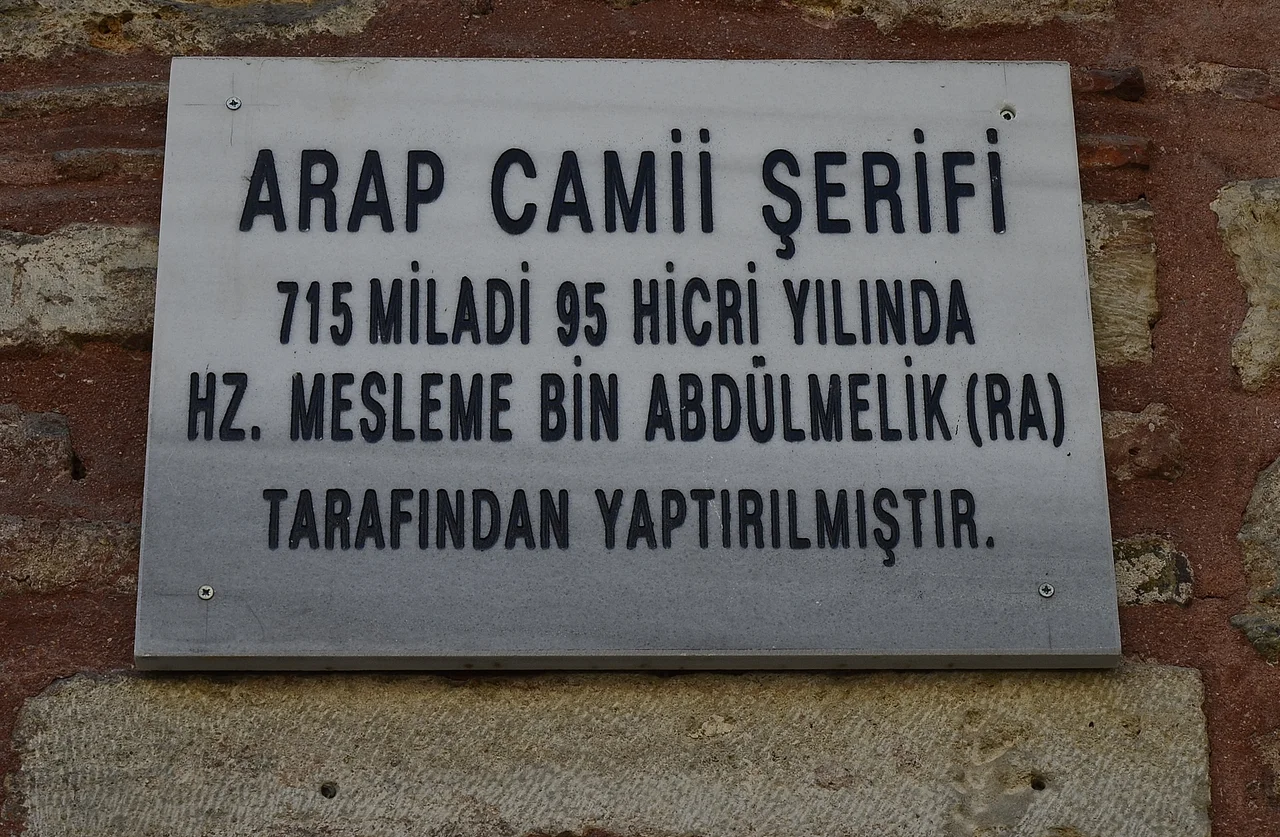
Later centuries brought patrons and damage in turns. Sultan Mehmed III repaired the building. The 1731 Great Fire of Galata gutted much of the neighborhood, and in 1734–35 Saliha Sultan, mother of Mahmud I, renovated the mosque, changing some windows and the portal from Gothic to Ottoman forms. The flat wooden ceiling and the wooden galleries inside date from a restoration in 1913–1919, during which the building's height was also lowered and several Genoese headstones were discovered embedded in the fabric of the walls. A major restoration completed in 2013 returned the mosque to active use — and also installed an inscription at the entrance claiming the mosque was founded in 715 AD by Maslama ibn Abd al-Malik, a legendary attribution without historical basis. The belfry itself is the counter-argument: visible above the courtyard's şadırvan, still in its original proportions, still reading as Italian Gothic, still the oldest medieval building of its kind remaining in Istanbul.
What Remains in the Passage
Walk through the passage under the belfry and run a hand along the stonework. Moldings survive there, carved in the northern European manner. Fragments of stone bearing armorial bearings — heraldic devices of the Genoese families who once worshipped here — are still set into the wall. The courtyard beyond is spacious and calm, a contrast to the narrow commercial streets outside. Arap Camii is the largest mosque on the Galata side of the Golden Horn, which is not what you expect from a building dressed in Gothic arches. It is a mosque where Moriscos once prayed, in a church the Dominicans built, on ground the Byzantines first consecrated. Each community left something that the next chose not to remove.
From the Air
Arap Mosque sits at 41.0244°N, 28.9708°E in the Karaköy quarter of Istanbul, on the European shore of the Golden Horn. From a low-altitude approach descending into LTFM (Istanbul Airport, ~35 km west-northwest), the Golden Horn's distinctive inlet and the Galata Tower — roughly 300 meters northeast of the mosque — serve as clear visual landmarks. A recommended viewing altitude of 1,500 feet allows the belfry-minaret and courtyard to be distinguished from the surrounding commercial blocks. The Bosphorus strait is visible just east, with the Galata Bridge crossing the Golden Horn's mouth a few hundred meters south.
Nearby Stories
- Kocaeli Peninsula 7.6 km away
- Second Battle of Çatalca 11 km away
- Istanbul's Rural Outskirts 14 km away
- MV Struma 20 km away
- HMAS AE2 36 km away
- Bursa 66 km away
- Sangarius Bridge 71 km away
- Januarius MacGahan 101 km away