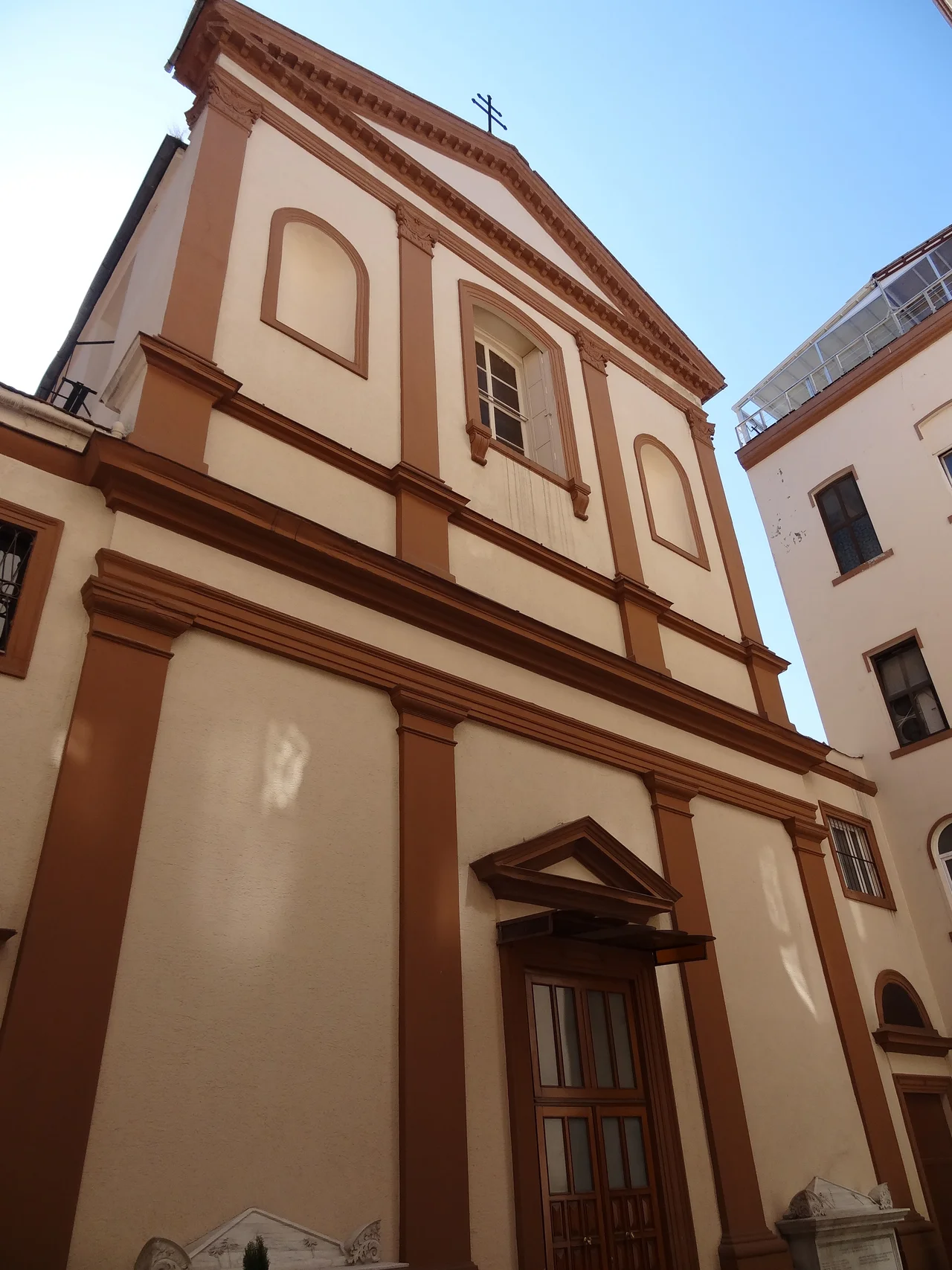

Armenian Catholic Archeparchy of Istanbul
Two traditions converge inside St. Mary of Sakızağaç Cathedral in Istanbul: the ancient liturgy of the Armenian Church, carried from the highlands of Anatolia and the Caucasus across many centuries, and communion with Rome, formalized in the nineteenth century. The Armenian Catholic Archeparchy of Istanbul holds both — an Eastern Catholic church that maintains Armenian rites, prayers, and culture while recognizing the authority of the Holy See. It is one of the quieter expressions of Istanbul's layered religious life: small in numbers, deep in history, and still very much alive.
A Church Between Two Worlds
Armenian Catholics occupy a specific theological position: they are Armenian Christians who entered into full communion with Rome while retaining their own liturgical rite, calendar, and clerical traditions distinct from the Latin Catholic Church. This union developed over centuries of contact between Armenian communities and Catholic missionaries. The archeparchy serves Armenian Catholics in Turkey and falls under the authority of the Armenian Catholic Patriarch of Cilicia — a patriarchate whose history of movement mirrors the displacements of the Armenian people themselves. The cathedral, St. Mary of Sakızağaç, stands in Istanbul as the physical anchor of this community: a place where the Armenian language, the traditional chant, and the sacramental life of an ancient Christian church continue to be celebrated in the heart of a predominantly Muslim city.
Founded by Papal Decree, Shaped by Ottoman Realities
Pope Pius VIII formally established the eparchy on 6 July 1830, giving institutional recognition to a Catholic Armenian community that had been present in Istanbul for generations without its own organized diocese. For most of the nineteenth century, the archeparchy's fate was intertwined with the larger Armenian Catholic Patriarchate of Cilicia: from 1866 to 1928, the patriarchal see was itself based in Istanbul, making the city the center of the entire Armenian Catholic world. When the patriarchal seat moved to Beirut, Lebanon, after the upheavals of the early twentieth century, the current archeparchy was formally constituted as an independent see on 15 October 1928 — Istanbul remaining the home of a locally-rooted church even as the wider institution reorganized around it.
A Community That Persisted
By 2008, approximately 3,650 Armenian Catholics belonged to the diocese — a figure that reflects both the community's endurance and the diminishment that the Armenian people suffered in Anatolia during the twentieth century. The early 1900s brought catastrophic losses to Armenian communities throughout the Ottoman Empire; what remained in Istanbul was a remnant of a far larger presence. That the archeparchy continues to function, to celebrate liturgy, to educate, and to maintain its cathedral is a testament to the commitment of those who stayed. The community is modest in size by the standards of global Catholicism, but its continuity across two centuries of institutional life — through wars, demographic upheaval, and the transformation of a great empire into a secular republic — carries its own weight.
Leadership and Continuity in Recent Decades
The recent history of the archeparchy's leadership reflects both the democratic instincts and the ecclesiastical procedures of Eastern Catholic governance. Archbishop Hovhannes Tcholakian stepped down in March 2015. The Synod of Bishops of the Patriarchal Church elected Boghos Lévon Zékiyan as his successor — a scholar and theologian who had spent decades in Istanbul. In October 2024, Zékiyan in turn resigned, and the Synod appointed Vartan Kirakos Kazanjian, who had served as the archeparchy's protosyncellus, as the new eparchial archbishop. These transitions of authority, conducted through synodal process and in dialogue with Rome, keep a living institution adapting to each generation of the small community it serves.
The Cathedral and Its Meaning
St. Mary of Sakızağaç Cathedral is more than a place of worship; it is the most visible sign that Armenian Catholics have a continuous home in Istanbul. The building's interior — its liturgical furnishings, its chant, its congregation — represents a link to a form of Christian life that predates the Ottoman Empire and survived its end. In a city where many communities came and went, leaving only architectural traces, the Armenian Catholic community gathers here still. The archeparchy's presence is modest, its profile low, its work largely internal to the community. But that continuity, maintained across nearly two centuries of institutional life since Pope Pius VIII signed the founding decree, is itself a kind of answer to the question of whether a small ancient community can persist in a changing world.
From the Air
The Armenian Catholic Archeparchy of Istanbul is centered near 41.0356°N, 28.9798°E, in the heart of the historic peninsula's northern neighborhoods. St. Mary of Sakızağaç Cathedral lies in the densely built central city, a few kilometers southwest of the Galata Tower and north of the Grand Bazaar district. Approaching LTFM (Istanbul Airport, ~35 km west-northwest), the European shore of the Bosphorus and the skyline of minarets mark the city's extent. A recommended viewing altitude of 2,000 feet provides a sense of Istanbul's layered urban fabric — the streets where Armenian, Greek, Jewish, and Muslim communities have lived side by side for centuries.
Nearby Stories
- Kocaeli Peninsula 7.6 km away
- Second Battle of Çatalca 11 km away
- Istanbul's Rural Outskirts 14 km away
- MV Struma 20 km away
- HMAS AE2 36 km away
- Bursa 66 km away
- Sangarius Bridge 71 km away
- Januarius MacGahan 101 km away