
Arnavutköy
The name is a puzzle at first glance: Arnavutköy, 'Albanian village,' on the European shore of the Bosphorus, in a city that has been Turkish for five and a half centuries. The explanation arrives quickly enough — Sultan Mehmed the Conqueror brought Albanian workers to Istanbul in 1468 to lay the city's pavements, and he settled them here — but the puzzle's deeper lesson endures. This stretch of coast has absorbed wave after wave of people: Albanian laborers, Genoese traders, Greek Orthodox families, Armenian residents, Jewish merchants, American educators. By 1912, the district's population of 7,482 included 5,973 Greek Christians, 493 Muslims, 342 Armenians, 32 Jews, and 642 people of other nationalities. The wooden houses along the shore do not look like a cosmopolitan archive, but that is precisely what they are.
Along the Shore: What the Waterfront Holds
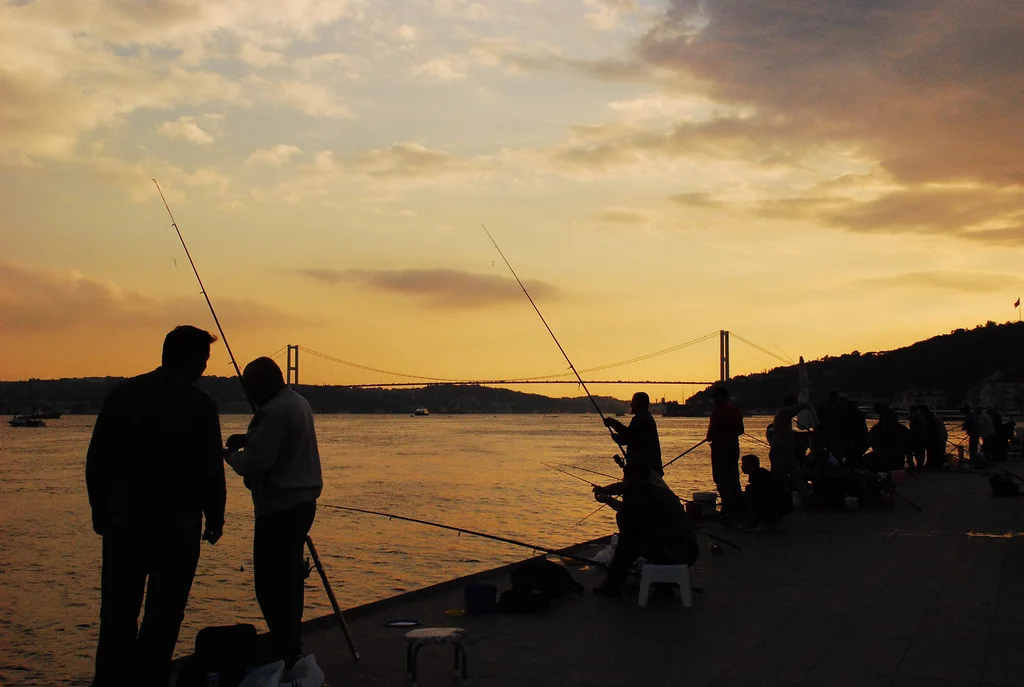
The Bosphorus at Arnavutköy is not still. Tankers move through in both directions; ferries from the Şehir Hatları (City Lines) service stop occasionally at the terminal facing the main square; fishing boats work the current. At the eastern end of the neighborhood, the coastline juts outward to form Akıntıburnu — the Cape of the Current — where the Bosphorus once ran so powerfully that small boats had to be towed around it. The Greeks knew this place simply as the Great Current. Today anglers line the coast road, their lines down in the same water that worried ancient mariners. The fish they pull out sometimes make it directly to the neighborhood's seafood restaurants, a supply chain of admirable directness. The freshness of the catch has long been part of Arnavutköy's reputation, as has the quality of its kitchen tables.
Wood and Art Nouveau: The Architecture of Persistence
The waterfront houses are the reason many people come to Arnavutköy today, and they repay attention. Built mostly in the late nineteenth and early twentieth centuries, they are wooden structures — the Ottoman residential building type called yalı — many decorated in Art Nouveau style, with carved eaves, ornate window frames, and painted facades in ochre and cream and faded rose. What looks, from a distance, like individualistic expression turns out to be something more complex on closer inspection: most of the decorative elements were mass-produced and applied to different houses, creating a unified aesthetic from standardized parts. The buildings look unique; they were, in a sense, designed to look that way. They are some of the most picturesque surviving examples of this style along the entire Bosphorus, which makes their continued existence — fragile wooden structures in an earthquake-prone city — both remarkable and somewhat precarious.
The Oldest American School Outside America
In 1863, an American missionary institution chose the hills above Arnavutköy for a new campus. Robert College, established that year on grounds stretching from Arnavutköy toward Bebek and Rumelihisarı, became — and remains — the oldest continuously operating American school outside the United States. Its clifftop campus, with stone buildings in a style more reminiscent of New England than the Bosphorus, produced generations of Turkish graduates who went on to lead government, business, and culture. In 1971, the college section of the institution was transferred to become Boğaziçi University, one of Turkey's most prestigious public universities. The high school section, historically called Robert Academy, still operates on the Arnavutköy side of the campus as an American school. The American College for Girls, another educational institution associated with Robert College, moved its campus to Arnavutköy in 1914 and remained here until merging with Robert Academy in 1971.
Strawberries, Seasons, and Slower Time
There is something else Arnavutköy was once known for that has largely disappeared: the Ottoman strawberry. Smaller than the varieties found elsewhere in Turkey, less juicy, intensely flavored by the particular soil and climate of this hillside, the Ottoman strawberry was a seasonal obsession. Every spring, local greengrocers were mobbed. A few strawberry fields still survive inland from the coast, and some years the fruit still appears at market. It is a small continuity in a neighborhood that has changed enormously — hit by British bombing during World War I, reshaped by urban pressure from Istanbul's expansion, transformed from a distinctly multiethnic seaside town into a sought-after address for those who can afford the wooden houses and the views. The strawberries persist anyway, as a reminder that the village, under all its layers, still has roots in the ground.
A Village Inside a City
Arnavutköy today has a population of around 3,574 people (2022 figure), which makes it intimate by Istanbul standards — a village scale inserted into one of the world's great metropolitan areas. It sits between Ortaköy to the south and Bebek to the north in the Beşiktaş district, connected to the city by a busy coastal road served by regular buses. The ferries come and go infrequently. The fishing boats work the current. On summer evenings, people eat at tables set close to the water, and the lights of the Asian shore reflect across the strait. The wooden houses hold their color in the dusk. What makes Arnavutköy worth a visit — and worth understanding — is not any single landmark but the accumulation of presences: Albanian, Greek, Armenian, American, Ottoman, Turkish, all folded into a stretch of shoreline less than a kilometer long.
From the Air
Arnavutköy sits at 41.0681°N, 29.0431°E on the European shore of the Bosphorus, between Ortaköy to the south and Bebek to the north. From altitude approaching LTFM (Istanbul Airport, ~33 km west-northwest), the Bosphorus strait is the dominant geographic feature — a narrow blue thread separating European and Asian Istanbul. The Bosphorus Bridge (officially the 15 July Martyrs Bridge) is visible approximately 4 km south of Arnavutköy, providing a navigation reference. A recommended viewing altitude of 1,500 feet allows the waterfront wooden houses and the distinctive curve of the Cape of the Current (Akıntıburnu) to be seen. The Robert College campus occupies the ridge above the village on the European side.
Nearby Stories
- Kocaeli Peninsula 7.6 km away
- Second Battle of Çatalca 11 km away
- Istanbul's Rural Outskirts 14 km away
- MV Struma 20 km away
- HMAS AE2 36 km away
- Bursa 66 km away
- Sangarius Bridge 71 km away
- Januarius MacGahan 101 km away