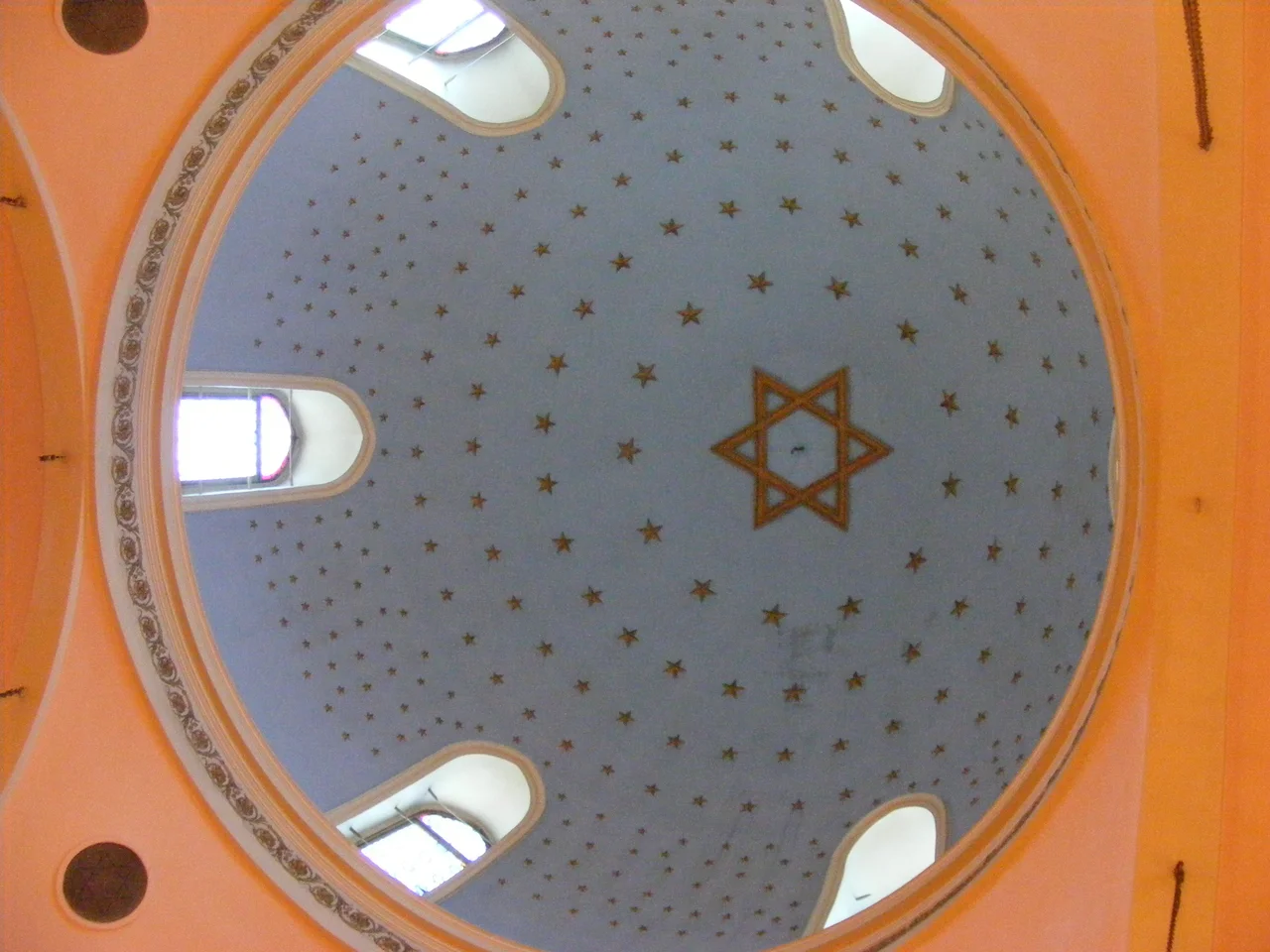

Ashkenazi Synagogue of Istanbul
The Galata Tower watches over a neighborhood of compressed histories, and a few hundred meters from its base, in the Karaköy quarter of Beyoğlu, the Ashkenazi Synagogue of Istanbul has been holding Shabbat morning services since 1900. It is the only currently active Ashkenazi synagogue in Istanbul open to visits and prayers — the last of three that the Ashkenazi community once maintained in the city. The building's survival is, in some ways, the whole story: there was a fire, there was a century of demographic change, there were waves of emigration that reduced a once-substantial community to a fraction of its earlier size. The synagogue persists anyway, a quiet but living institution in one of the world's most storied cities.
The Austrian Temple and the Fire of 1866
The history of this site predates the current building by several decades. In 1831, an earlier synagogue known as the Österreichischer Temple — the Austrian Temple — stood on this ground, built to serve the Ashkenazi Jewish community of Austrian origin that had settled in Galata. The building reflected Austrian architectural sensibilities and served as a hub for a community distinct from the much larger Sephardic Jewish population of Istanbul, whose ancestors had arrived from Spain after 1492. The Austrian Temple functioned for thirty-five years before a catastrophic fire in 1866 destroyed it. Fires were an occupational hazard of nineteenth-century Istanbul; the city's predominantly wooden neighborhoods burned with terrible regularity. The Ashkenazi community lost its gathering place but not its presence in Galata, and three and a half decades later, it built again.
A New Synagogue for a New Century
The Ashkenazi Synagogue that stands today was founded in 1900, rising on or near the site where the Austrian Temple had stood. By the standards of the late Ottoman period, this was a moment of relative openness: the city's Jewish communities maintained their neighborhoods, their schools, and their institutions with reasonable stability under the Ottoman millet framework. The synagogue was designed to serve an Ashkenazi congregation — Jews whose roots lay in Central and Eastern Europe, worshipping in a rite distinct from the Sephardic tradition dominant among Istanbul's Jewish majority. Its dome, visible from the street, distinguishes it architecturally in the dense urban fabric of Karaköy. Inside, the Torahs, the prayer books, and the order of service follow Ashkenazi custom, connecting the congregation to a European Jewish world that, over the twentieth century, contracted dramatically.
Rabbi Marcus and the School He Built
Among those who shaped the synagogue's early life, Rabbi Dr. David Marcus stands out. He served as rabbi and spiritual leader until his death in 1938, a tenure that spanned nearly four decades of turbulent history — the late Ottoman years, World War I, the collapse of the empire, the founding of the Turkish Republic, and the social upheavals that accompanied modernization. Beyond his pastoral role, Rabbi Marcus established the Jewish school Bene Berit, an institution that served the community's educational needs during a period of considerable change. His decades of service built the infrastructure of a community life — not just prayers on Saturday morning, but education, continuity, and a sense of purpose — that the synagogue maintained even as the broader Jewish population of Istanbul fluctuated.
A Minority Within a Minority
Ashkenazi Jews have always been a small fraction of Turkey's Jewish population. As of the sources available, Ashkenazim account for approximately four percent of the total Jewish community in Turkey — itself a community that has diminished significantly since the mid-twentieth century through emigration, primarily to Israel and elsewhere. Of the three Ashkenazi synagogues once operating in Istanbul, only this one remains active and open. The congregation that gathers on Saturday mornings for Shabbat services, and on weekday mornings for weekday prayer, represents the continuation of a community that chose — generation after generation — to remain in Istanbul rather than depart. That choice is neither simple nor universal; many families left. Those who stayed built the synagogue into an institution that still functions today, hosting weddings, bar mitzvahs, and the full calendar of Jewish religious life in the Ashkenazi tradition.
Still Open, Still Praying
Since 2003, Rabbi Mendy Chitrik has served as the synagogue's rabbi. He is also the chairman of the Alliance of Rabbis in Islamic States, a role that places the Istanbul congregation within a broader network of Jewish communities in Muslim-majority countries — communities maintaining Jewish life in circumstances that require particular attentiveness and resilience. Visitors are welcome at the Ashkenazi Synagogue during weekday morning services and on Saturday mornings for Shabbat. The dome overhead filters light into the sanctuary. The Torahs — some photographed and known to researchers of Sephardic and Ashkenazi heritage alike — rest in their ark. Near the Galata Tower, in a neighborhood that has housed Genoese merchants, Dominican friars, Moroccan refugees, and Ottoman traders, the Ashkenazi congregation of Istanbul gathers and prays in the language and rite their community has carried for centuries.
From the Air
The Ashkenazi Synagogue of Istanbul is located at 41.0252°N, 28.9751°E in the Karaköy neighborhood of Beyoğlu, a few hundred meters from the Galata Tower (one of Istanbul's most recognizable aerial landmarks). Approaching LTFM (Istanbul Airport, ~35 km west-northwest), the Golden Horn waterway is visible below, with Karaköy situated at the northern end of the Galata Bridge where the Golden Horn meets the Bosphorus. A recommended viewing altitude of 1,200 feet allows the distinctive form of the Galata Tower — the cylindrical medieval tower rising above the surrounding urban blocks — to serve as a precise navigation reference for locating the synagogue just to its south and west.
Nearby Stories
- Kocaeli Peninsula 7.6 km away
- Second Battle of Çatalca 11 km away
- Istanbul's Rural Outskirts 14 km away
- MV Struma 20 km away
- HMAS AE2 36 km away
- Bursa 66 km away
- Sangarius Bridge 71 km away
- Januarius MacGahan 101 km away