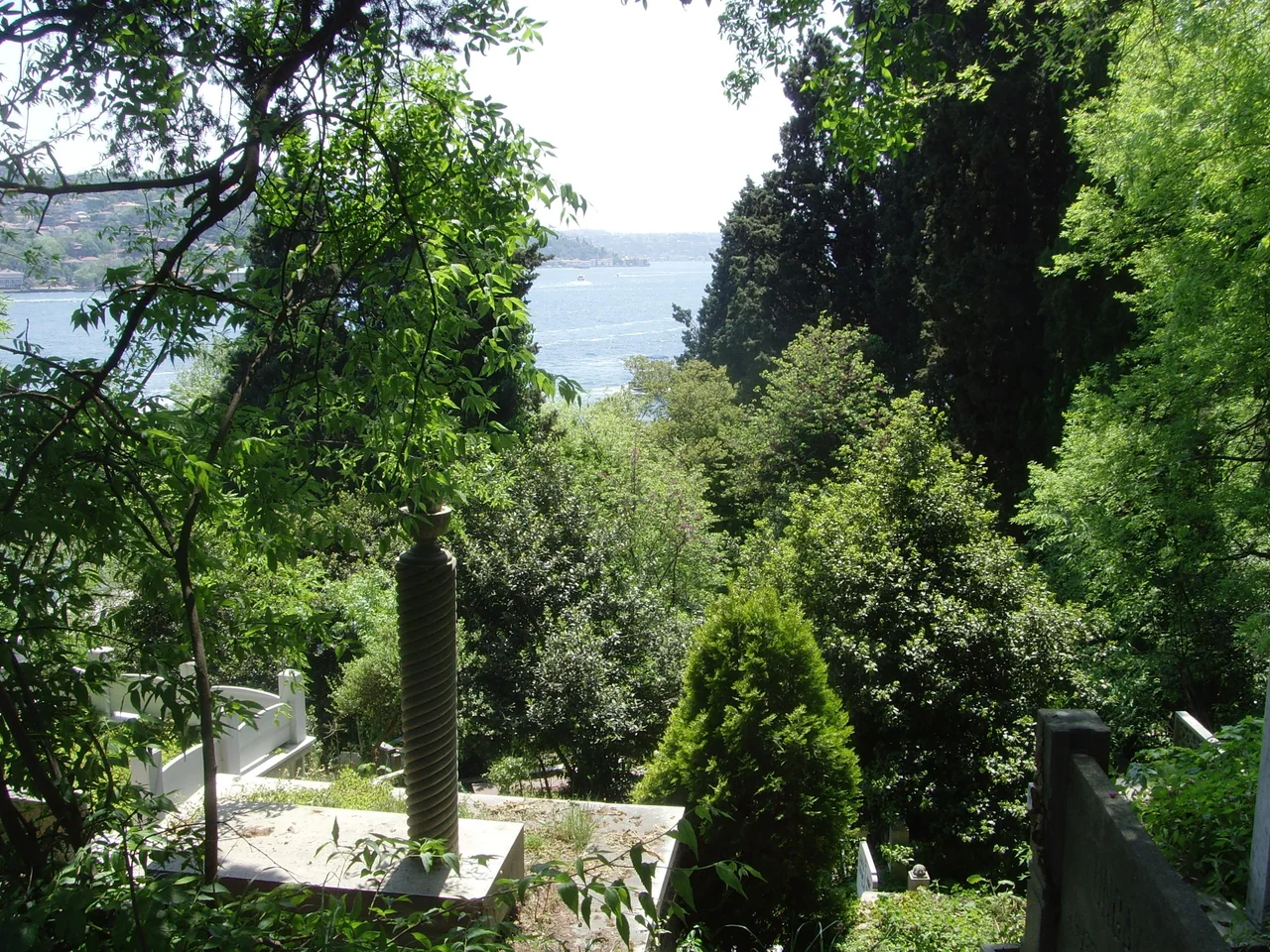

Aşiyan Asri Cemetery
Some cemeteries are famous for their scale or their famous generals. Aşiyan Asri Cemetery is famous for something quieter — the density of literary genius compressed into a small hillside plot above the Bosphorus, where the water below shimmers silver and pale green through the cypress trees. Tucked between Bebek and Rumelihisarı on Istanbul's European shore, this modest burial ground holds more pages of Turkish literature per square meter than perhaps any other place on earth.
A Hill Above the Strait
The cemetery sits on the Aşiyan slope — the name itself means something like 'nest' in Persian — at an altitude that commands a panoramic sweep of the Bosphorus. Ships from the Black Sea pass below in both directions. From many of the graves you can see the water. For a collection of poets and writers who made Istanbul their subject and their home, there is a rightness to this placement. They spent their lives writing about the city's light and its waterways; now they look out over both.
The grounds are modest in extent. No grand mausoleums, no imperial domes. The headstones are mostly upright, some weathered, some still clear-cut with inscriptions in the Arabic script of the Ottoman era or the Latin characters introduced in 1928 with Atatürk's language reform. The dates span nearly two centuries.
Poets in the Ground
The roll call at Aşiyan Asri is a syllabus in Turkish literature. Tevfik Fikret (1867–1915), who founded the modern school of Turkish poetry and whose house just above the cemetery later became a museum, rests here. So does Orhan Veli Kanık (1914–1950), who died young but whose plain-spoken, modern verse helped strip Ottoman formalism from the Turkish lyric. Yahya Kemal Beyatlı (1884–1958) and Nigâr Hanım (1856–1918) are here too — different generations, different registers, the same slope.
Attila İlhan (1925–2005), poet and journalist, and Ahmet Hamdi Tanpınar (1901–1962), whose novel A Mind at Peace became one of the defining meditations on Istanbul's layered identity, are buried within a short walk of one another. Tezer Özlü (1943–1986), a writer whose short life generated fiction of quiet intensity, lies not far away.
Beyond Literature
Not everyone here wrote poems. Ziya Songülen (1886–1936) founded Fenerbahçe Sports Club, one of Turkey's great football institutions. Ömer Fahreddin Pasha (1868–1948), the Ottoman military commander who became legendary for holding Medina under siege conditions during World War One for years after the armistice, is buried here alongside the literary figures who were his contemporaries.
Ahmet Vefik Paşa (1823–1891) — grand vizier, historian, and linguist — is the cemetery's earliest notable resident. Ottoman princesses appear too: Ulviye Sultan (1892–1967), Rukiye Sabiha Sultan (1894–1971), Hanzade Sultan (1923–1998), and Necla Sultan (1926–2006), daughters and granddaughters of the last sultans. The painter Abidin Dino (1913–1993) rests here without a headstone, by his own wish. Münir Nurettin Selçuk (1900–1981), the great tenor of classical Turkish music, is here as well.
Into the Twenty-First Century
The cemetery has continued to receive Istanbul's cultural figures into recent decades. The actress Yıldız Kenter (1928–2019), one of the foundational voices of modern Turkish theater, is buried here. So is Doğan Cüceloğlu (1938–2021), the psychologist whose popular nonfiction brought ideas about human connection to a mass readership. The singer İlhan İrem (1955–2022), whose rock voice was a fixture of Turkish popular music in the 1980s, chose this hillside for his burial, as did actress Ayla Algan (1937–2024) and film actress Filiz Akın (1943–2025).
The cemetery administered by Istanbul Metropolitan Municipality, accepts the remains of people who shaped the city's cultural life — and continues to do so. It is open to visitors, though it remains primarily a place for the dead. Walking through it, you read names that anchor whole chapters of Turkish intellectual history.
A Quiet Continuity
There is something clarifying about Aşiyan Asri Cemetery in an era when literary reputations rise and fall on social media. The graves here represent work that outlasted its makers — poems still read, novels still taught, performances still discussed. The view of the Bosphorus has not changed much since Tevfik Fikret climbed this hill in 1906, or since Orhan Veli Kanık was laid to rest here in 1950. Ships still pass. The cypress trees still stand. The water below still catches the light in the particular way that has preoccupied Turkish writers for generations.
Aşiyan Asri is not a famous destination in the way that Istanbul's great mosques or palaces are famous. But for anyone who has read the poets buried here — or who wants to understand what Turkish literature felt like as it moved through the Ottoman twilight and into the Republic — the hillside above Bebek offers something the grand monuments cannot.
From the Air
Aşiyan Asri Cemetery sits on the European shore of the Bosphorus at approximately 41.083°N, 29.055°E, on the Aşiyan hillside between the Bebek and Rumelihisarı neighborhoods of Istanbul. From the air at 3,000–5,000 feet, the Bosphorus strait is the dominant landmark — a wide, busy shipping channel connecting the Black Sea to the Marmara Sea. The Rumeli Fortress (Rumelihisarı), an Ottoman fortification dating to 1452, is visible just to the north. Bebek Bay, a sheltered cove popular with small watercraft, lies to the south. The nearest major airport is Istanbul Airport (LTFM), approximately 22 km to the northwest. For visual approach, the Bosphorus Bridge (15 July Martyrs Bridge) to the south and the Fatih Sultan Mehmet Bridge to the north bracket the area. The cemetery's wooded hillside is most visible in clear conditions at altitudes below 2,000 feet.
Nearby Stories
- Kocaeli Peninsula 7.6 km away
- Second Battle of Çatalca 11 km away
- Istanbul's Rural Outskirts 14 km away
- MV Struma 20 km away
- HMAS AE2 36 km away
- Bursa 66 km away
- Sangarius Bridge 71 km away
- Januarius MacGahan 101 km away