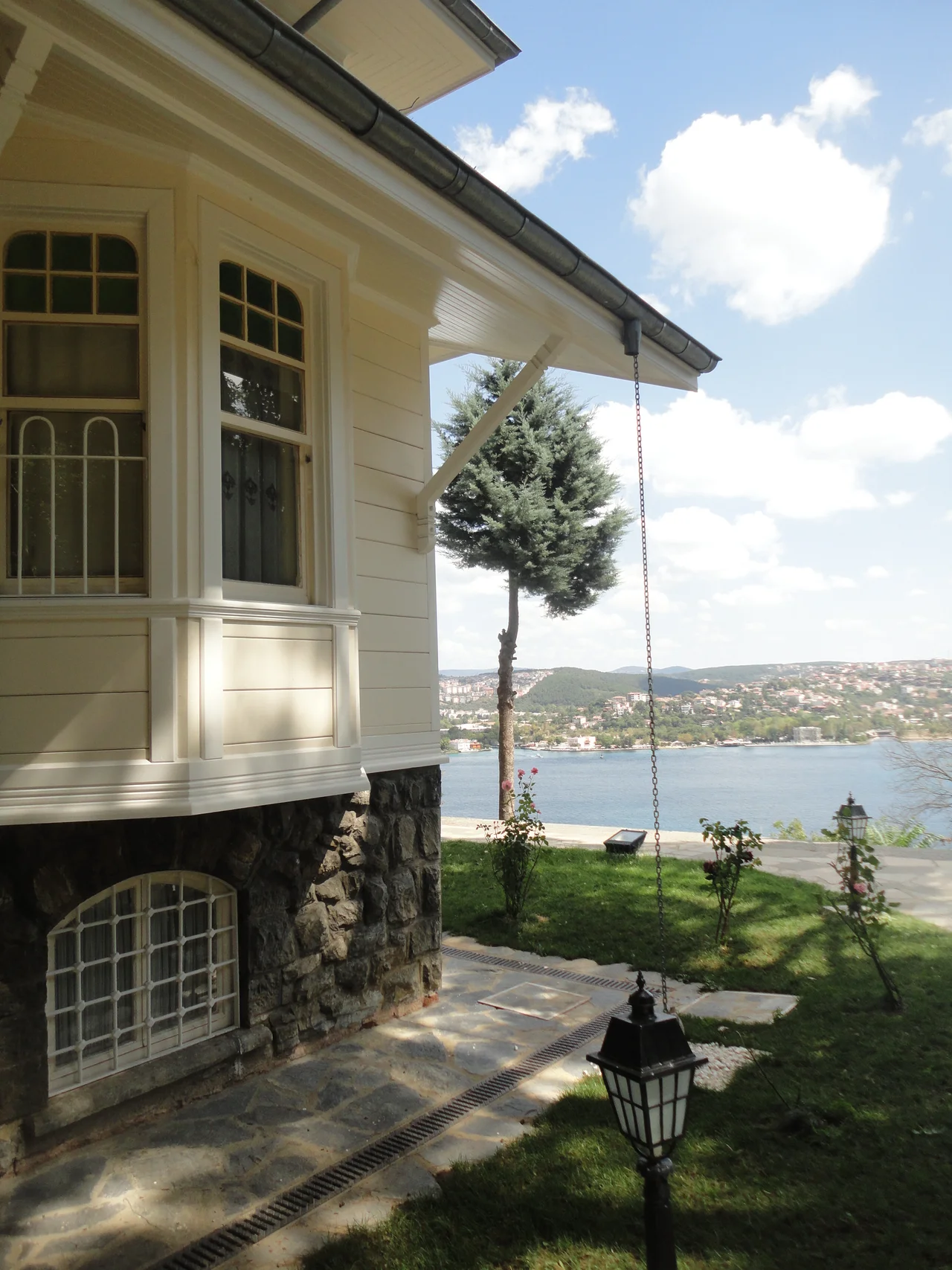

Aşiyan Museum
Tevfik Fikret named his house Aşiyan — 'nest' in Persian — and the word fits. The three-story wooden building clings to a hillside above the Bosphorus in Istanbul's Beşiktaş district, perched at exactly the altitude where a bird might pause to look down at the shipping lanes below. Fikret designed the structure himself, overseeing its construction in 1906, and he lived and wrote here until his death nine years later. Today the house is a museum and, per his own wish after a change of burial plans, his final resting place as well.
The Poet Who Built His Own Stage
Tevfik Fikret (1867–1915) is considered the founder of the modern school of Turkish poetry. In an era when Ottoman verse was still largely confined to classical forms and Arabic and Persian borrowings, Fikret pushed toward plainness, political engagement, and a distinctly modern sensibility. He was a teacher at Galatasaray High School, a co-founder of the literary journal Servet-i Fünun, and a figure whose opposition to the Hamidian autocracy made him, alternately, celebrated and embattled.
The house on the Aşiyan hill was his answer to a city that could feel oppressive. He designed it to his specifications — three wooden stories, a garden, and an unobstructed panorama of the Bosphorus. Writing at his desk on the upper floor, he looked out over the same water that Ottoman poets had praised for centuries; but his language was shifting toward something new. He died here in August 1915 as the empire around him was collapsing.
From Home to Museum
After Fikret's death, his wife Nazime continued to live in the house. In 1940, with the initiative of Lütfi Kırdar — then serving as both Mayor and Governor of Istanbul — the municipality acquired the property from her. The transformation was deliberate: this was not simply a historic building to be preserved, but a space to be made into Turkey's first museum of literature.
The Museum of New Literature, as it was first called, opened in 1945. It was renamed Aşiyan in 1961, the same year Fikret's remains were moved from Eyüp Cemetery — where he had been buried after his death — to the garden of his house, the spot he had always loved for its view of the Bosphorus. The renaming and the reburial completed what the museum had been reaching toward: a place that was not just about the poet but literally around him.
What the Rooms Hold
The ground floor is administrative. The first floor is devoted to two other figures of the New Literature Movement: Abdülhak Hâmid Tarhan (1851–1937) and Nigâr Hanım (1856–1918), the female poet who was one of the most prominent literary voices of the late Ottoman period. Two separate rooms hold their paintings, photographs, books, and personal belongings.
The second floor belongs to Fikret himself. His study and bedroom are arranged much as he left them — writing desk, armchair, the drawings and paintings he made himself. A death mask of Fikret is displayed in the bedroom. On the wall hangs a painting by the then-Shahzada Abdülmecid (later Abdülmecid II, 1868–1944), created as a visual response to Fikret's famous poem 'Sis' — 'Fog' — a meditation on Istanbul's melancholy grandeur. The painting's presence in the poet's own bedroom creates a quiet conversation across artistic forms.
Restoration and Return
By the early twenty-first century the building needed attention. Istanbul Metropolitan Municipality undertook a comprehensive restoration, and Mayor Kadir Topbaş reopened the museum in December 2012 after a year and a half of work that cost approximately 1.128 million Turkish liras — around US$640,000 at the time. The restoration included remaking furniture from original photographs and adding a wax sculpture of Fikret, giving visitors a more immediate sense of the poet's physical presence in his own house.
Admission to Aşiyan Museum is free of charge. The museum is closed on Mondays; visiting hours are 9:00 to 16:00. It sits within a short walk of the Aşiyan Asri Cemetery, where Fikret's own grave is located in the garden — and where many of the writers he influenced were eventually buried too.
The View He Chose
It is worth pausing on why Fikret built where he did. The Bosphorus panorama from the Aşiyan hill is genuinely extraordinary — a wide, luminous channel of water between two continents, busy with tankers and ferries, changing color through the day with the shift of Turkish light. He could have lived anywhere in the city. He chose this hillside, and he named his house after the nests of birds.
The museum preserves that choice. When you stand in Fikret's study and look out at the same water he looked at while writing, the distance between visitor and poet narrows somewhat. He was a man who believed that poetry should speak clearly, that language should be answerable to the present, and that beauty was not incompatible with political engagement. The view he chose embodied all of it: precise, particular, breathtaking, and entirely his own.
From the Air
Aşiyan Museum sits at approximately 41.083°N, 29.053°E on the European shore of the Bosphorus, in the Aşiyan neighborhood of Beşiktaş district, Istanbul. The building occupies a wooded hillside between the Bebek and Rumelihisarı neighborhoods — from the air at 2,000–4,000 feet, the Bosphorus strait is the dominant feature, with the Rumeli Fortress clearly visible to the north and Bebek Bay to the south. The museum is a three-story wooden structure surrounded by garden and trees; distinguishing it from the air at higher altitudes is difficult, but the Bosphorus corridor itself is unmistakable. The nearest major airport is Istanbul Airport (LTFM), approximately 22 km to the northwest. Approach from the north following the Bosphorus offers the best contextual view of the hillside location.
Nearby Stories
- Kocaeli Peninsula 7.6 km away
- Second Battle of Çatalca 11 km away
- Istanbul's Rural Outskirts 14 km away
- MV Struma 20 km away
- HMAS AE2 36 km away
- Bursa 66 km away
- Sangarius Bridge 71 km away
- Januarius MacGahan 101 km away