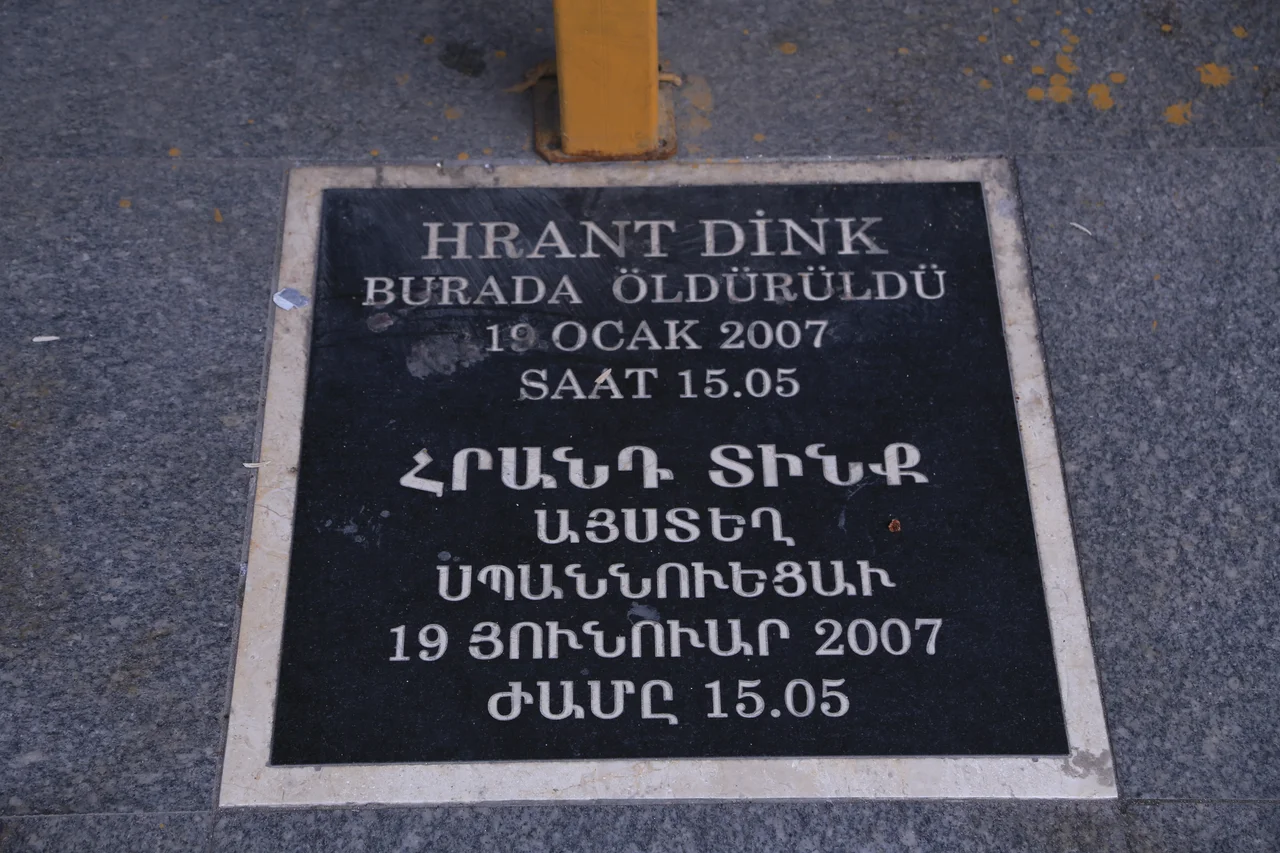

Assassination of Hrant Dink
On 19 January 2007, Hrant Dink stepped out of the Agos newspaper office in Istanbul's Şişli district and was shot three times in the head. He died on the pavement. He was 52 years old. Dink was a journalist, an editor, and a man who had spent his adult life arguing — in Turkish and in Armenian, in print and in public — that Turks and Armenians could move past the weight of history if they were honest enough to confront it. The killing of Hrant Dink sent a shock through Turkey and through the wider world. What came after, in the courts and in the streets, revealed a great deal about the country he had tried to change.
Who Hrant Dink Was
Hrant Dink was born in 1954 in Malatya to an Armenian family. He grew up partly in an orphanage in Istanbul, studied at Robert College, and became a journalist. In 1996 he co-founded Agos, a bilingual Turkish-Armenian weekly newspaper that addressed the concerns of Turkey's Armenian minority and engaged with the broader questions of identity, memory, and rights that defined his life's work.
Dink was not a polemicist. He advocated for dialogue between Turks and Armenians at a time when such dialogue was genuinely difficult, believing that acknowledgment of the Armenian Genocide — and honest engagement with what that history meant — was the only foundation for any lasting reconciliation. He faced legal pressure for his views: at the time of his death he was on trial under Article 301 of the Turkish Penal Code, charged with 'denigrating Turkishness' for statements he had made about Armenian identity. He had also long endured threats from extreme Turkish nationalists. In the final column he published in Agos on 10 January 2007, nine days before he was killed, he wrote of feeling both frightened and determined — comparing himself to a dove, 'equally obsessed by what goes on on my left and right, front and back.'
The Killing and Its Immediate Aftermath
The gunman was Ogün Samast, who was 17 years old at the time. He had traveled to Istanbul from Trabzon and shot Dink outside the Agos offices on Halaskargazi Caddesi in the Şişli district on the afternoon of 19 January 2007. Samast was arrested the following day in Samsun. He later confessed and was convicted; a Turkish juvenile court sentenced him to 22 years and 10 months in prison.
Erhan Tuncel, identified as having orchestrated the assassination, received a sentence of 99 and a half years. The immediate perpetrators, however, were only part of the story that would unfold over the years that followed.
The reaction in Turkey was swift and striking. Within days, hundreds of thousands of people took to the streets of Istanbul and other cities, many holding signs that read 'We are all Hrant Dink' and 'We are all Armenians' — a public declaration of solidarity that was as much about what Dink had stood for as about the act of violence itself. His funeral drew enormous crowds. Grief and protest were intertwined.
The Long Reckoning in the Courts
The legal proceedings that followed Dink's murder stretched across nearly two decades. Investigations revealed that Turkish security services had received specific warnings about the threat to Dink's life and failed to act on them. Evidence emerged that police intelligence officers had been aware of the plot; some were accused of destroying files related to the case.
In 2021, an Istanbul court convicted former police intelligence chief Ramazan Akyürek and his former deputy Ali Fuat Yılmazer, sentencing them to life imprisonment for their role in failing to prevent the murder despite possessing prior knowledge. Twenty-four other officials received prison sentences on charges including negligence and membership in an illegal organization. The European Court of Human Rights had already ruled in 2010 that Turkey had violated Dink's right to life under the European Convention, finding that the state had known of the threat and had not taken reasonable steps to protect him.
In February 2025, following a retrial, an Istanbul court issued nine life sentences in connection with the case. The Dink family and their legal representatives have stated across the years that the full picture of who was responsible — and at what levels — has not yet been established to their satisfaction.
What He Left Behind
Agos newspaper, which Dink co-founded, has continued to publish. It remains a voice for Turkey's Armenian community and for the ideas Dink championed: dialogue, minority rights, historical honesty. The newspaper's offices on Halaskargazi Caddesi have become a place of memory; each year on 19 January, ceremonies mark the anniversary of his death outside the building where he was killed.
Hrant Dink was a person before he was a symbol — a journalist who wrote about difficult things because he believed the truth of those things mattered, a man who knew he was in danger and kept writing anyway. The demonstrations after his death showed that his work had reached far beyond the Armenian community he came from, into a Turkey that was debating its own identity. The sign 'We are all Hrant Dink' expressed something specific: not agreement with every position he had taken, but recognition that the act of killing a journalist for his words was an act against everyone.
A Contested Accounting
The trials in the Dink case have produced convictions, but they have also produced controversy. Questions about the depth of state involvement — who knew what, and at what level of authority — have not been fully resolved to the satisfaction of independent observers or the Dink family. Charges have been contested, appealed, and relitigated. In 2025, RSF (Reporters Without Borders) reported that some charges in the case had been dropped after 18 years.
What is established by the courts is this: warnings about the threat to Dink's life existed within the Turkish security apparatus and were not acted upon adequately. The consequences of that failure have been the subject of criminal proceedings at multiple levels. The full accounting, as of this writing, remains incomplete. Hrant Dink died on a pavement in Istanbul in January 2007. He was trying to build something — a conversation, a reconciliation, a more honest country. His murder did not stop that effort; if anything, in the years since, it has given it a particular weight.
From the Air
The Agos newspaper offices where Hrant Dink was killed are located on Halaskargazi Caddesi in the Şişli district of Istanbul, at approximately 41.053°N, 28.988°E. Şişli is a dense commercial and residential district on the European side of Istanbul, several kilometers north of the historic peninsula. From the air at 3,000–5,000 feet, the area appears as a continuous urban fabric; the Bosphorus is visible to the east, and the Golden Horn to the south. The nearest major airport is Istanbul Airport (LTFM), approximately 30 km to the northwest. The Taksim Square area, a major urban landmark, lies approximately 1.5 km to the south. Low-altitude visual navigation is possible using the Bosphorus and the city's historic peninsula as reference points.
Nearby Stories
- Kocaeli Peninsula 7.6 km away
- Second Battle of Çatalca 11 km away
- Istanbul's Rural Outskirts 14 km away
- MV Struma 20 km away
- HMAS AE2 36 km away
- Bursa 66 km away
- Sangarius Bridge 71 km away
- Januarius MacGahan 101 km away