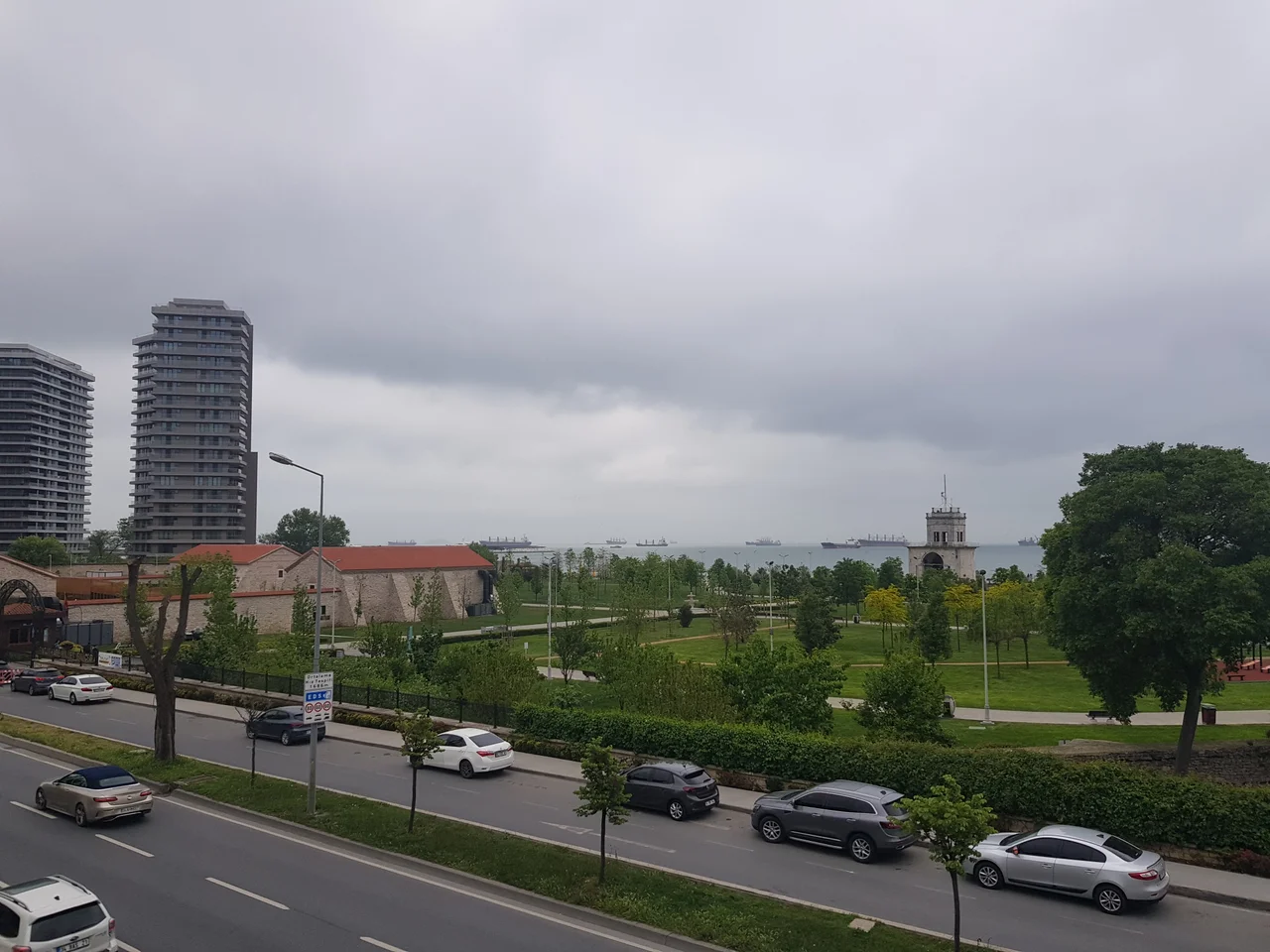

Ataköy Gunpowder Mill
For more than two centuries, the Ottoman Empire's gunpowder arrived from here. The Baruthane-i Âmire — the Imperial Gunpowder Mill — sat on the Marmara shore in what is now Ataköy, in the Bakırköy district of Istanbul, and it ground out the propellant for Ottoman cannons, muskets, and warships through campaigns that defined the empire's rise, stall, and long decline. Fire destroyed parts of it repeatedly; the Ottomans rebuilt in stone. Sultans appointed directors; those directors shaped the neighborhood around the mill. Today what remains of the complex is becoming a park.
From Hippodrome to Shore
The Ottoman Turks began producing gunpowder in Istanbul almost immediately after the conquest of Constantinople in 1453. The city's first gunpowder facility operated within what had been the Hippodrome of Constantinople until 1490 — a striking repurposing of a late Roman public space as an industrial site for the empire's military needs.
That facility was eventually replaced, and in 1700 the Ottomans completed a new gunpowder mill at Makriköy — the neighborhood now called Bakırköy — funded through Muqata'ah revenue from Gümüşhane and the Imperial Treasury. The new site was chosen for safety: its position outside the main urban area reduced the risk to the city from the inevitable accidents that came with gunpowder production. The caution was warranted. Fires disrupted operations repeatedly through the eighteenth century.
Fire and Stone
Throughout the eighteenth century the mill produced approximately 85 to 160 tonnes of gunpowder per year, though the quality was a persistent source of debate and complaint. In October 1791, following a particularly close call with fire, the complex was rebuilt entirely in stone — a structural decision that preserved much of what still stands today.
In 1793, Sultan Selim III took a further step: he ordered the founding of a dedicated Ministry of Gunpowder Mill, establishing an administrative structure to improve production practices. Selim III was a reformist sultan, and his intervention in the gunpowder works reflected the broader Ottoman effort of the period to modernize military infrastructure in response to European pressures. The mill's output mattered strategically; its quality mattered even more.
The Dadyan Family and a Neighborhood Takes Shape
Among the most interesting chapters in the mill's history is the appointment of an Armenian-Ottoman officer named Dad Arakel as director during the reign of Sultan Mahmud II. His sons, Ohannes and Bogos — who took the surname Dadyan — continued the management after him, overseeing the facility for an extended period. The Dadyan family became significant figures in Ottoman industrial and cultural life of the era.
The effect on the surrounding neighborhood was tangible. Historical records note that after Armenian officers took responsibility for the mill at Makriköy, the Armenian population of the area grew to around 100 households. The complex had its own estate, which included an Ayazma — a holy well — where local children and women would come to drink the water and hold picnics. The industrial site and the community around it were intertwined.
From Empire to Republic to Rubble
The mill operated through the end of the Ottoman Empire, passing from military control to the newly established Mechanical and Chemical Industry Corporation after the proclamation of the Turkish Republic. Then, in 1955, the complex — which by that point covered four million square meters — was sold to Emlak Kredi Bank. In 1957, residential construction began on parts of the former estate. The Ataköy neighborhood of apartment buildings and boulevards that emerged in subsequent decades overlaid most of what had been the mill's grounds.
In the northern portion of what remained, Bakırköy Municipality restored a group of the mill's historic stone buildings and converted them into the Yunus Emre Cultural Centre in 1993. That cultural reuse was a first step in what would eventually become a broader reclamation.
A Park Returns
In 2018, TOKİ — Turkey's Housing Development Administration — transferred a 60,000-square-meter parcel of the former gunpowder mill grounds to Istanbul Metropolitan Municipality. That land was converted into a public park called Baruthane Millet Bahçesi, giving back to the surrounding city a green space where Ottoman industry once operated at industrial scale.
In 2024, Istanbul Metropolitan Municipality completed another phase: the renovation of additional historic mill buildings, converting them into a museum, a theatre hall, and a public library. The library holds 8,000 books and seats 110 people. The old stone walls of the Baruthane-i Âmire now hold reading rooms. The tower near the Marmara shore still stands, visible from the water, a remnant of the centuries when this stretch of coast was about something entirely different.
From the Air
The Ataköy Gunpowder Mill complex sits on the Marmara shore at approximately 40.976°N, 28.860°E, in the Ataköy neighborhood of Bakırköy district on Istanbul's European side. From the air at 3,000–5,000 feet, the Marmara Sea stretches broadly to the south and west, with the Bosphorus visible to the northeast. The Baruthane park and remaining historic buildings occupy a coastal area southwest of the main Ataköy residential development. The nearest metro station is Bakırköy Sahil. The nearest major airport is Istanbul Airport (LTFM), approximately 28 km to the north-northwest; Atatürk Airport's former site lies approximately 5 km to the northeast. The historic tower near the shoreline is the most distinctive identifying feature from lower altitudes.
Nearby Stories
- Kocaeli Peninsula 7.6 km away
- Second Battle of Çatalca 11 km away
- Istanbul's Rural Outskirts 14 km away
- MV Struma 20 km away
- HMAS AE2 36 km away
- Bursa 66 km away
- Sangarius Bridge 71 km away
- Januarius MacGahan 101 km away