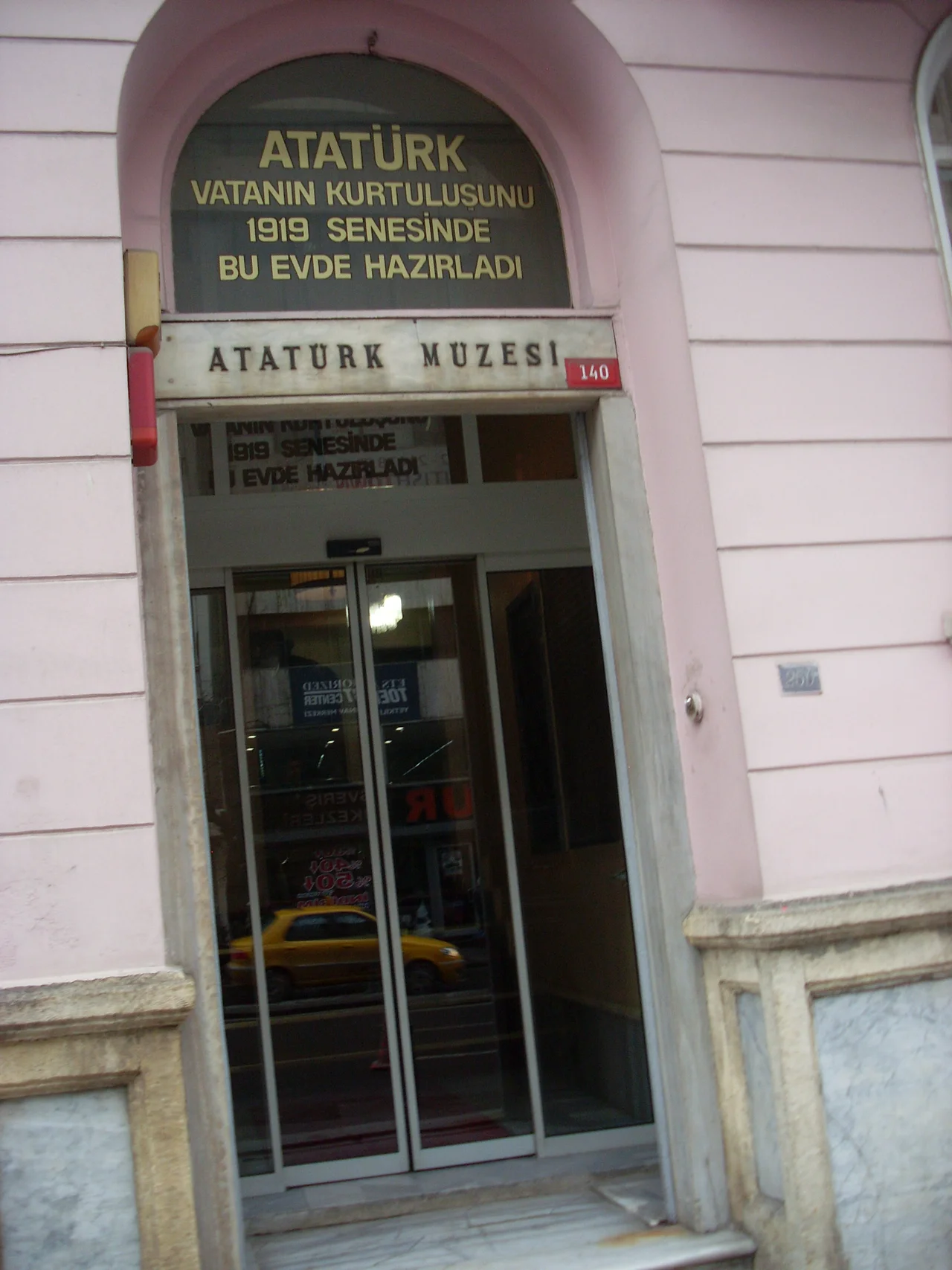

Atatürk Museum, Şişli
On the morning of May 16, 1919, Mustafa Kemal said goodbye at this house. He embraced his mother Zübeyde, his sister Makbule, and his adopted son Abdurrahim, then walked out the door and did not come back. He boarded the steamship Bandırma and sailed for Samsun on the Black Sea, where he would ignite the Turkish War of Independence and, within a few years, found an entirely new republic. The three-storey house in Şişli where he spent those final Istanbul months has stood ever since as a monument to that departure — ordinary enough to feel human, freighted enough to stop you cold.
A House Built for a Different World
The building dates to 1908, the year the Young Turk Revolution shook the Ottoman Empire and briefly rekindled hopes of constitutional reform. It was constructed as a private residence at a moment when Şişli, on the European side of Istanbul, was becoming a fashionable bourgeois neighborhood — prosperous enough for a well-appointed townhouse, residential enough to feel removed from the clamor of the old city around the Golden Horn. The house has three stories, each with the measured proportions of late-Ottoman domestic architecture: high ceilings, shuttered windows, rooms that feel serious without being grand. Mustafa Kemal rented it after returning from the Syrian Front following the Ottoman defeat in the First World War, a battle-hardened general in a collapsing empire, living quietly with his family while the victorious Allied powers began occupying Istanbul.
The Family Who Lived Here
What makes the house more than a political landmark is the life it briefly contained. Mustafa Kemal was not alone here. His mother Zübeyde — a woman who had sacrificed much to support his education and ambitions — lived with him in these rooms. So did his sister Makbule and his adopted son Abdurrahim Tuncak. The arrangement was domestic and tender in a way that the formal portraits of Atatürk rarely suggest. He was, in this period, a son and a brother before he was a leader. The household occupied a city that had lost the war, where Ottoman authority was crumbling and foreign warships sat in the Bosphorus. The pressure of that moment would have been constant. Yet the house held it — and held them.
The Morning He Left
May 16, 1919 is the date the Turkish Republic traces to the beginning of everything. That morning, Mustafa Kemal left this house for the docks. His official title was Inspector General of the Ninth Army Troops Inspectorate, a bureaucratic assignment that gave him cover to travel to Anatolia. His real purpose was to organize resistance against the Allied partition of Ottoman territory and the Greek landing at Smyrna, which had begun just days earlier. He sailed on the Bandırma — a small, aging steamship — and arrived at Samsun the following day. From that point forward he never returned to live in Istanbul. The house, quiet and uninhabited, held the memory of that departure for nearly a decade before the city acquired it.
From Home to Museum
The Municipality of Istanbul purchased the building in 1928, five years after the Republic was proclaimed and Atatürk had become its first president. Personal belongings were gathered and stored here. Then, on June 15, 1942 — three and a half years after Atatürk's death — the building opened as the Atatürk Revolution Museum. The museum preserves the intimate objects of a remarkable life: clothing, personal collections, historical documents, photographs, and paintings from across his years. The rooms are maintained to evoke the period of his residence, so visitors move through spaces that feel inhabited rather than merely displayed. Walking from room to room, it is possible to feel the weight of that particular moment in 1919 — a man at the edge of an enormous decision, living in these specific rooms, among these specific things.
What the Quiet Street Holds
Şişli today is a busy Istanbul district — commercial, dense, always in motion. The museum sits within it as a kind of pause. There is nothing imposing about the exterior; it looks like what it is, a substantial private house from the late Ottoman era. But the ordinariness is part of the point. History does not always announce itself in grand civic architecture. Sometimes it happens in a rented townhouse where a man says goodbye to his family, picks up his coat, and changes the course of a nation. The building received its current name, Atatürk Museum, in keeping with the many memorials to the republic's founder that exist across Turkey. This one, though, has something the others cannot offer: it is where he was last simply at home.
From the Air
The Atatürk Museum in Şişli sits at 41.0564°N, 28.9872°E, on the European side of Istanbul in a residential district northeast of the historic peninsula. From the air at 3,000 feet, the Golden Horn estuary is visible to the south and the Bosphorus Strait to the east. The nearest major airport is Istanbul Airport (LTFM), approximately 30 kilometers to the northwest. On approach to LTFM from the east, the dense urban fabric of Şişli passes beneath the right wing; the neighborhood's grid of streets, interrupted by the green ribbon of Maçka Park, offers useful orientation. Visibility in Istanbul is often hazy in summer due to humidity and urban particulate; spring and autumn provide the clearest views of the city's layered topography.
Nearby Stories
- Kocaeli Peninsula 7.6 km away
- Second Battle of Çatalca 11 km away
- Istanbul's Rural Outskirts 14 km away
- MV Struma 20 km away
- HMAS AE2 36 km away
- Bursa 66 km away
- Sangarius Bridge 71 km away
- Januarius MacGahan 101 km away