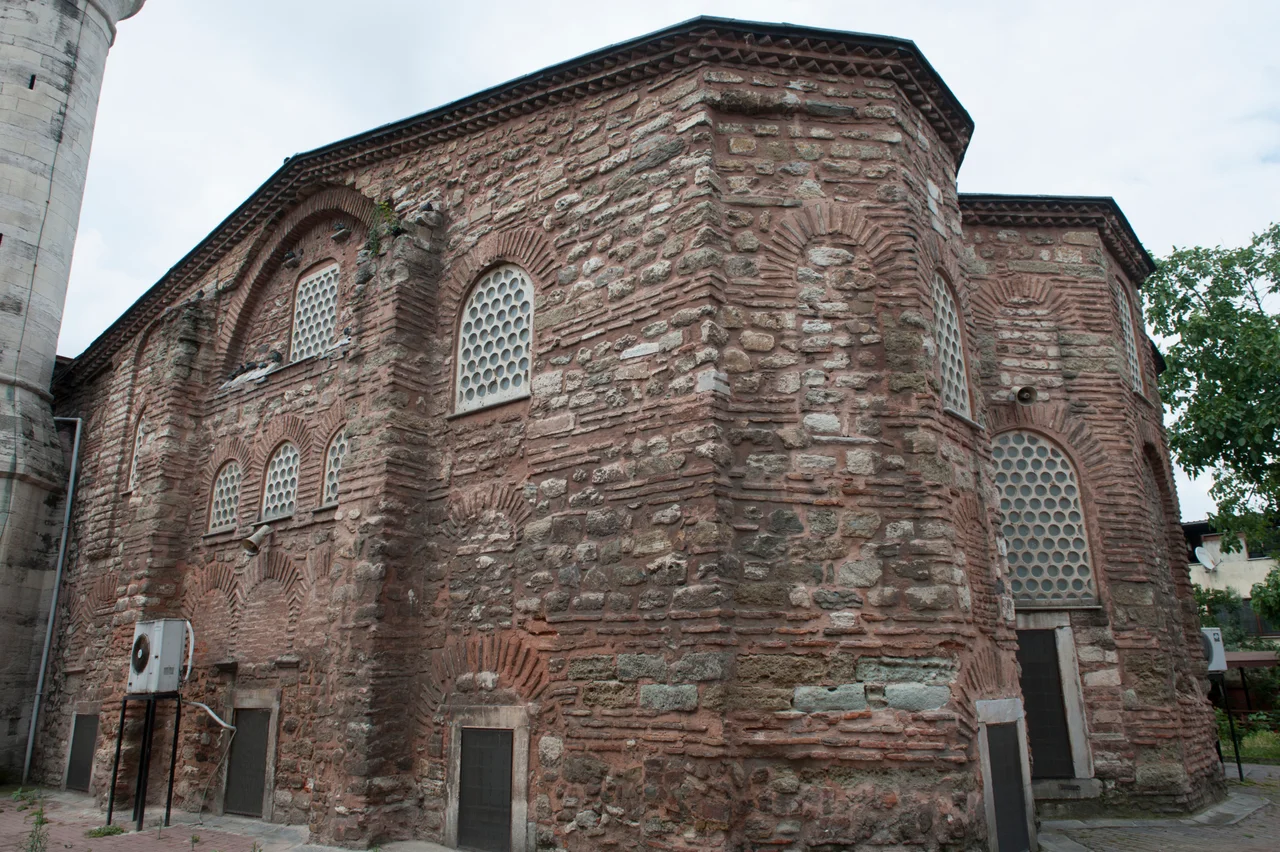

Atik Mustafa Pasha Mosque
Ask what this building is called and you will get two answers, neither of them certain. Most Istanbulites know it as Hazreti Cabir Camii — the mosque of Jabir ibn Abd-Allah, an Arab companion of the Prophet said to have fallen nearby during the first Arab siege of Constantinople in 678. Scholars call it the Atik Mustafa Pasha Mosque, after the Ottoman official who converted it. What it was before the Ottomans arrived is where the arguments begin. The question of its original Byzantine identity has never been definitively resolved, and the building itself, squatting quietly on Çember Sokak in the Ayvansaray neighborhood near the Golden Horn, seems indifferent to the controversy.
Layers of Identity
For a long time historians identified this church as the Church of Saints Peter and Mark, but no evidence supports that attribution. The current scholarly consensus — careful to note it remains unproven — suggests the building is more likely to be the Church of Saint Thekla of the Palace of Blachernae, known in Greek as Hagia Thekla tou Palatiou tōn Vlakhernōn. The Blachernae district lay just beyond the city's land walls, at the northern tip of Constantinople, and the palace complex there was an important imperial seat. Stylistically, the building belongs to the eleventh or twelfth century, which fits the Blachernae identification. But Istanbul has a way of burying its certainties under centuries of use and rebuilding, and this one has stayed buried.
A Princess, an Emperor, and a Hunting Accident
The history that can be traced begins in the ninth century, when Princess Thekla — eldest daughter of the Byzantine Emperor Theophilus — enlarged a small oratory dedicated to her patron saint, which stood roughly 150 meters east of the famous Church of Theotokos of the Blachernae. Then in 1059, Emperor Isaac I Komnenos rebuilt it on a larger scale. His reason was personal: he had survived a hunting accident and built the church in gratitude. The historian Anna Comnena, writing of her own family's devotion, records that her mother Anna Dalassena frequently came here to pray. That detail — a powerful woman of the Komnenian dynasty seeking out this particular church, again and again — suggests a building of some spiritual standing in its day.
The Architecture That Survived
Whatever its name, the structure is genuinely old and genuinely interesting. The building measures 15 meters wide and 17.5 meters long, with a domed Greek cross plan oriented northeast to southwest — an unusual alignment that hints at constraints imposed by the surrounding streets. Three polygonal apses project from one end; the narthex, the entrance vestibule, has been destroyed. The dome itself, which sits without a drum directly on its supporting arches, is almost certainly Ottoman work, though the arches and piers beneath it are Byzantine. During floor repairs in the 1990s, workers found scattered tesserae — the tiny colored cubes of Byzantine mosaic — confirming that the interior was once decorated with mosaic panels, now lost. The arms of the cross-shaped plan are covered with barrel vaults, and arcaded openings march along the north and south walls at three levels. Despite all of this, the building has never been the subject of a systematic archaeological or architectural study.
The Ottoman Conversion
Koca Mustafa Pasha — who served as a palace official before later becoming Grand Vizier — repaired the church after the Ottoman conquest of Constantinople and converted it into a mosque, giving the building its formal Ottoman name. The türbe, or tomb, in the south apse, traditionally identified as the grave of Hazreti Cabir (Jabir ibn Abd-Allah), became the building's most venerated feature and the basis for its popular name. The mosque's foundation originally included a hamam — a bathhouse — situated 150 meters to the south, though this was gone by the end of the nineteenth century. The compound of a mosque, its charitable institutions, and community facilities was a standard Ottoman pattern; this building followed it in compressed, neighborhood-scale form.
A Neighborhood Secret
Çember Sokak is not a street that draws tourists by the busload. The Ayvansaray neighborhood sits well inside the old walled city, close to the Golden Horn but off the main route between the great Ottoman mosques. That obscurity has preserved something. The building sits in a quiet residential pocket, its modest profile giving no indication of the depth of history inside. Walking up to the door, you might pass it without a second glance — a small domed structure on a narrow street, unremarkable from the outside. Inside, where the Ottoman dome sits on Byzantine piers and the walls once glittered with mosaic, the centuries compress. Even now, the building has not given up all of its secrets.
From the Air
The Atik Mustafa Pasha Mosque sits at 41.0386°N, 28.9440°E, in the Fatih district of Istanbul's historic peninsula, close to the Golden Horn waterway. From the air at 2,500 feet, the Golden Horn's distinctive inlet is an unmistakable reference — the mosque lies just inside the old land walls at the northern end of the peninsula, in the Ayvansaray neighborhood. The nearest major airport is Istanbul Airport (LTFM), approximately 25 kilometers to the northwest. The land walls of Constantinople, still largely intact along their original line, are visible from altitude running north-south roughly half a kilometer to the west. Spring and autumn offer the clearest views; summer haze can obscure lower detail.
Nearby Stories
- Kocaeli Peninsula 7.6 km away
- Second Battle of Çatalca 11 km away
- Istanbul's Rural Outskirts 14 km away
- MV Struma 20 km away
- HMAS AE2 36 km away
- Bursa 66 km away
- Sangarius Bridge 71 km away
- Januarius MacGahan 101 km away