
Augustaion
Stand in the plaza in front of Hagia Sophia today — the broad open space the Turks call Aya Sofya Meydanı — and you are standing where the center of the Byzantine world used to be. The Augustaion has been gone for centuries, demolished by the Ottomans not long after they took Constantinople in 1453, its marble paving buried under centuries of accumulation, its great column toppled. But the space persists. Public plazas have a way of doing that: the human need to gather in one specific place outlasts whatever architecture marks it. The Augustaion was the place, in Constantinople, where the empire announced itself to itself — and the announcement lasted more than a thousand years.
Before the Emperors
The square's origins predate the Christian empire entirely. When the Roman Emperor Septimius Severus rebuilt the ancient Greek city of Byzantium around 200 CE after destroying it in a siege, he laid out a large colonnaded square at the city's center — four covered walkways defining an open space, in the Greek tradition of the stoa. He called it the Tetrastoon: the four stoas. In the center stood a column bearing a statue of the sun god Helios. It was a market, a civic gathering place, a demonstration of Roman urban order imposed on a Greek city by an emperor who wanted to be remembered for more than the devastation he had caused. The Tetrastoon was thus, from its first moment, a statement. They usually were.
Constantine's Transformation
In the 320s, when Constantine the Great chose Byzantium as his new imperial capital and renamed it Constantinople, the city underwent an extraordinary building campaign. Constantine expanded and adorned the Tetrastoon area; somewhere in this process, what became known as the Augustaion was carved out of its eastern portion. The name honored his mother Helena, who bore the imperial title Augusta. A porphyry column carrying her statue gave the space its new identity. The Augustaion was subsequently rebuilt in 459 by Emperor Leo I and then again in the 530s by Justinian I, after the Nika riot — one of the most violent urban uprisings in Byzantine history — burned much of the city center. Each rebuilding added new ambition. After Justinian's reconstruction, the square was no longer a public market: access became restricted, the space formalized into a forecourt of the great church of Hagia Sophia rising just to the north.
Monuments and Messages
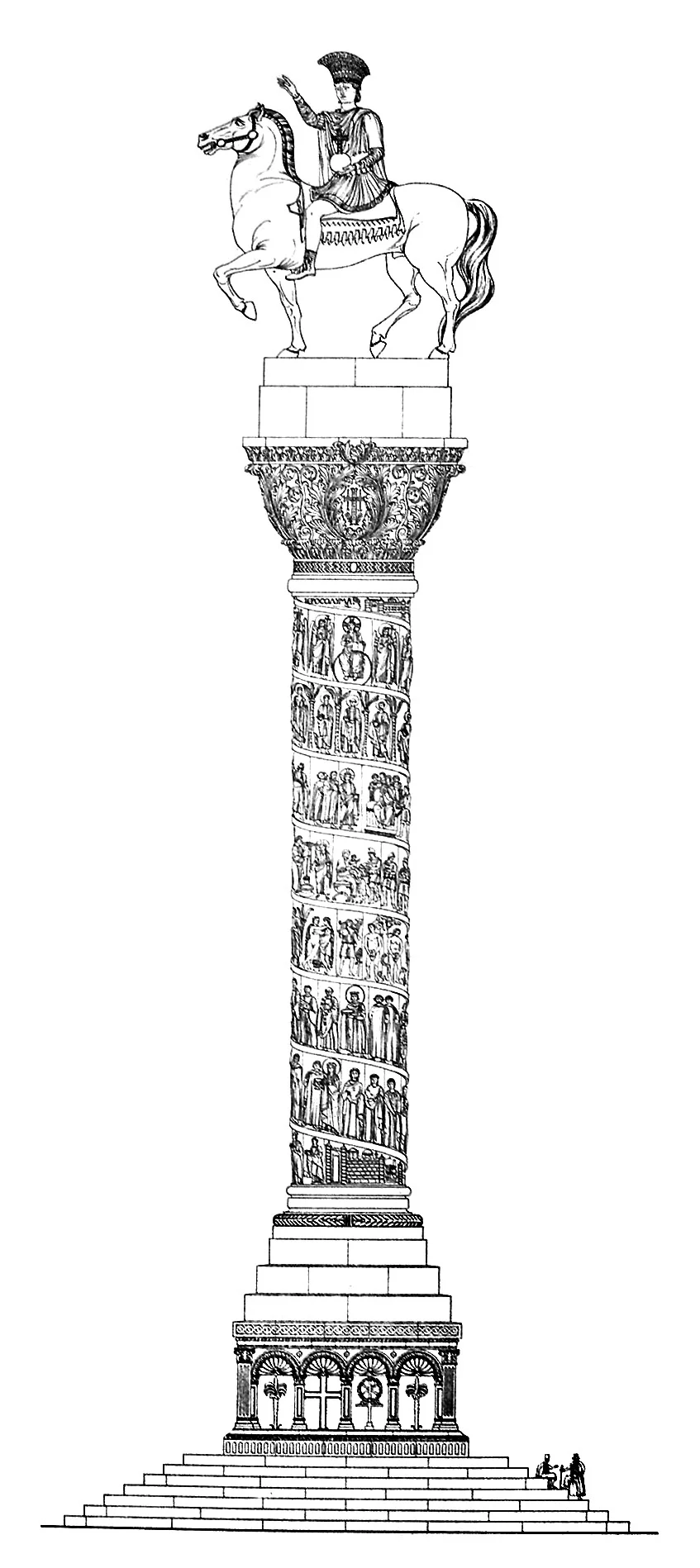
The square's defining feature after Justinian's rebuilding was a tall column erected in 543, topped by an equestrian statue of Justinian himself — reusing bronze elements from an earlier statue of the Emperor Theodosius. Three sculptural figures of barbarian kings knelt at the base, offering tribute. The message was blunt: here is your emperor, here are your enemies, here is the order of things. It was the kind of monumental propaganda that required a great open space to deploy effectively. Earlier, in the time of Theodosius the Great, a silver equestrian statue of that emperor had stood here, flanked by statues of his sons Arcadius and Honorius. The square accumulated imperial imagery across generations, each reign contributing its own testament to power. Below all of it, the pavement was marble, as excavations have confirmed.
The Edges of Power
What gave the Augustaion its importance was not only what stood in it but what surrounded it. At its corners and along its edges gathered some of the most significant buildings in the empire. Hagia Sophia lay immediately to the north; by the seventh century, Byzantine writers referred to the Augustaion explicitly as the forecourt of the great church, in Greek: proaulion. The Senate house of Constantinople occupied one side. At the southeastern corner stood the Chalke Gate — the monumental bronze entrance to the Great Palace precinct, where the Byzantine emperors actually lived and governed. The square was thus the hinge between church and state, between sacred and imperial authority, a space where both met and neither fully owned it.
Traces and Absence
The Augustaion declined with the empire that built it. By the late Byzantine period it survived in ruins, and records from the early sixteenth century note that traces were still visible after the Ottoman conquest of 1453. The great column of Justinian, already stripped of its equestrian statue, was finally brought down by the 1509 Constantinople earthquake. The marble paving was built over. The square's identity dissolved into the new city taking shape around Hagia Sophia, now a mosque. Excavations in the twentieth century recovered some of the marble paving, confirming the ancient accounts. Today the plaza in front of Hagia Sophia carries the functional memory of what was here — a cleared, usable space between the great church and the Topkapı Palace, maintaining without knowing it the old spatial relationship between the house of God and the house of the emperor.
From the Air
The Augustaion's location, now Aya Sofya Meydanı, sits at approximately 41.0080°N, 28.9790°E on the tip of Istanbul's historic peninsula, directly adjacent to Hagia Sophia. From the air at 2,500 feet, the historic peninsula is one of the most recognizable landforms in the world: a wedge of land between the Bosphorus to the east, the Golden Horn to the north, and the Sea of Marmara to the south. Hagia Sophia's distinctive large dome flanked by four minarets is an unmistakable landmark. The Topkapı Palace gardens and the Sultanahmet Mosque are immediately adjacent. The nearest major airport is Istanbul Airport (LTFM), approximately 35 kilometers to the northwest; on approach from the east, the entire historic peninsula passes beneath the flight path at a scale that compresses a thousand years of history into a single glance.
Nearby Stories
- Kocaeli Peninsula 7.6 km away
- Second Battle of Çatalca 11 km away
- Istanbul's Rural Outskirts 14 km away
- MV Struma 20 km away
- HMAS AE2 36 km away
- Bursa 66 km away
- Sangarius Bridge 71 km away
- Januarius MacGahan 101 km away