.JPG)
Avrupa Pasajı
The fire that burned through Beyoğlu on June 5, 1870 took everything on the site — the Naum Theater, the Jardin des Fleurs Hotel, and the surrounding buildings that had made this neighborhood Istanbul's most cosmopolitan quarter. What came back in their place was something Europe had been building for decades: a covered shopping arcade, a passage, a world unto itself with a ceiling of glass and a floor of stone. The Avrupa Pasajı — the European Arcade, or Passage d'Europe as the French name has it — opened in the ruins of the fire as an assertion that Beyoğlu intended to remain what it had been: a place of elegance, commerce, and a certain deliberate ambition to resemble somewhere else.
What Stood Here Before
The Naum Theater was one of the great cultural institutions of Ottoman Istanbul — a venue that brought opera and European theatrical productions to the city's cosmopolitan Pera neighborhood for decades. Beside it, the Jardin des Fleurs Hotel offered accommodation to travelers and visiting dignitaries in a quarter that was, by the mid-nineteenth century, home to European embassies, foreign merchants, and the Levantine families who moved between cultures with a facility that their settled neighbors sometimes envied and sometimes resented. Both the theater and the hotel burned in the Great Beyoğlu Fire of 1870, one of several catastrophic fires that reshaped the district across the nineteenth century. The site was cleared, and the decision was made to build differently — in Maltese limestone, a fire-resistant material, as if the architects were determined not to repeat the lesson twice.
The Arcade and Its Mirrors
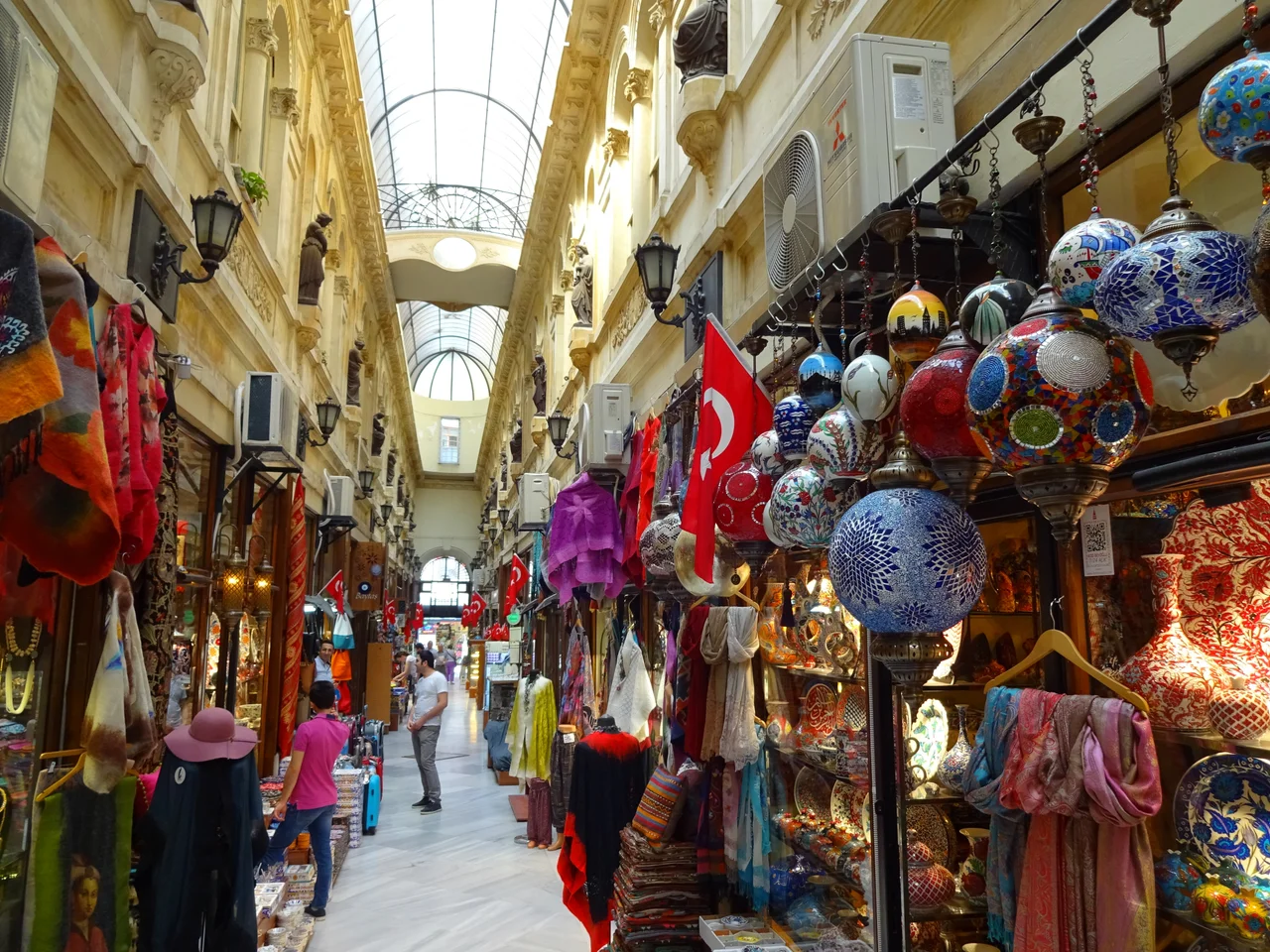
The Avrupa Pasajı connects Meşrutiyet Caddesi to Sahne Sokak, cutting through the block in the manner of the great European arcades after which it was explicitly modeled — Milan's Galleria Vittorio Emanuele, Paris's Passage des Panoramas, Brussels's Galeries Royales Saint-Hubert. The arcade's most distinctive early feature was its lighting: gas lamps placed in front of large mirrors, which multiplied the light and gave the passage its alternative name, Aynalı Pasaj — the Arcade with Mirrors. This was showmanship with purpose. In a pre-electric city, the brightness of a well-lit arcade was itself an attraction, a signal that something worth entering lay inside. The ceiling is partially covered with windows that admit daylight, and chandeliers hang overhead — the gas lamps long replaced, but the principle of deliberate illumination maintained.
The Shops and Their Tenants
The early tenants of the arcade give a clear picture of the neighborhood it served. A shoemaker. Two hairdressers. Two tailors. A grocery store. A haberdasher. Two soap-makers. A carpet seller. This is not a luxury retail catalog; it is a functional mixed neighborhood arcade in a prosperous commercial district. Over the years the mix evolved. Florists arrived, then watchmakers. Piano manufacturers established themselves here — a trade that speaks to the musical life of the Pera neighborhood, with its European families, its concert halls, its taste for parlor culture. Fashion houses followed. Each store was built with its own staff room, kitchen, and basement, an arrangement that treated the individual tenant as a self-sufficient operation rather than merely a unit in a larger commercial scheme. Arches separate each shop from the next, giving the passage rhythm without monotony.
The Statues on the Upper Façade
Look up inside the arcade and you will find female statues ranged along the upper inner façade, each one representing a different craft. They are an unusual decorative program for a shopping arcade — more ambitious than ornamental garlands, more specific than generic classical figures. The tradition they draw on is the allegorical representation of human arts and industries that filled European public buildings throughout the nineteenth century: female figures personifying music, commerce, weaving, the mechanical arts. In an arcade that once housed piano manufacturers and tailors and haberdasher shops, these figures were not abstract decoration but a recognition of the trades actually practiced below them. They give the passage a mild civic gravity, as if the building were making an argument that commerce, done well, deserves the same allegorical treatment as the arts.
A Passage That Endures
Istanbul's nineteenth-century arcades have had mixed fates. Some have been demolished, others converted beyond recognition. The Avrupa Pasajı has survived, in the Hüseyinağa subdistrict of Beyoğlu, close to the Galatasaray High School and the Beyoğlu Fish Market that are themselves institutions of long standing in this part of the city. It sits within a neighborhood that has absorbed everything the twentieth century sent its way — mass tourism, economic upheaval, shifting fashions in shopping and leisure — without losing the essential structure that gives a covered arcade its appeal: the sense of being inside and outside at once, sheltered from the street but connected to it, moving through a space that belongs to commerce but aspires to something more. The mirrors, the chandeliers, the arches, the statues — they are still there.
From the Air
The Avrupa Pasajı sits at 41.0339°N, 28.9771°E in the Beyoğlu district of Istanbul, on the European side of the city north of the Golden Horn. From the air at 2,500 feet, the Golden Horn waterway marks the boundary between the historic peninsula to the south and the Beyoğlu district to the north; the arcade lies in the dense urban fabric of Beyoğlu, a few hundred meters west of the Bosphorus shore. The Galata Tower, a prominent cylindrical medieval landmark, stands nearby and provides easy aerial orientation. The nearest major airport is Istanbul Airport (LTFM), approximately 25 kilometers to the northwest. The Beyoğlu neighborhood's grid of streets and rooftops is visible from altitude; the passage itself is too narrow to distinguish from above, but the surrounding urban grain of 19th-century commercial blocks marks the area clearly.
Nearby Stories
- Kocaeli Peninsula 7.6 km away
- Second Battle of Çatalca 11 km away
- Istanbul's Rural Outskirts 14 km away
- MV Struma 20 km away
- HMAS AE2 36 km away
- Bursa 66 km away
- Sangarius Bridge 71 km away
- Januarius MacGahan 101 km away