
Ayazma Mosque
Sultan Mustafa III built his first mosque not for himself, but for his mother. Mihrişah Kadın had died before she could see it finished, and whether Mustafa built it out of grief, duty, or love — or all three — the building that rose on the hillside above Üsküdar between 1757 and 1761 carries a tenderness that the grandest imperial mosques often lack. This is the Ayazma Mosque, a baroque jewel on the Asian shore of Istanbul, and it is, in every sense, a son's monument.
A Sultan Who Built First Here
Mustafa III reigned from 1757 to 1774, a period when the Ottoman Empire was beginning to feel the pressure of European powers more acutely. He was the son of Ahmed III and the successor of Osman III, and during his reign he engaged in ambitious building programs that extended the Ottoman Baroque style introduced under his predecessor Mahmud I. The Ayazma Mosque was his first foundation — not his largest or most celebrated, but first, which says something about where his mind went when he came to power.
Construction ran from 1757 to 1761. The architect is not confirmed by historical record, but current scholarly opinion points to Mehmed Tahir, who went on to become chief imperial architect from 1761 to 1784 — a promotion that suggests the Ayazma Mosque impressed the right people. Mustafa III later commissioned the Laleli Mosque in the Fatih district of Istanbul, a larger and more complex project, but the Ayazma Mosque remained his first statement in stone.
Baroque on the Bosphorus
The Ayazma Mosque belongs to a family of 18th-century Ottoman buildings that absorbed European Baroque influences and filtered them through an Ottoman sensibility. In form it closely resembles the Nuruosmaniye Mosque, Istanbul's landmark Baroque imperial mosque completed in 1755 — the Ayazma is essentially a smaller version, which signals how influential the Nuruosmaniye had become as a model for Ottoman architects.
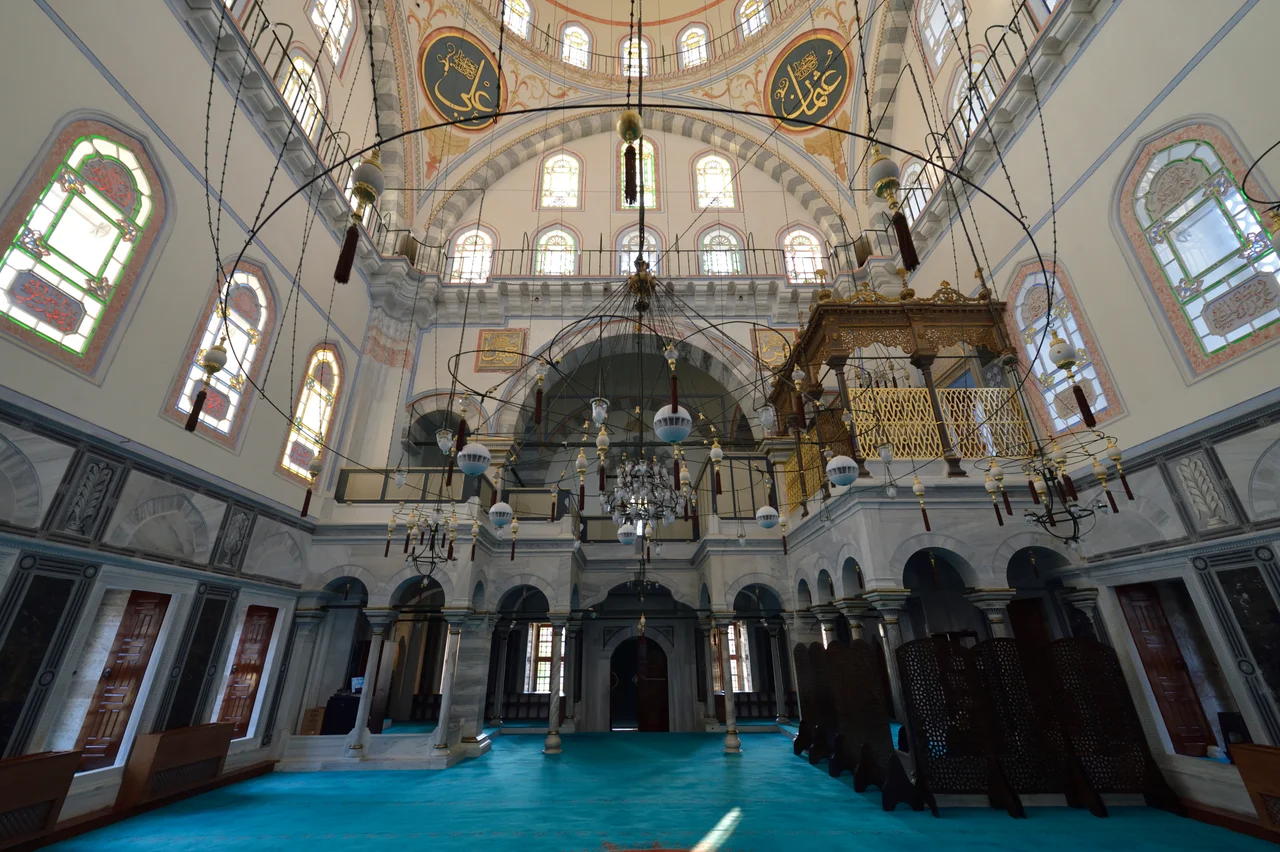
The main structure is a single-domed prayer hall, flanked by a minaret. What distinguishes the Ayazma from others of its type is the front façade: a five-arched portico reached by a wide semicircular staircase that sweeps upward with theatrical confidence. The interior carries richly carved Baroque stonework, especially in the mihrab and minbar. The mosque is relatively tall for its proportions, a deliberate choice that enhances its presence on the hillside — a quality that later mosques like the Nusretiye would push even further. After a lengthy restoration, the mosque reopened for prayer in July 2022.
Houses for Birds, Built Into Stone
Look carefully at the exterior walls of the Ayazma Mosque and you will find small stone birdhouses carved directly into the façade. These are not decorations in the conventional sense — they are functional, built to shelter sparrows and other small birds, a tradition in Ottoman architecture that reflects an Islamic ethic of care for living creatures.
Birdhouses had appeared on Ottoman buildings in the preceding century, but during the Baroque period they became more elaborate and more common, attached to both religious and civil buildings across Istanbul. The examples on the Ayazma Mosque are among the more ornate surviving specimens. They appear as tiny niched recesses with carved stone arches, miniature architectural flourishes tucked between the larger stonework of the walls. The birds that nest there now are the inheritors of a hospitality extended across more than 260 years.
The Imperial Pavilion and the Sultan's Loge
Like other imperial mosques of the period, the Ayazma includes spaces designed for the sultan's exclusive use. The imperial pavilion — a lounge and private entrance reserved for the sultan — is attached to the mosque, allowing Mustafa III and his successors to arrive, pray, and depart without mingling with ordinary worshippers. Inside the prayer hall, the sultan's loge occupies an elevated position, visible from below as a kind of architectural reminder of the hierarchy that Ottoman religious architecture never quite forgot.
These features are not unusual in mosques of this period, but they give the Ayazma a layered social dimension: a building that is simultaneously a public place of worship and a statement of imperial presence, open to the faithful and reserved for the sovereign at the same time. The tension between those two purposes runs through the whole tradition of Ottoman imperial mosque-building, and the Ayazma Mosque, modest as it is compared to the great sultanic complexes, enacts it in miniature.
From the Air
The Ayazma Mosque stands at approximately 41.023°N, 29.009°E on the Asian shore of Istanbul, in the Üsküdar district. From the air, the mosque is visible on the hillside above the Bosphorus waterfront, its single minaret rising above the surrounding residential rooflines. The Bosphorus strait is immediately to the west, providing a clear geographic reference from altitude. Nearest major airport is Sabiha Gökçen International Airport (LTFJ), approximately 25 km to the southeast. Viewing altitude of 1,000–2,000 feet on a clear day offers a good view of the mosque's position on the hill and its relationship to the Üsküdar waterfront below.
Nearby Stories
- Kocaeli Peninsula 7.6 km away
- Second Battle of Çatalca 11 km away
- Istanbul's Rural Outskirts 14 km away
- MV Struma 20 km away
- HMAS AE2 36 km away
- Bursa 66 km away
- Sangarius Bridge 71 km away
- Januarius MacGahan 101 km away