
Ayvansaray
At the far end of the Golden Horn, where the great Theodosian Land Walls make their final turn and descend to the water, there is a neighbourhood that carries a Persian name meaning something like Veranda Palace. Ayvansaray — *Iwan Saray* in the original — recalls a palace complex of the Byzantine emperor Alexios I Komnenos that stood here and is now entirely lost. The palace is gone, but the walls around it are still standing, massive and polygonal and old, and the neighbourhood that grew up inside them has been inhabited continuously since well before the Ottoman conquest of 1453.
Where Blachernae Stood
The modern neighbourhood of Ayvansaray occupies the ground of what was once Blachernae — in Greek, *Vlachérnai* — the imperial quarter at the northwest corner of Constantinople's walled circuit. It was here that the Byzantine emperors retreated when the Great Palace on the Marmara shore became too exposed or too decayed to inhabit. Alexios I Komnenos expanded the Blachernae complex in the late 11th and early 12th centuries, and later emperors added to it until it became the primary imperial residence in the final centuries of Byzantine rule.
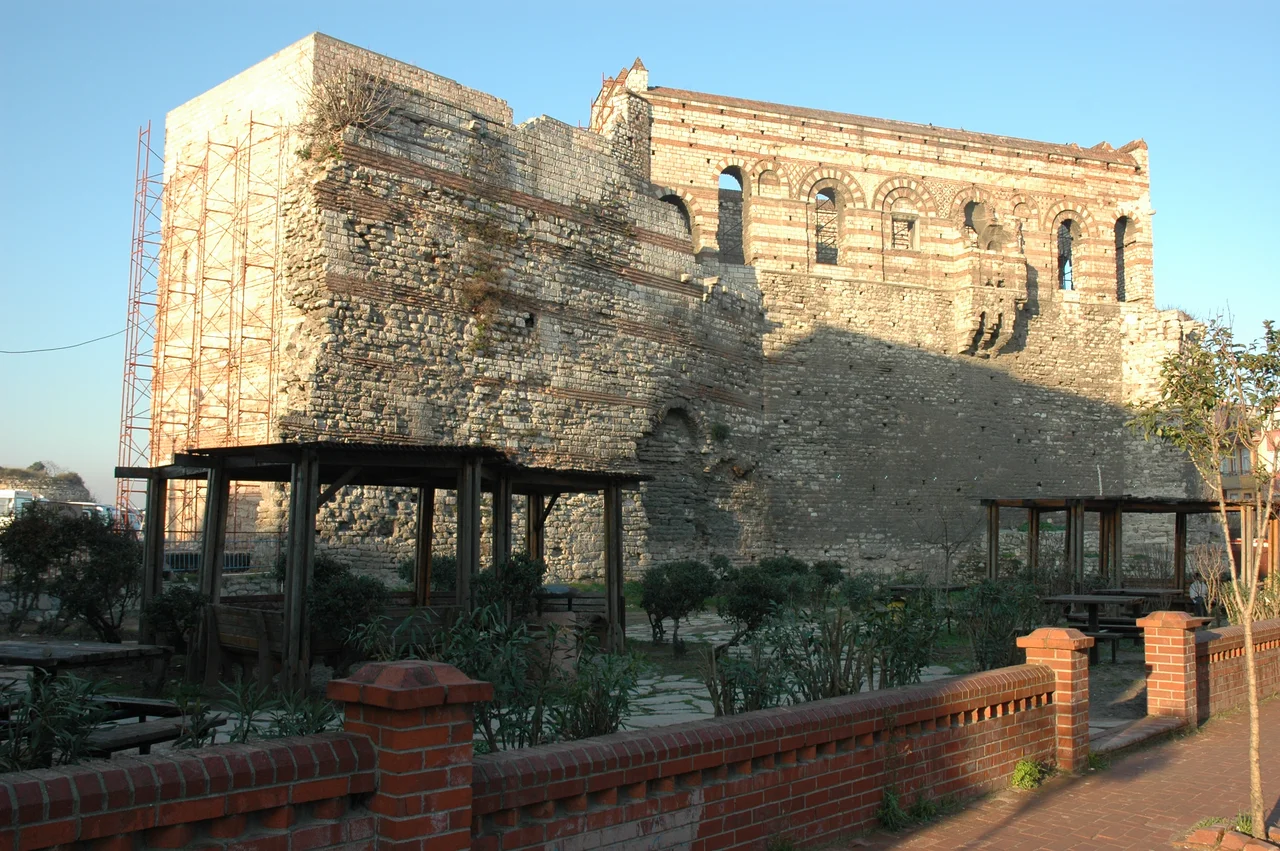
The palace itself has vanished almost completely, absorbed by time and subsequent construction. What remains is the Palace of the Porphyrogenitus — also known as Tekfur Palace — a remarkable late Byzantine ruin that still stands to three stories, its brick-and-stone banded façade visible from a distance. It is one of the very few secular Byzantine buildings to survive above ground in Istanbul, and it stands in Ayvansaray as a remnant of the imperial grandeur that once defined this corner of the city.
The Walls Come Down to the Water
The Theodosian Land Walls — built in the 5th century under the Emperor Theodosius II and extended over the following centuries — trace their final descent through Ayvansaray before meeting the Golden Horn. Here, three huge polygonal towers mark the terminus of the land defenses, where they connected to the sea walls that ran along the Horn's southern shore. For over a thousand years, this junction was one of the most strategically critical points in the Mediterranean world: the place where the landward and seaward defenses of Constantinople joined.
Just inside this stretch of the walls is a small cemetery attached to the shrine of Ebu Şeybet-ül Hudri. According to tradition, several companions of the Prophet Muhammad are buried here, including Toklu İbrahim Dede, believed to have taken part in the Ottoman siege that ended with the fall of Constantinople in 1453. The cemetery is a place of quiet and significance, tucked against ancient walls, its headstones shaded by trees that have grown up among the remnants of the city's oldest defenses.
Byzantine Stones, Ottoman Names
Ayvansaray's monuments tell the overlapping history of a city that changed hands and religions without entirely shedding what came before. The Mosque of Atik Mustafa Pasha was once thought to be the Byzantine church of Sts Peter and Mark — the conversion left the building's bones largely intact, and the debate over its original identity continued for centuries. The Mosque of Kazasker İvaz Efendi stands nearby, and the small church of St. Mary of Blachernae — built over an *ayazma*, a sacred holy spring — survives with a particularly attractive garden around it, still used by Istanbul's small Greek Orthodox community.
These buildings occupy the same few streets, palimpsests of devotion in different languages and faiths, each generation building on and around what the previous one left standing. The pattern is common across Istanbul, but in Ayvansaray — where the Byzantine, Ottoman, and modern city all converge at the corner of the old walls — it is especially concentrated.
The Neighbourhood Today
Home to roughly 15,747 residents as of the 2022 census, Ayvansaray sits between Balat to the south and Eyüpsultan to the west along the Golden Horn shore. The Golden Horn ferry stops here, connecting it to Üsküdar and Karaköy and Eyüp. The T5 tram skirts the neighbourhood, linking it to the Alibeyköy bus terminal and points beyond.
The area is residential and relatively quiet, the daily business of a working Istanbul neighbourhood carried on in the shadow of extraordinary history. During World War I, British bombing of Istanbul in 1918 caused damage here, a reminder that the walls of Constantinople could not protect against aerial attack. The walls still stand, however, and the neighbourhood still occupies the ground they were built to defend. In Ayvansaray, the ordinary and the ancient coexist with the ease of long familiarity.
From the Air
Ayvansaray lies at approximately 41.038°N, 28.943°E at the far western end of the Golden Horn, in Istanbul's European historic peninsula. From the air, the neighbourhood is identifiable by the line of the Theodosian Land Walls descending toward the water, and by Tekfur Palace's distinctive banded façade visible from low altitude. The Golden Horn's terminal bend provides a clear geographic landmark. Nearest major airport is Istanbul Airport (LTFM), approximately 30 km to the northwest. Best viewed from 1,000–2,000 feet looking east along the Golden Horn, with the land walls visible as they curve down to meet the water at the neighbourhood's western edge.
Nearby Stories
- Kocaeli Peninsula 7.6 km away
- Second Battle of Çatalca 11 km away
- Istanbul's Rural Outskirts 14 km away
- MV Struma 20 km away
- HMAS AE2 36 km away
- Bursa 66 km away
- Sangarius Bridge 71 km away
- Januarius MacGahan 101 km away