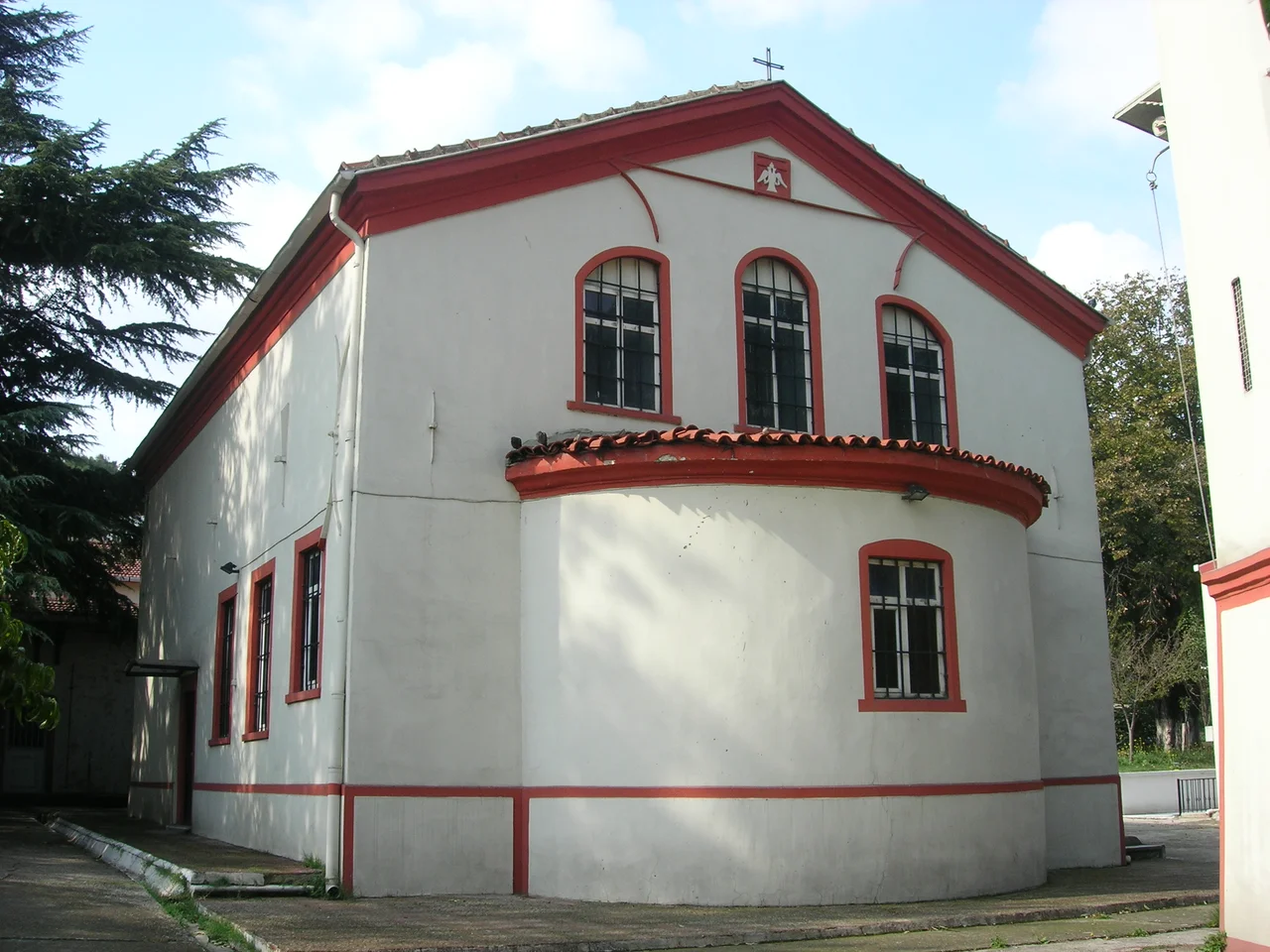

Balıklı Greek Hospital
The story begins with a monk frying fish. It was May 29, 1453, and word reached him that Ottoman forces had breached the walls of Constantinople. He declared he would only believe it when the fish in his pan came back to life — and according to the legend held dear by Istanbul's Greek Orthodox community, that is exactly what happened. The fish sprang from the pan into the sacred spring nearby, half-fried but swimming. Centuries later, goldfish still glide through the pool beneath the Church of the Zoodochos Pege, the 'Life-Giving Spring,' on the grounds of the Balıklı Greek Hospital in the Zeytinburnu district. History and miracle are threaded together here in ways that are difficult to separate — and perhaps that is the point.
A Spring Before the City
The ayazma — the sacred spring — predates the hospital by more than a millennium. Byzantine tradition holds that a soldier named Leo, resting near the city's Theodosian walls in the fifth century, heard a divine voice directing him to a hidden spring and instructing him to apply its mud to a blind man's eyes. The man's sight was restored. Leo went on to become Emperor Leo I, and he built a church over the spring to mark the miracle. Later, Emperor Justinian I expanded it into a major church and monastery, reportedly using surplus materials from the construction of Hagia Sophia. The site passed through centuries of destruction and rebuilding — burned by Bulgarian Tsar Simeon I in 924, damaged in earthquakes, occupied during the Latin crusader period, and finally razed after the Ottoman conquest. In 1821, during the Greek War of Independence, Janissaries destroyed a chapel built over the spring and buried the water itself. The current church was built between 1833 and 1835, after Sultan Mahmud II issued an imperial decree permitting its construction. Twenty-five steps descend from the courtyard into the domed crypt below, where holy water flows from four marble faucets and the fish pool shimmers in candlelight.
The Hospital the Grocers Built
The Balıklı Greek Hospital was founded in 1753 — not by a sultan, a patriarch, or a wealthy benefactor, but by the Union of Greek Grocers of Istanbul. The founding came by Ottoman government edict, and the institution was originally called the Yedikule Hospital after the nearby fortress. That a guild of tradespeople built and sustained a hospital speaks to the depth of civic organization within Istanbul's Greek community during the Ottoman period. The compound grew over generations to encompass not only wards and clinics but also the Panagia Church, the Zoodochos Pege ayazma, and a cemetery that became one of the most historically significant Greek Orthodox burial grounds in Turkey. Among those interred here are fourteen of the Ecumenical Patriarchs who have led the Greek Orthodox Church since the nineteenth century. The cemetery also holds what scholars recognize as the largest surviving collection of inscriptions in Karamanli — the Greek-script Turkish used by Anatolian Christians — making it a document of a linguistic and cultural world that no longer exists.
Bright Friday and the Ecumenical Patriarch
The most important day at Balıklı is Bright Friday, the Friday after Orthodox Easter. On that morning, the Ecumenical Patriarch of Constantinople leads the liturgy at the Church of the Zoodochos Pege, drawing Istanbul's Greek community together with pilgrims from Greece and the diaspora. The church's icon, traditionally attributed to Saint Luke, is brought forward. The crypt fills with incense and prayer. Outside, the fish drift in their pool as they always have — or as the faithful believe they always have, carrying the weight of the 1453 legend in their unhurried circles. The feast commemorates the miracle of Leo I and speaks to a continuous thread of devotion that has survived conquest, fire, pogrom, and demographic transformation.
What the Fires Left Behind
The twentieth century was not kind to Balıklı. The 1955 Istanbul Pogrom — a coordinated wave of violence targeting the city's Greek, Armenian, and Jewish communities — reached the compound. The church was damaged. Sarcophagi of Patriarchs buried in the cemetery were broken open and their remains scattered. The abbot was killed on the grounds. The violence of that September night accelerated a decades-long departure of Istanbul's Greek community that had already been underway. Today, the Greek population of Istanbul numbers in the thousands rather than the hundreds of thousands it once was. The hospital remained, continuing to serve the public regardless of religion. By 2011 it employed 440 people including 39 doctors and 98 nurses. Then, on August 4, 2022, a fire broke out on the roof and destroyed the upper floor of the main building. The ground floor survived. The hospital's restoration has proceeded in the years since — one more chapter in a history that has required rebuilding, again and again, from the rubble of each disaster.
Still Open, Still Tended
The Balıklı Greek Hospital remains the oldest surviving hospital in Istanbul still operated by a minority community, run today under the auspices of the Greek community of Turkey. It accepts patients of all religions and backgrounds, as it has done for most of its history. The compound — hospital, church, spring, cemetery — functions as a complete world within Zeytinburnu, modest in scale but dense with meaning. Visitors who descend the stone steps into the crypt find the fish moving through green water, half in legend and half in fact. Whether you read that as continuity or as remarkable resilience, the Balıklı spring has been tended by someone — monk, nurse, patient, patriarch — for over fifteen centuries.
From the Air
The Balıklı Greek Hospital sits at approximately 41.00°N, 28.92°E in the Zeytinburnu district on Istanbul's European side, roughly 500 meters outside the historic Theodosian walls near the Silivrikapı gate. Approaching from the northwest at 3,000–4,000 feet, the Sea of Marmara coastline and the ancient land walls are visible landmarks. The nearest major airport is Istanbul Airport (LTFM), approximately 35 km to the northwest. Clear days offer views of the Marmara shoreline, the old city walls, and the distinct silhouette of the historic peninsula beyond.
Nearby Stories
- Kocaeli Peninsula 7.6 km away
- Second Battle of Çatalca 11 km away
- Istanbul's Rural Outskirts 14 km away
- MV Struma 20 km away
- HMAS AE2 36 km away
- Bursa 66 km away
- Sangarius Bridge 71 km away
- Januarius MacGahan 101 km away