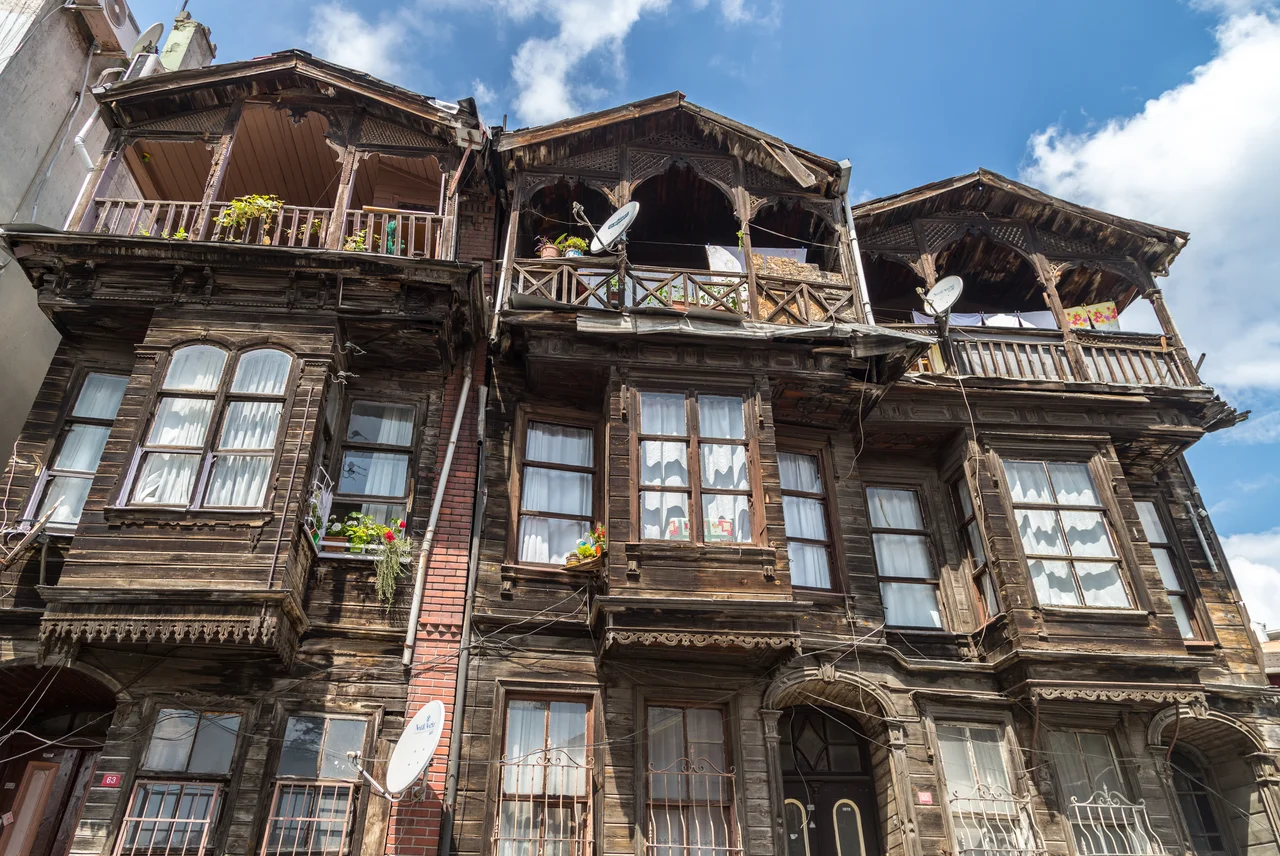

Balat, Fatih
Sultan Bayezid II made an offer in 1492 that changed this neighborhood forever. When Spain issued the Alhambra Decree expelling Jews from the Iberian peninsula, Bayezid opened the gates of the Ottoman Empire and offered citizenship to those fleeing the Inquisition. Many of those families, Sephardic Jews carrying with them the Ladino language and centuries of Iberian culture, settled in Balat — a district on the western shore of the Golden Horn that would become, at its peak, home to nineteen synagogues. The name Balat probably derives from the Greek word for palace, *palatium*, after the nearby Palace of Blachernae; the neighborhood had been layered with communities long before the Jewish arrivals. But Balat's most intense chapter as a place of plural coexistence belongs to the centuries after 1492, and its most painful chapter belongs to the twentieth century, when that coexistence was dismantled by force.
The Communities That Built It
Balat was never one thing. Tucked between Fener and Ayvansaray, pressed against the old Byzantine sea walls and the waterway of the Golden Horn, it held Jewish, Greek Orthodox, and Armenian populations who built their institutions side by side across centuries. The Ahrida Synagogue, founded in the fifteenth century by Jews from the Macedonian city of Ohrid, contains a wooden *bema* — a raised pulpit — and is notable as the place where Sabbetai Zevi, the seventeenth-century Jewish mystic who declared himself the Messiah and then converted to Islam, announced his breakaway beliefs in 1666. The Yanbol Synagogue, also from the fifteenth century and founded for Jews from Bulgaria, has a painted ceiling that has survived multiple fires. Three synagogues remain in use today: Ahrida, Istipol, and Yanbol. The Or-Ahayim Hospital, founded in 1898 by the Jewish community under an Ottoman imperial decree and designed by architect Gabriel Tedeschi, opened in 1899 to serve the neighborhood's Jewish residents; it continues to operate today, its patient base now predominantly Muslim. The Bulgarian Iron Church — the Church of St. Stephen of the Bulgars — stands on the Golden Horn shore and was built entirely from prefabricated iron panels shipped from Vienna down the Danube and assembled in place; it represents the Bulgarian Exarchate, which broke from the Orthodox Patriarchate in 1872, and reopened after complete restoration in 2018.
Sacred Water and Hidden Texts
Balat's churches have their own remarkable histories. The Church of Hagios Georgios Metochi, enclosed in a courtyard off Vodina Caddesi, was probably first a chapel for governors of Wallachia before becoming associated, by the seventeenth century, with the Church of the Holy Sepulchre in Jerusalem. In the early twentieth century, a scholar examining manuscripts kept here uncovered the Archimedes Palimpsest — a medieval prayer book in which, in the thirteenth century, a scribe had scraped clean the text of seven works by the ancient Greek mathematician Archimedes and written prayers over the top. Three of those Archimedes texts are not known to exist in any other copies. The Armenian Church of Surp Hreşdagabed, the Church of the Archangels, was built in the sixteenth century over an *ayazma* — a sacred spring — and rebuilt in the eighteenth century. The journalist Tim Kelsey documented a joint Muslim and Christian gathering held at the church on one day each year, in which sheep and cockerels were sacrificed in hope of healing a disabled member of the community; that gathering no longer takes place. The proximity of the neighborhood to the Ecumenical Patriarchate of Constantinople in neighboring Fener meant that a significant Greek Orthodox population lived here too, with several churches still standing, including the Church of Hagios Ioannis Prodromos, historically linked to St. Catherine's Monastery in the Sinai.
A History Told in Fire
Balat burned with terrible regularity. The first recorded fire dates to 1303, during the Byzantine period. In 1510 a single fire consumed around 800 shops as it spread from Balat toward Bahçekapı. A 1639 fire began in a candle-making workshop and, fanned by strong winds, reduced the district to ashes overnight. The 1692 fire started in a cotton-carding shop and destroyed 1,500 houses and shops. The 1729 fire, starting in a greengrocer's stall, consumed roughly one-eighth of all Istanbul, burning from Fener Gate to Ayvansaray. Fires continued in 1743, 1746, 1780, 1812, 1866, 1868, 1892, 1911, 1967, and 1968. The wooden houses that define Balat's streetscape were rebuilt after each disaster, which is partly why the neighborhood retains a domestic, intimate scale rather than the monumental one of wealthier districts. The back streets are lined with two- and three-story stone terraced houses and the occasional grander mansion, precisely because the pressure of repeated rebuilding kept the architecture close to human size.
The Weight of the Twentieth Century
What fire could not accomplish, policy and violence did. The Armenian Genocide, which began in 1915, reached the Armenian families of Balat. The Greek Genocide of the same era, followed by the population exchange between Greece and Turkey in 1923, reduced the Greek Orthodox community. Then came September 6–7, 1955: a coordinated pogrom targeting Istanbul's Greek, Armenian, and Jewish communities destroyed thousands of homes and businesses across the city. Balat was not spared. Later decades brought further departures, some voluntary in search of economic opportunity, others compelled by legal pressure and social hostility. By the 2020s Balat is overwhelmingly Muslim, its minority populations reduced to small remnants of what once flourished here. The historian Dimitri Cantemir, who was born in 1673 and lived in Balat, wrote one of the earliest systematic accounts of Ottoman history and culture; his house still stands, recognizable if you know to look, now absorbed into the grounds of a cafe on Merdivenli Mektep Sokak. The Ferruh Kethüda Mosque, a minor work of the master Ottoman architect Mimar Sinan completed in 1562, contains tiles from the kilns of Tekfur Sarayı around its mihrab — a detail that rewards careful looking.
Balat Now
In 1985 the Historic Areas of Istanbul were inscribed on the UNESCO World Heritage List, an inscription that covers the broader historic peninsula of which Balat forms part. By the 2020s the neighborhood had become one of Istanbul's most visited quarters, its colorful house facades repainted specifically to attract tourists and photographers, its workshops and courtyards increasingly converted to cafes and boutique accommodation. The tension between that photogenic surface and the depth of what the neighborhood carries — the losses, the textures of communities largely gone — is something visitors navigate differently. The tram stop on the T5 line connects Balat to the rest of the city; Golden Horn ferries stop at the waterfront. Cats, which have always been a feature of Istanbul street life, are abundant here. But the Ahrida Synagogue still holds services. The Iron Church stands restored beside the water. The Or-Ahayim Hospital still treats patients. Not everything was lost.
From the Air
Balat sits at approximately 41.032°N, 28.948°E on Istanbul's European side, along the western shore of the Golden Horn. From the air at 3,000 feet, the S-curve of the Golden Horn is the most distinctive landmark, with Balat's dense low-rise roofscape visible on its southern bank. The Bulgarian Iron Church's distinctive profile sits at the water's edge. The nearest major airport is Istanbul Airport (LTFM), approximately 28 km to the northwest. Approaching from the Bosphorus, the Galata Tower across the Horn provides a clear reference point.
Nearby Stories
- Kocaeli Peninsula 7.6 km away
- Second Battle of Çatalca 11 km away
- Istanbul's Rural Outskirts 14 km away
- MV Struma 20 km away
- HMAS AE2 36 km away
- Bursa 66 km away
- Sangarius Bridge 71 km away
- Januarius MacGahan 101 km away