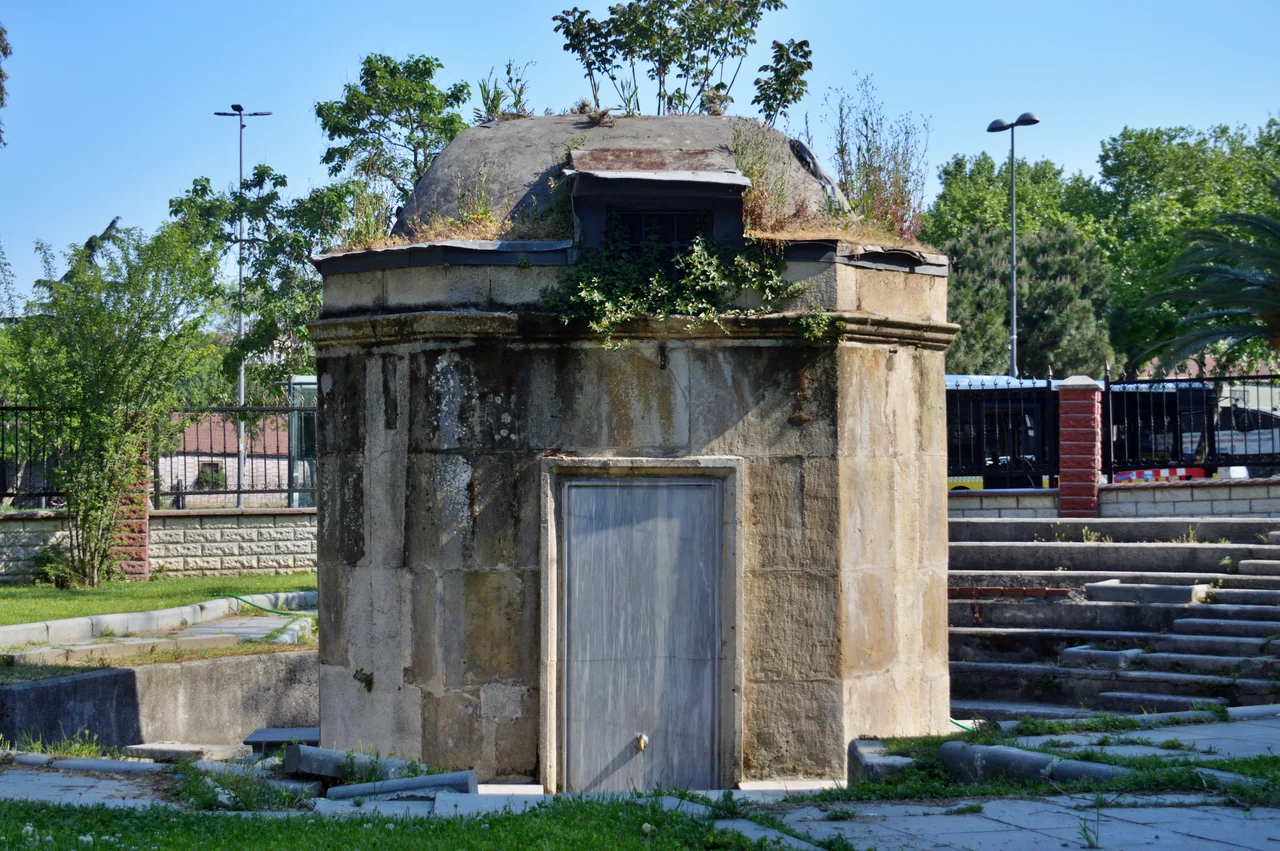

Balat Fountain
Ottoman cities were built around water, and nowhere more deliberately than Istanbul, where the logistics of supplying millions of people across a hilly peninsula demanded an elaborate infrastructure of aqueducts, cisterns, pipes, and public fountains. The Balat Fountain — formally called the Yusuf Şucaeddin Mosque Fountain — stands in the Ayvansaray neighborhood of the Fatih district as a survivor of that system, compact and hexagonal, cut from limestone and once covered with lead. Road construction along the Golden Horn in the 1980s transformed its surroundings without touching the fountain itself, leaving it in the garden of the Yusuf Şucaeddin Mosque, where it continues to function in diminished but real form: of its four fountain faces, one still flows.
Six Sides and a Single Flow
The Balat Fountain is built in the Ottoman *çeşme* tradition — public fountains that served as neighborhood infrastructure, social gathering points, and acts of religious charity all at once. Its hexagonal form is unusual; most Ottoman neighborhood fountains were rectangular. Cut limestone forms the body; a lead covering once protected the upper reservoir. A marble slab occupies the space where what Ottoman builders called a *ayna taşı* — a mirror stone, a decorative reflective panel — once gleamed. The fountain has four active faces, each bearing a spout, though only one continues to carry water. The others stand dry, their marble basins intact, their spouts silent. That the fountain functions at all, after the road project of the 1980s rerouted the Golden Horn coastal street through this part of Ayvansaray, speaks to a quiet persistence. The Yusuf Şucaeddin Mosque garden now serves as its setting and shelter.
Water as Urban Architecture
Istanbul's public fountains were instruments of civic order as much as of thirst. Ottoman charitable endowments, known as *vakıf*, funded the construction and maintenance of fountains across the city, connecting them to mosques, medreses, and hospitals as part of a larger system of public provision. The fountain at Balat sits near the edge of the historic district where the Fatih neighborhood transitions into Ayvansaray, close to the shoreline that the Byzantine sea walls once defended. The Golden Horn around it was, for centuries, the industrial and commercial waterfront of the city — a place of ships, tanneries, workshops, and the noise of urban life. Fountains like this one served the people who lived and worked in that density: not monuments for distant visitors but neighborhood fixtures, visited daily. Their forms were crafted carefully nonetheless — the carved limestone, the lead reservoir, the marble details — because Ottoman urban culture treated the provision of water as something that deserved beauty.
What the Road Took, and What It Left
The coastal road works of the 1980s remade the Golden Horn waterfront across Istanbul, cutting between the old neighborhoods and the water's edge in ways that altered the character of districts like Balat and Ayvansaray permanently. The Balat Fountain was not demolished in that process — it was preserved in the mosque garden — but its original urban context was severed. It no longer stands at a busy crossroads where people stop to wash hands and fill vessels; it stands in a garden, an artifact in a setting that no longer fully explains it. That is not an unusual fate for Istanbul's Ottoman fountains, of which hundreds survive across the city in various states: some still flowing, some dry, some integrated into modern street life, some orphaned like this one by the layers of infrastructure that the twentieth century laid over the nineteenth. The Balat Fountain's single working spout is a modest but genuine link to the water system that once served this neighborhood.
From the Air
The Balat Fountain sits at approximately 41.034°N, 28.947°E in the Ayvansaray neighborhood of Istanbul's Fatih district, on the European side of the city near the western shore of the Golden Horn. From the air at 2,500 feet, the Golden Horn's shoreline and the dense roofscape of Balat and Ayvansaray are visible below. The Theodosian land walls run just to the west. The nearest major airport is Istanbul Airport (LTFM), approximately 28 km to the northwest. The historic waterway of the Golden Horn is the dominant aerial landmark in this part of the old city.
Nearby Stories
- Kocaeli Peninsula 7.6 km away
- Second Battle of Çatalca 11 km away
- Istanbul's Rural Outskirts 14 km away
- MV Struma 20 km away
- HMAS AE2 36 km away
- Bursa 66 km away
- Sangarius Bridge 71 km away
- Januarius MacGahan 101 km away