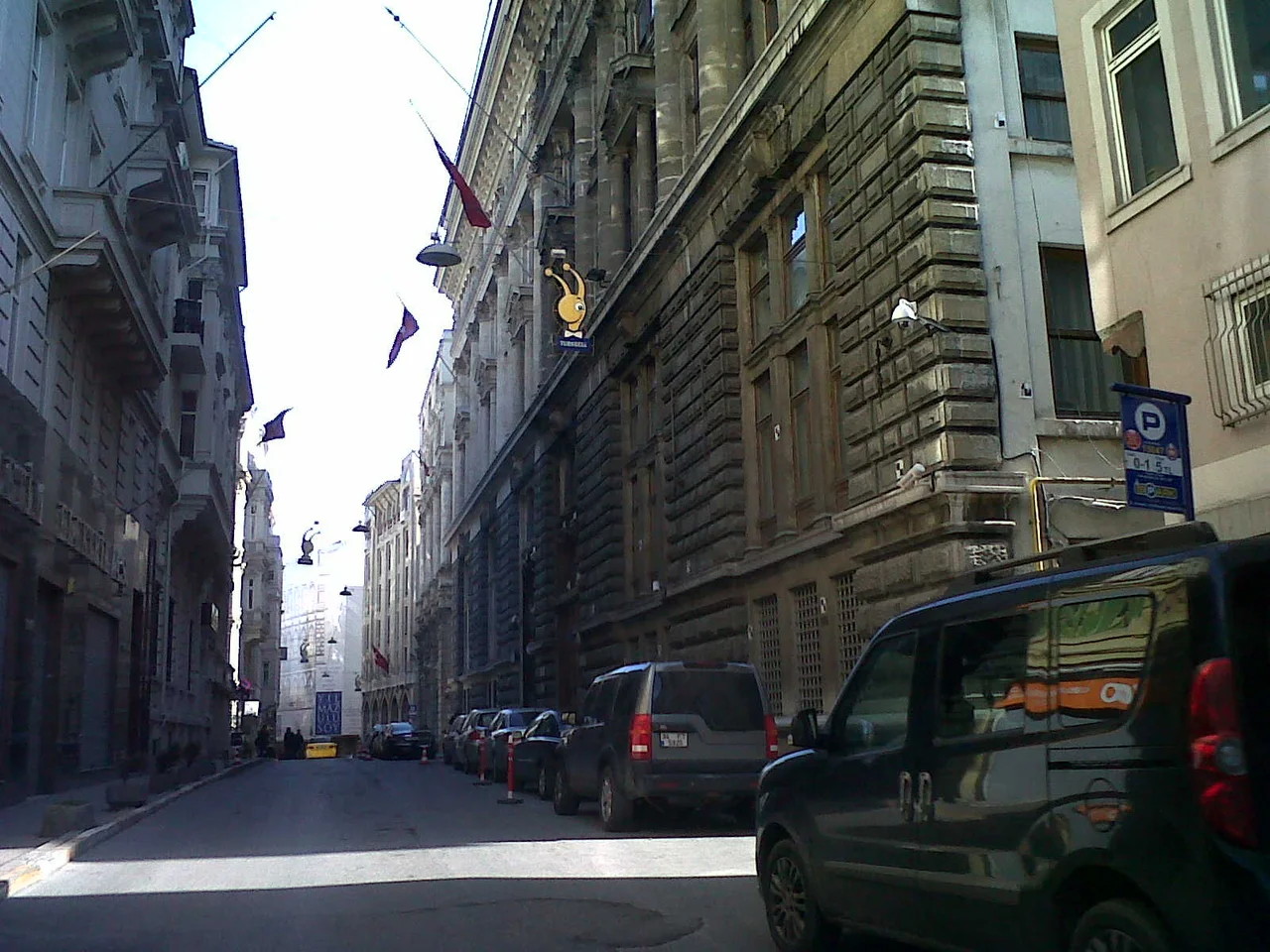

Bankalar Caddesi
The street has been named three things. In the seventeenth century, when Ottoman traveller Evliya Çelebi recorded it in his monumental *Seyahatnâme*, it was called Voyvoda Yolu — Voivode Road, named for the Romanian princes who once maintained residences here. By the nineteenth century it had acquired the name Bankalar Caddesi, Banks Street, because every significant financial institution of the late Ottoman Empire had placed its headquarters along its two short blocks. Today both names circulate, though the banks themselves have mostly gone, replaced by hotels, cultural centers, and the archives of an empire that no longer exists. The facades remain magnificent: heavy stone neoclassical fronts from the 1880s and 1890s, their proportions calibrated to project permanence and confidence. Whether that projection was warranted is another matter.
The Financial Heart of a Dying Empire
During the nineteenth century, as the Ottoman Empire contracted militarily and accumulated debt, Galata became its financial nervous system. The Ottoman Central Bank — established in 1856 as the Bank-ı Osmanî and reorganized in 1863 as the Bank-ı Osmanî-i Şahane — anchored the western end of Bankalar Caddesi in a building completed in 1892 and designed by architect Alexandre Vallaury. The Ottoman Stock Exchange was established in 1866 and formally renamed the Dersaadet Securities Exchange in 1873. Insurance companies, foreign banks, and investment houses filled the buildings between. The geography was deliberate: Galata had been the commercial district of Constantinople since Genoese merchants governed it in the fourteenth century, and the networks of European finance capital that dominated Ottoman borrowing in the nineteenth century found the location both familiar and convenient. What concentrated here was not simply money but the specific financial architecture of a state that was, in the language of European diplomacy, the 'Sick Man of Europe' — borrowing to sustain itself, mortgaging its customs revenues, negotiating with creditors in the very buildings that lined this street.
A Staircase and Its Photographer
The most famous object on Bankalar Caddesi is not a bank but a staircase. The Camondo Stairs sweep in a curving double arc between the street and the parallel lane above it, Kart Çınar Sokak, built sometime between 1870 and 1880 by Abraham Salomon Camondo, an Ottoman-Venetian Jewish banker and philanthropist of significant wealth. The staircase combines Neo-Baroque curves with early Art Nouveau ornament — an unusual hybrid that makes it instantly recognizable. In 1964 Henri Cartier-Bresson photographed the stairs, producing one of his most widely reproduced Istanbul images, and they have appeared in crime fiction since: Barbara Nadel set a scene on them in her novel *Pretty Dead Things*. The Camondo family, originally from Venice and long established in Istanbul, were among the leading figures of Ottoman Jewish financial and philanthropic life in the nineteenth century. Abraham Salomon Camondo later moved to Paris, where a branch of the family established the Musée Nissim de Camondo. The stairs carry his name in both cities.
Genoese Shadows at the Top
At the top of the Camondo Stairs, where Kart Çınar Sokak runs parallel to Bankalar Caddesi, stand the remains of the Genoese Palazzo del Comune, built in 1314 by Montano De Marini, the Podestà — governor — of Galata, and modeled on the thirteenth-century wing of the Palazzo San Giorgio in Genoa. The building marks a period when this part of Istanbul was not Ottoman or even Byzantine but an autonomous Genoese trading colony, operating under its own laws and administration. The palazzo's original facade on what would become Bankalar Caddesi was rebuilt in the 1880s, and the building became known as the Bereket Han office block. By the early twenty-first century it had fallen into severe disrepair; in 2022 it was put up for sale. The layers of the street compress fourteen centuries of commercial ambition into a short walk: Genoese trade, Ottoman banking, European finance, and now the tourism economy of a world heritage city.
Archives of a Vanished World
The building that housed the Imperial Ottoman Bank now belongs to Garanti BBVA and contains two institutions that repurpose the archive of empire for public use. The Ottoman Bank Museum holds objects and records from the bank's history. SALT Galata, a research and cultural institution, safeguards the bank's documentary archives and makes them available to scholars — a collection that amounts to one of the most complete financial records of the late Ottoman period. The building's reading rooms, set within Vallaury's 1892 interior, draw historians and researchers who work through the ledgers, correspondence, and photographs of an institution that once funded both Ottoman statecraft and European imperial ambition. Bankalar Caddesi served as Istanbul's primary financial district until the 1990s, when Turkish banks began moving headquarters to the modern business districts of Levent and Maslak, and the Istanbul Stock Exchange relocated — first to Sirkeci, then in 1995 to İstinye. The street's formal financial function ended quietly, without ceremony. What replaced it took longer to arrive but has given the buildings a second life: not as centers of capital but as containers of memory.
From the Air
Bankalar Caddesi sits at approximately 41.024°N, 28.974°E in the Galata quarter (present-day Karaköy) of the Beyoğlu district, on Istanbul's European side just north of the Golden Horn. The Galata Tower, a few hundred meters to the north-northwest, is the most prominent aerial landmark for this neighborhood. At 2,000–3,000 feet approaching from the Bosphorus, the distinctive shape of the tower and the dense hillside of Beyoğlu rising behind it define the area clearly. The southern entrance to the Tünel underground funicular (1875) is minutes from the eastern end of the street. The nearest major airport is Istanbul Airport (LTFM), approximately 30 km to the northwest.
Nearby Stories
- Kocaeli Peninsula 7.6 km away
- Second Battle of Çatalca 11 km away
- Istanbul's Rural Outskirts 14 km away
- MV Struma 20 km away
- HMAS AE2 36 km away
- Bursa 66 km away
- Sangarius Bridge 71 km away
- Januarius MacGahan 101 km away