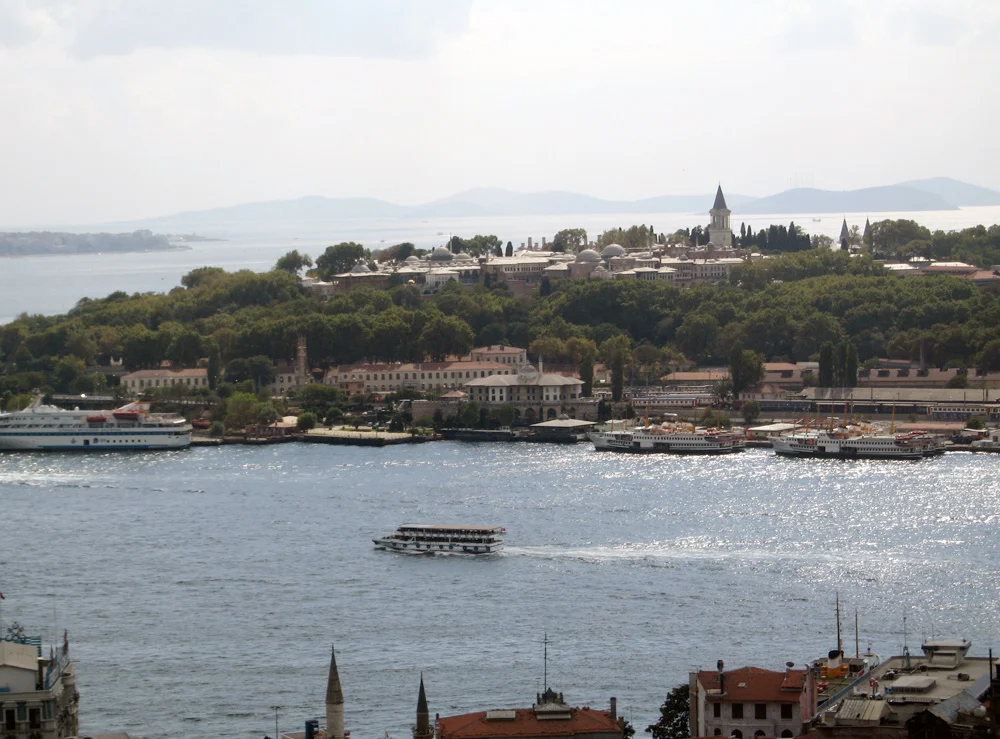

Basketmakers' Kiosk
It carries the name of people most rulers never thought to honor. The Basketmakers' Kiosk — Sepetçiler Kasrı in Turkish — stands at the tip of the Golden Horn in Istanbul's Sirkeci district, a four-story stone pavilion wedged between the ancient sea walls and the glittering waters of the Bosphorus. Sultans built it, rebuilt it, and sometimes forgot it. But it was the Sepetçi Romanlar, the Roma basketmakers who once worked and sold their crafts in this area, whose name stuck to the stone.
A Palace Born of Three Sultans
Construction began in 1591 under Sultan Murad III, who raised the building within the outer yard of Topkapı Palace as a place where Roma basketmakers could sell their goods. By the mid-seventeenth century the structure had aged enough that Sultan Ibrahim ordered it rebuilt — an inscription carved into the door arch of the pavilion records this reconstruction in 1643. Tradition holds that the basketmakers themselves contributed to the cost of that rebuilding, and that Sultan Ibrahim kept the guild under his patronage. Whether the dedication of the building's name was a formal gesture or simply the way people talked about it, the name held. Sultan Mahmud I renewed the pavilion again in 1739, adding another layer to its long life. Each sultan left his mark, but the building carries the tradespeople's name — a small, accidental democracy of memory.
The Last One Standing
Once, a whole row of pavilions and small palaces lined this stretch of the sea wall, each serving some function in the sprawling life of the Ottoman court. Today the Basketmakers' Kiosk is the only one left. The others have disappeared — dismantled, collapsed, or swallowed by later construction. This building survives partly because it was useful in inconvenient ways. Its thick stone walls and spacious halls made it easy to repurpose. After the nineteenth century brought alterations, it became a warehouse. During the Turkish Republic era it functioned as an army pharmacy. Then it stood empty until a restoration in the late 1980s gave it new life as a venue for meetings and banquets, eventually managed for a time by Swissôtel.
Where Admirals Said Farewell
Before any of those later uses, this stretch of the shore had its own ceremonial gravity. The kiosk was built next to — though it no longer stands alongside — the Yalı Köşkü, a waterfront pavilion erected by Selim I. There, Kapudan Pashas, the fleet admirals of the Ottoman Empire, would present themselves to the sultan before setting sail for campaigns at sea, and the fleet would be saluted upon its return. The Basketmakers' Kiosk thus sat at the edge of an imperial ritual — the point where the land power of the palace met the sea power of the fleet, where empire reached out toward the horizon and came back again.
What the Windows Show
Stand at one of those high wooden doors on the upper floors and the view opens outward in all directions. The Galata Bridge sweeps across the mouth of the Golden Horn. The Galata Tower rises above the rooftops of Karaköy. The Bosphorus itself runs between Asia and Europe in the near distance, its surface shifting color with the light. The building sits atop the remnants of the ancient Byzantine sea walls at the tip of the Sarayburnu promontory, just below Topkapı Palace. Layers of history compress at this location: Roman sea walls, Ottoman pavilion stones, and the modern city traffic of Sirkeci all coexist within a few hundred meters.
Name That Outlasted Everything Else
The Roma basketmakers who gave this place its name left no monuments, no inscriptions of their own. They were craftspeople working near a palace, selling goods at the margin of imperial splendor. Yet the building remembers them when it has forgotten almost everything else about its own early life — its precise original dimensions, the goods sold within its walls, the faces of those who passed through. Sepetçiler Kasrı. The Basketmakers' Kiosk. Four centuries later, the name is still here, pressed into stone at Sarayburnu.
From the Air
The Basketmakers' Kiosk sits at coordinates 41.0163°N, 28.9817°E, at the very tip of the Sarayburnu (Seraglio Point) promontory where the Golden Horn meets the Bosphorus. Flying over Istanbul at 3,000–5,000 feet, look for the sharp triangular point of land where the Golden Horn inlet diverges from the main Bosphorus channel. Topkapı Palace occupies the elevated ground just behind; the kiosk hugs the waterfront immediately below the palace walls. The Galata Bridge and Galata Tower on the north bank provide clear orientation. The nearest major airport is LTFM (Istanbul Airport), approximately 35 km northwest. For light aircraft, LTFJ (Sabiha Gökçen International Airport) lies about 35 km to the southeast on the Asian shore. Visibility over the Bosphorus is frequently excellent in summer, with the city's geography strikingly legible from above.
Nearby Stories
- Kocaeli Peninsula 7.6 km away
- Second Battle of Çatalca 11 km away
- Istanbul's Rural Outskirts 14 km away
- MV Struma 20 km away
- HMAS AE2 36 km away
- Bursa 66 km away
- Sangarius Bridge 71 km away
- Januarius MacGahan 101 km away