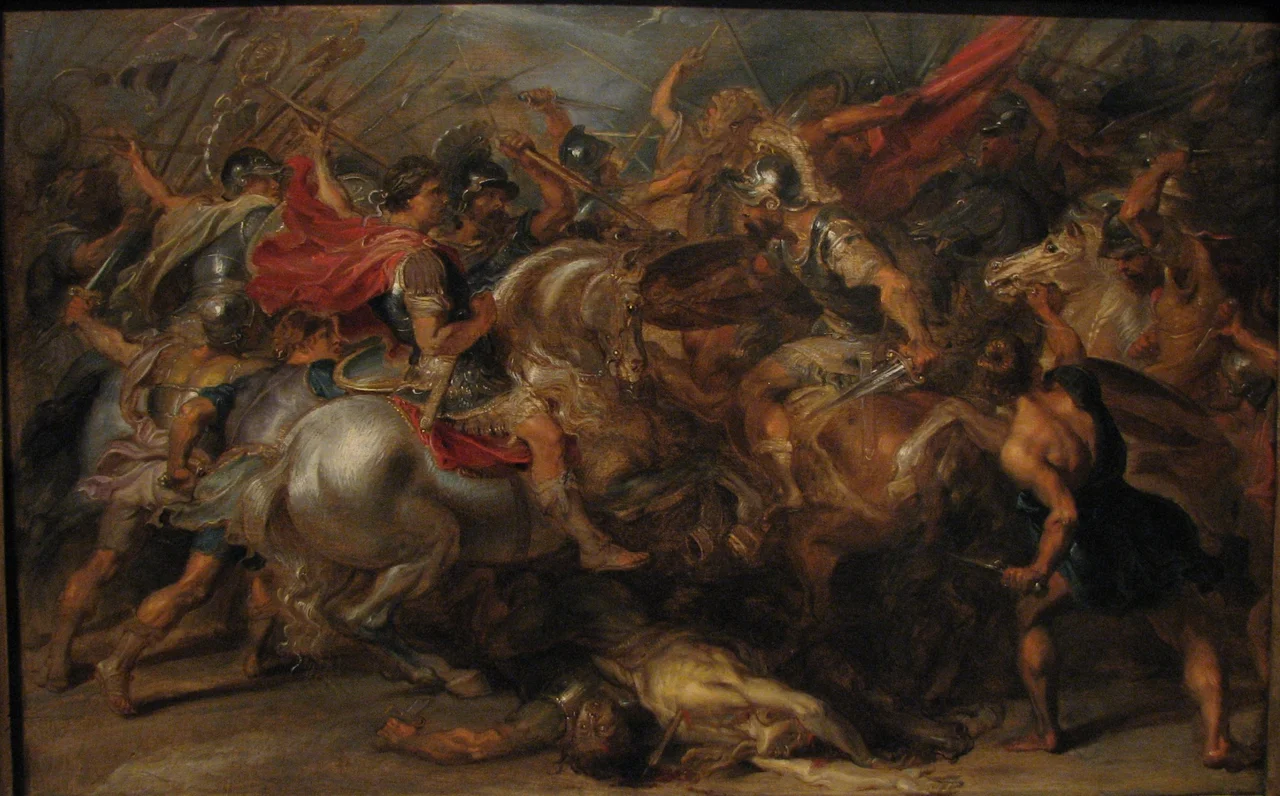

Battle of Chrysopolis
Two armies drew up their battle lines on the Asian shore of the Bosphorus on 18 September 324, and the difference between them was visible from a distance. Licinius displayed the traditional images of the pagan gods of Rome. Constantine advanced under the labarum — his personal Christian standard, a banner bearing the Chi-Rho symbol. Licinius had reportedly forbidden his troops from even looking at the labarum directly, so great was the superstitious dread it inspired in his camp. By the end of the day at Chrysopolis, that psychological asymmetry had become a military one.
A Civil War's Final Stage
The struggle between Constantine and Licinius was the last act of the Tetrarchy — the system of shared imperial rule that Diocletian had established to govern Rome's sprawling territories. By 324 it had collapsed into civil war. Licinius had already lost the Battle of Adrianople in the Balkans earlier that year. His fleet was then decisively defeated at the Battle of the Hellespont by Constantine's son Crispus, who commanded a significantly smaller force. These two defeats stripped Licinius of his land superiority and his naval power in one campaign season. He evacuated his garrison from Byzantium, gathered his surviving troops on the Asiatic shore at Chalcedon (modern Kadıköy), and summoned Visigothic auxiliaries under their commander Aliquaca, along with the forces of his newly appointed co-emperor Martinian, to rebuild his army. Whether Martinian's troops arrived before the battle is unclear.
Crossing Into Asia
Constantine did not wait for Licinius to reorganize. He had a flotilla of light transport vessels built quickly on the Bosphorus and used them to cross to the Asian shore, landing at a place ancient sources call the Sacred Promontory and marching south toward Chalcedon. Licinius, for his part, moved his army slightly northward to meet the threat near Chrysopolis — the settlement that stood on the site of modern Üsküdar. Constantine's forces arrived at the approaches to Chrysopolis before Licinius could secure the ground. Seeking divine guidance before the engagement, Constantine withdrew briefly to his tent. Then he gave the order to attack.
The Battle and Its Cost
Constantine launched a direct frontal assault. It worked. Licinius' army broke. The fifth-century historian Zosimus wrote simply: "There was great slaughter at Chrysopolis." Ancient sources give widely varying figures for the dead. The Anonymus Valesianus, a source that modern scholars regard as more reliable than Zosimus, records losses of around 25,000 men on Licinius' side — soldiers who died in the assault, the rout, and the pursuit that followed. Zosimus offered a figure of 100,000 casualties, which historians today consider grossly inflated. What is not in dispute is that this was a large-scale engagement, and that Licinius survived it only by fleeing north to his capital at Nicomedia with perhaps 30,000 survivors.
Surrender and Its Consequences
Recognizing that Nicomedia could not hold against Constantine's army, Licinius accepted the intercession of his wife Constantia — Constantine's own half-sister. He threw himself on his brother-in-law's mercy. Constantine initially granted it. Licinius was spared, his life guaranteed by what the historian Socrates Scholasticus later called a solemn oath. Months later, Constantine ordered his execution anyway, citing suspected treasonous contact with the Goths and pressure from the army's command. The younger Licinius — Constantine's nephew by marriage — was executed in 326 and had his name erased from official inscriptions, a punishment the Romans called damnatio memoriae. These were the private costs of Constantine's victory, paid in family blood as well as battlefield dead.
The City That Followed
Constantine became, at Chrysopolis, the first sole ruler of the Roman Empire since Diocletian had elevated Maximian to co-emperor in April 286 — nearly four decades earlier. He was now master of an empire stretching from Britain to Mesopotamia. What he did with that power, in the years that followed the battle, reshaped the physical world. He chose the Greek city of Byzantium, directly across the Bosphorus from the battlefield, as the site of a new eastern capital. He refounded it, expanded it, and gave it his own name: Constantinopolis. The city that grew there became the capital of the Eastern Roman Empire for over a thousand years. Its modern name is Istanbul, and it sits today on both shores of the strait where Chrysopolis once stood.
From the Air
The Battle of Chrysopolis was fought at approximately 41.015°N, 29.030°E, near the site of ancient Chrysopolis — now the Üsküdar district on Istanbul's Asian shore. From the air at 3,000–5,000 feet, the battle site lies on the broad coastal plain directly east of the Bosphorus strait, with the historic peninsulas of old Byzantium/Constantinople visible across the water to the west. The geography of the decisive crossing — from the European shore to the Asian shore — is immediately legible from altitude. The nearest airport on the Asian side is LTFJ (Sabiha Gökçen International Airport), approximately 25 km to the east. LTFM (Istanbul Airport) is on the European side, about 50 km to the northwest. The Bosphorus strait below is one of the busiest waterways in the world, easily identified by the constant passage of tankers and ferries.
Nearby Stories
- Kocaeli Peninsula 7.6 km away
- Second Battle of Çatalca 11 km away
- Istanbul's Rural Outskirts 14 km away
- MV Struma 20 km away
- HMAS AE2 36 km away
- Bursa 66 km away
- Sangarius Bridge 71 km away
- Januarius MacGahan 101 km away