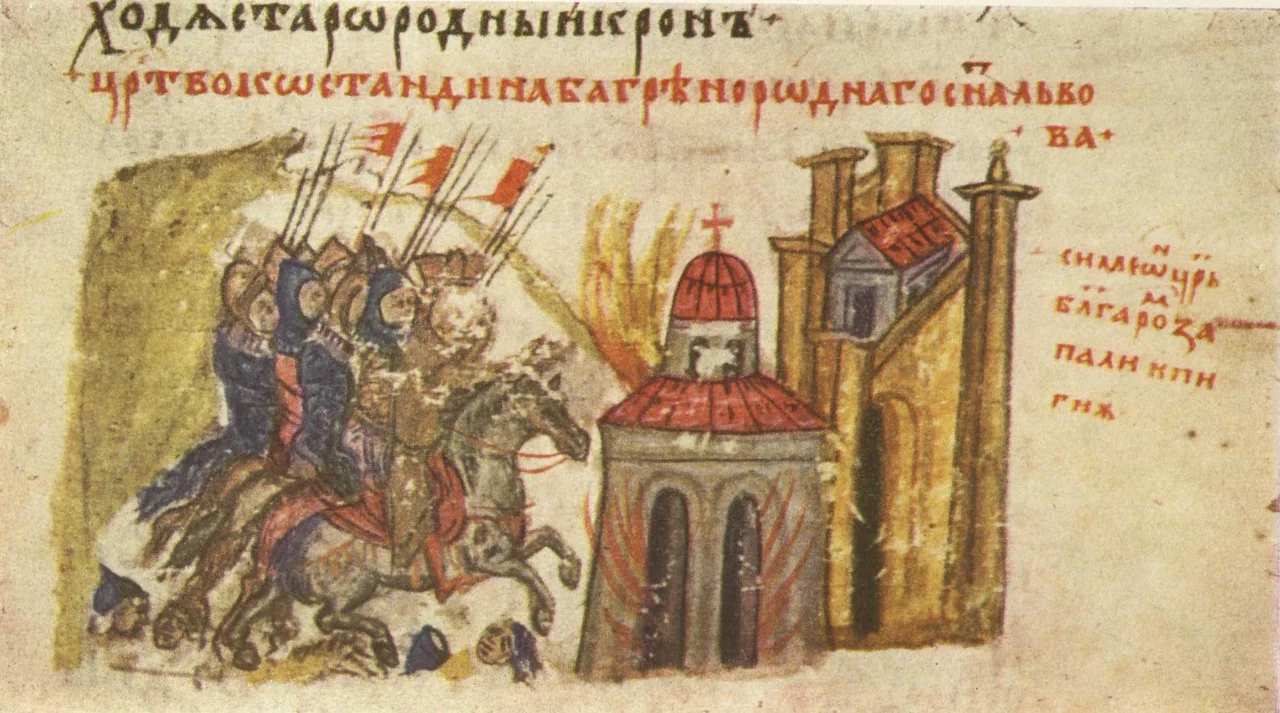

Battle of Pegae
The place took its name from a spring—Pegae in Greek, 'the fountain'—and its reputation from a church nearby dedicated to the Virgin Mary, whose waters were said to work miracles. By March 921, the spring and the church had become famous for a different reason: it was here, in the fields outside Constantinople's western walls, that the Byzantine Empire suffered another humiliating defeat at the hands of Bulgarian Tsar Simeon I, and where the commander sent to defend the holy city turned and fled before his men had even properly formed their lines.
The Ambitions of Simeon I
Simeon I of Bulgaria was not an ordinary conqueror. Raised in Constantinople and educated at the Magnaura School, he spoke Greek, read the church fathers, and understood Byzantine court politics from the inside. He had ruled Bulgaria since 893 and was pursuing something extraordinary: the imperial throne of Constantinople itself. His first approach was diplomatic—he sought to marry his daughter to the young emperor Constantine VII and thereby become basileopator, father-in-law and effective regent of the empire. That plan collapsed when Admiral Romanos Lekapenos outmaneuvered him, marrying his own daughter to Constantine VII in 919 and proclaiming himself senior emperor the following year. Simeon never accepted the legitimacy of that move. What diplomacy had failed to deliver, war would have to win.
A Campaign Without a Winner
The road to Pegae ran through four years of relentless Bulgarian campaigning. After the catastrophic Byzantine defeat at the Battle of Achelous in 917 and the follow-up rout at Katasyrtai the same autumn, Simeon's armies had ranged through Byzantine Thrace nearly unchallenged, reaching the walls of Constantinople and raiding as far south as the Isthmus of Corinth. In 921, the Bulgarian tsar sent a large force under commanders named Kaukanos and Menikos toward the capital while he himself led another army to besiege Adrianople, the most important city in Thrace. Emperor Romanos I responded by dispatching the Domestic of the Schools Pothos Argyros, his brother Leo Argyros, the admiral Alexios Mosele, and an official called John the Rhaiktor with the tagmata—the professional units of the imperial army—and the Hetaireia, the imperial guard itself.
The First Blow, and the Flight
The Bulgarian army that arrived at Pegae between March 11 and 18 did not negotiate. They charged with what the Byzantine sources call a dreadful battle cry, and their first strike broke the imperial lines. John the Rhaiktor fled immediately. Many of the soldiers who died at Pegae died not fighting the Bulgarians but covering their commander's retreat—killed protecting a man who had already decided to run. In the rout that followed, most of the Byzantine soldiers were cut down by sword, drowned as they tried to escape across water, or taken prisoner. It was a swift and total collapse. The men of the tagmata and the imperial guard—trained professionals who were supposed to be the finest soldiers in the empire—were destroyed in the fields beside a sacred spring, their deaths as swift and undignified as any in Byzantine history.
After the Spring
Pegae was not the end of Simeon's campaign; it was barely a pause. In 922 the Bulgarians captured Adrianople, which surrendered after a long siege. Another Bulgarian army engaged and defeated yet another Byzantine force near Constantinople. Simeon was attempting to arrange a joint assault on the city with the Fatimid Caliphate, a diplomatic maneuver that the Byzantines managed to uncover and counter—they intercepted the ship carrying Bulgarian and Fatimid envoys and outbid the alliance. Constantinople, protected by its triple walls and access to the sea, remained beyond Bulgarian reach as long as Simeon lacked a fleet capable of blockading it. He died in 927 without taking the city he had spent decades trying to claim. The spring at Pegae still rose from the earth, the church above it still stood. The soldiers who drowned and bled in those fields in March 921 were buried where they fell, in ground that has been Istanbul for more than five hundred years.
From the Air
Pegae was located near the western outskirts of Constantinople, in the area of modern Yedikule or Bakırköy along the Marmara coast of Istanbul. Coordinates: 41.01°N, 28.98°E. The Church of St. Mary of the Spring (Balıklı in Turkish) still exists in Istanbul's Zeytinburnu district, marking the general area of the battle site. Istanbul Airport (LTFM) lies approximately 20 km to the northwest. On approach from the west, the surviving segments of the Theodosian Walls—built in the early 5th century and still standing—are visible running north-south across the western peninsula, the same walls that Byzantine commanders desperately needed to keep between themselves and the Bulgarian army in 921.
Nearby Stories
- Kocaeli Peninsula 7.6 km away
- Second Battle of Çatalca 11 km away
- Istanbul's Rural Outskirts 14 km away
- MV Struma 20 km away
- HMAS AE2 36 km away
- Bursa 66 km away
- Sangarius Bridge 71 km away
- Januarius MacGahan 101 km away