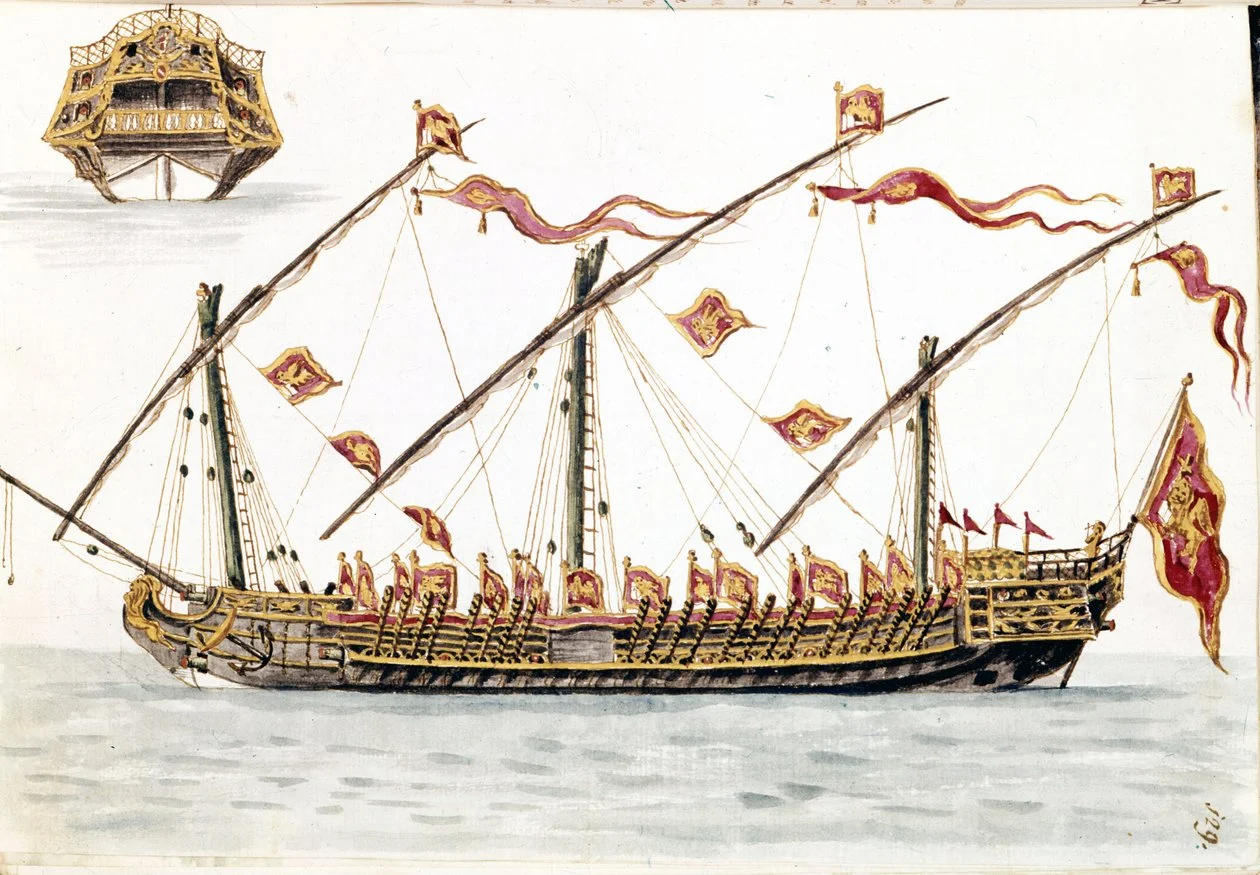

Battle of the Bosporus
The battle started with only two hours of daylight left, which should have been enough reason to wait. The Aragonese commander Santapau disagreed—he insisted on fighting. By the time the two fleets clashed in the narrows north of Galata, night had fallen, a storm was building, and roughly 150 ships from four different powers were tangled together in the dark, unable to tell ally from enemy. What followed on February 13, 1352, was not a decisive naval engagement so much as a catastrophe for everyone involved—and it determined who would control trade to the Black Sea for the next generation.
The Colony That Swallowed Its Host
By the mid-14th century, the Genoese merchant colony of Galata—just across the Golden Horn from Constantinople—had effectively become more powerful than the empire that tolerated it. A Byzantine historian named Nikephoros Gregoras recorded the numbers that made the relationship humiliating: in 1348, the customs revenues collected at Galata were 200,000 in standard currency, while those collected by Constantinople itself amounted to just 30,000. The Genoese had turned a commercial concession granted by the Treaty of Nymphaeum in 1261 into a stranglehold on Byzantine trade. When Emperor John VI Kantakouzenos tried to push back by rebuilding the imperial fleet, the Genoese captured those new ships and blockaded his own capital. They also controlled access through the Bosporus to the Black Sea, threatening to shut Venice out of the region's lucrative trade entirely. Venice responded by making alliances: with Byzantium in 1351, and with the Crown of Aragon, which agreed to contribute a fleet.
The Fleets Converge
The Genoese commander Paganino Doria had sailed from Genoa in July 1351 with sixty ships, each carrying 180 men. He was there to defend Galata and the Genoese position. The allied response under the Venetian admiral Niccolò Pisani was slower and plagued by setbacks—storms delayed the fleet, ships were lost en route, and Doria managed to blockade Pisani at the Venetian colony of Negroponte (modern Chalkis, in Greece) until an Aragonese fleet of forty galleys under Ponç de Santa Pau arrived to break the standoff. By early February 1352, Pisani's refloated squadron and the Aragonese had finally joined forces near the Princes' Islands, southeast of the Bosporus entrance. The allied fleet numbered 89 or 90 ships: 45 Venetian, 30 Aragonese, and 14 Byzantine. The Genoese had 60 to 64. By sheer numbers, the battle should not have been close.
Carnage in the Dark
Doria tried to engage the Aragonese and Venetians before they could link up with the Byzantines, but contrary winds stopped him. He withdrew north into the Bosporus, and the allied fleet followed. The two forces met in the narrow waters near Diplokionion—the district now known as Beşiktaş, on the European shore of Istanbul. The Byzantine ships, despite being part of the alliance that had brought this battle about, apparently never engaged; they fled before the fighting began. The storm intensified as night fell. Both sides tried to form battle lines and could not. In the confusion of darkness, crashing waves, and tangled rigging, sailors on opposing ships could not tell friend from enemy. Genoese galleys lost 16 ships. The Venetians and Aragonese lost 23, including admiral Pancrazio Giustinian. The Aragonese, fighting in waters they did not know, suffered disproportionately. When the allies finally withdrew, the Genoese—who had held the field, though barely—were the victors by the only measure that counted: they were still there.
The Price of Victory
The aftermath revealed how unclear victory had been. Franciscan friars attempted to arrange a prisoner exchange and found almost no one to exchange—the sea and the storm had taken most of the missing. Aragón's commander, Santapau, wrote to King Peter IV claiming to have captured 23 Genoese galleys. In reality, the battle was what it looked like: an atrocious draw fought in terrible conditions, claimed by both sides and decisive for neither. But strategically, the Genoese position held. Abandoned by their allies, the Byzantines had no choice but to settle. In a treaty signed on May 6, 1352, Emperor Kantakouzenos formally recognized Genoese possession of Galata, barred Venetian and Aragonese ships from his ports, and agreed to restrict his own merchants' trade without Genoese consent. The colony had won. Doria returned to Genoa in August—but the losses were so severe he received no honors for the campaign. The men who drowned in the Bosporus that February night were buried by the current, in the same cold water that had always divided Europe from Asia.
From the Air
The battle took place in the narrows of the Bosporus strait north of the Galata district, in the area now occupied by the Beşiktaş neighborhood of Istanbul. Coordinates: 41.05°N, 29.04°E. The strait here is roughly 700 meters wide—tight enough that a medieval fleet could easily lose track of position and alignment in the dark. From the air, the Bosporus Bridge (now the 15 July Martyrs Bridge) spans approximately this section of the strait. Istanbul Airport (LTFM) lies approximately 30 km to the northwest. Approaching from the Black Sea to the north, the dramatic narrowing of the strait as it passes through central Istanbul—with the old city visible to the south and the Galata Tower marking the site of the former Genoese colony on the northern bank of the Golden Horn—makes the strategic geography of the medieval War of the Straits immediately legible from altitude.
Nearby Stories
- Kocaeli Peninsula 7.6 km away
- Second Battle of Çatalca 11 km away
- Istanbul's Rural Outskirts 14 km away
- MV Struma 20 km away
- HMAS AE2 36 km away
- Bursa 66 km away
- Sangarius Bridge 71 km away
- Januarius MacGahan 101 km away