
Bayezid II Mosque, Istanbul
Pigeons have lived at the Bayezid Mosque for so long that Istanbullus gave it a name: Güvercin Camii, the Pigeon Mosque. They settle on the courtyard arcades, they roost in the galleries, they move through the spaces between the minarets in drifting clouds at dusk. The birds arrived on their own schedule and stayed. But the mosque itself was not an accident of history—it was a deliberate architectural statement, built on ground that had been a center of imperial power since ancient Rome, commissioned by a sultan determined to show that the Ottoman dynasty was the rightful successor to everything Constantinople had ever been.
Ground Beneath Ground
Beyazıt Square, where the mosque stands today, occupies the site of the Forum of Theodosius, built in the late fourth century by the Emperor Theodosius I as one of the great ceremonial spaces of Constantinople. The Romans had paved it, the Byzantines had built over it, the Ottomans had transformed it. When Bayezid II commissioned his mosque complex in 1500, the forum had been gone for centuries—but the ground still carried the memory of imperial presence. The mosque was erected on that ground deliberately, a new layer of sacred and political authority placed over layers that stretched back eleven hundred years. Columns and column bases from the Forum of Theodosius have been found beneath and around the square; some were reused in later Byzantine and Ottoman construction.
The Second Mosque and What It Meant
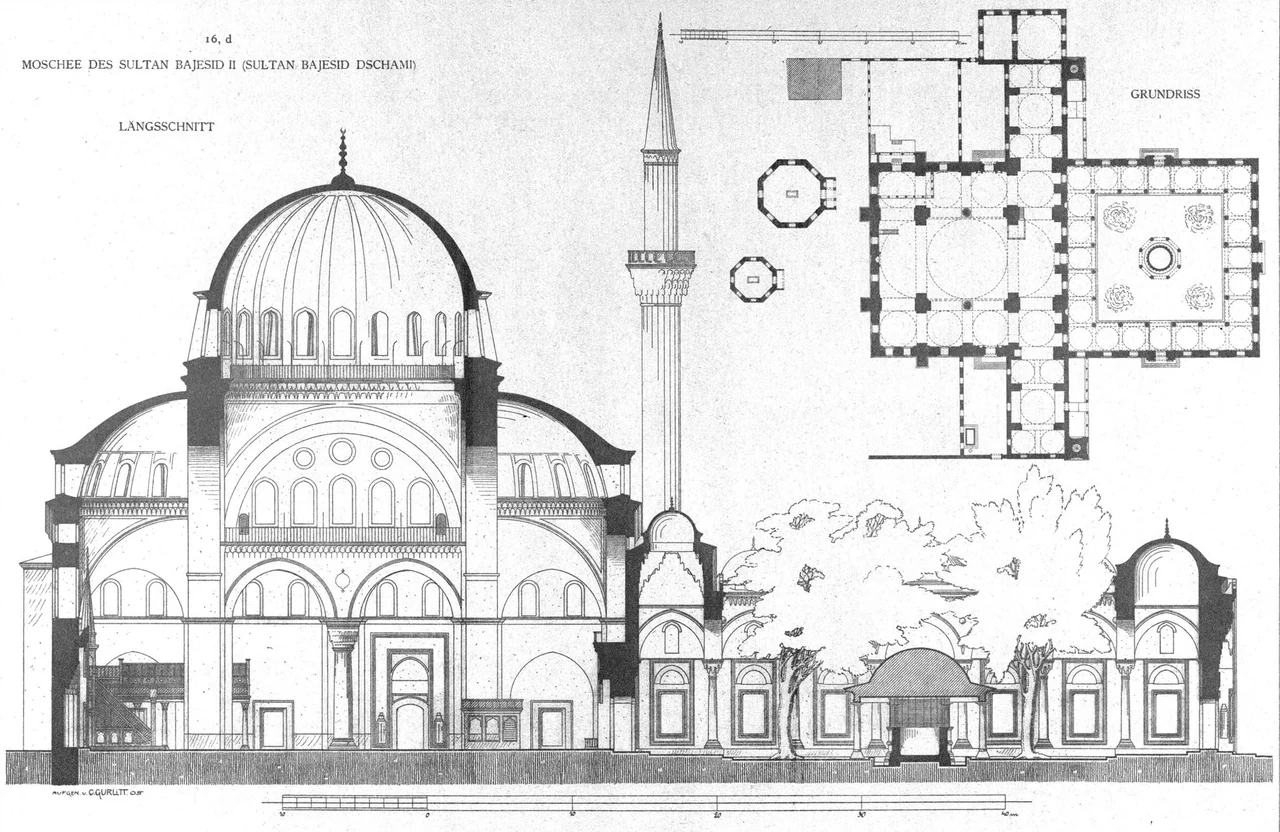
The Bayezid II Mosque was the second large imperial mosque complex built in Istanbul after the Ottoman conquest in 1453. The first was the Fatih Mosque, commissioned by Mehmed II, the conqueror himself. But the Fatih Mosque was later destroyed by earthquakes and completely rebuilt in the 18th century in a different style. That rebuilding erased its original architecture. The Bayezid complex, constructed between 1500 and 1506, has survived in more or less its original form—which means it stands today as the oldest intact example of the Ottoman imperial mosque tradition in the city. The chief architect is not definitively known, though 20th-century scholarship identified Yakubşah ibn Islamşah as the most likely candidate based on Ottoman documents. The mosque's design draws clearly on the geometry of Hagia Sophia, with a central dome flanked by two semi-domes on the main axis—an architectural gesture toward the great Byzantine church visible less than a kilometer to the east.
A City Within the City
The mosque was the center of a külliye—the Ottoman concept of an integrated charitable complex built around a mosque, providing services to the surrounding community. The Bayezid külliye included a medrese (theological college), completed in 1507; the large hamam (bathhouse) that still stands on Divanyolu Street, completed before 1507; an imaret (soup kitchen) that fed the poor; a caravanserai for travelers; and several mausolea, including the türbe of Bayezid II himself. These were not ornamental additions—they were functional institutions that served the population of the city. The imaret fed hundreds daily. The medrese trained scholars. The hamam provided hygiene and social life. Together, they created a self-sufficient neighborhood of piety and civic purpose, built to last and designed to earn the dynasty continued legitimacy through service.
The Sultan Who Built It
Bayezid II reigned from 1481 to 1512, and his rule was defined by consolidation rather than the dramatic expansion of his father Mehmed II. He fought his brother Cem for the throne, maintained a cautious foreign policy, welcomed Sephardic Jewish refugees expelled from Spain in 1492, and spent his reign deepening the administrative and cultural foundations of the empire his father had built. The mosque he commissioned reflects that temperament: monumental but measured, ambitious but not aggressive. He was deposed in 1512 by his own son Selim I, who forced him into retirement and may have had him poisoned. Bayezid II died in May 1512, weeks after leaving Constantinople for the last time. His türbe stands in the courtyard of the mosque he built, in the shadow of the domes that have outlasted every political reversal, every earthquake, every century of change that has remade the city around them.
From the Air
The Bayezid II Mosque stands on Beyazıt Square in the Fatih district of Istanbul's historic peninsula. Coordinates: 41.01°N, 28.97°E. The mosque's two minarets and central dome are clearly visible from the air as part of the dense skyline of the old city, located between the Grand Bazaar to the north and the Sea of Marmara to the south. Hagia Sophia and the Blue Mosque are approximately 600 meters to the east. Istanbul Airport (LTFM) is approximately 40 km to the northwest. On approach from the west over the Sea of Marmara, the entire historic peninsula is visible as a distinct landform—the Theodosian Walls forming its western edge, the Bosporus its eastern boundary, and the minarets of the imperial mosques rising from its hills in a sequence that spans five centuries of building.
Nearby Stories
- Kocaeli Peninsula 7.6 km away
- Second Battle of Çatalca 11 km away
- Istanbul's Rural Outskirts 14 km away
- MV Struma 20 km away
- HMAS AE2 36 km away
- Bursa 66 km away
- Sangarius Bridge 71 km away
- Januarius MacGahan 101 km away