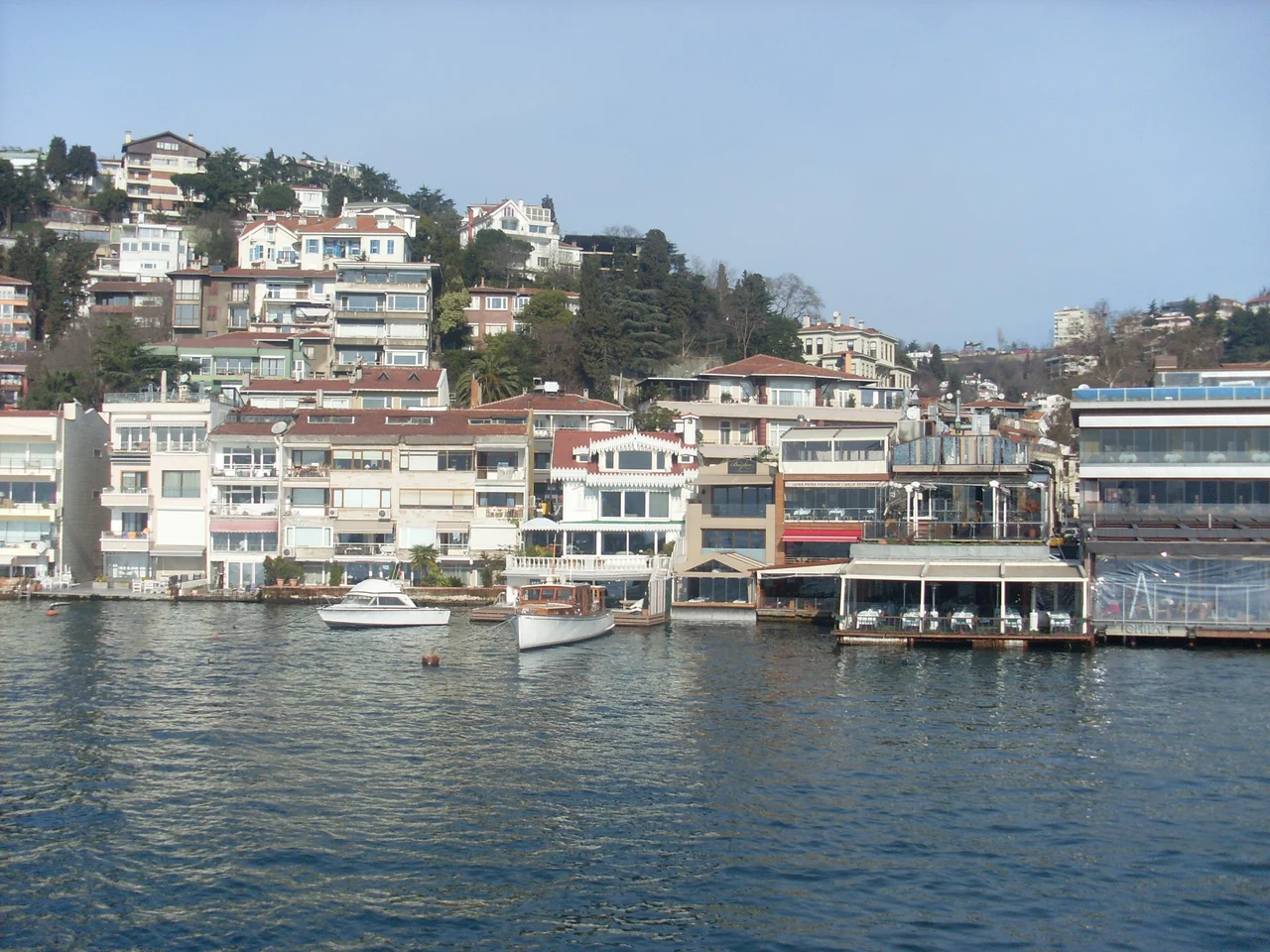

Bebek, Beşiktaş
The name might mean 'baby' in Turkish, or it might be a contraction of Boğaz'ın gözbebeği—'the apple of the Bosphorus's eye.' Either way, Bebek has spent several centuries earning the compliment. Tucked into a sheltered bay on the European shore of the Bosphorus, this small neighbourhood of Beşiktaş has the particular quality of places that have always known they were beautiful and have never had to advertise the fact.
The Apple of the Bosphorus's Eye
Bebek's origins as a settlement likely trace to the Ottoman period following the conquest of Constantinople in 1453. One tradition holds that the name honours Mustafa Çelebi, a local administrator appointed in the years after the conquest, whose nickname stuck to the land. Another interpretation points simply to the Turkish word for 'pretty as a baby.' The third—and perhaps most evocative—derives the name from gözbebeği, the pupil of the eye, as though the Bosphorus itself regarded this particular curve of shore as its most precious point of focus. What is not disputed is that Bebek Bay, sheltered from the strait's stronger currents and facing the hillsides of the Asian shore, drew the wealthy and well-connected throughout the Ottoman centuries. Wooden mansions rose on the waterfront. Greek, Armenian, Jewish, and Turkish families built summer homes in the heights above the bay. The neighbourhood became what it remains: a place of significant beauty and significant money.
Royal Summers and a Consulate on the Water
The most imposing building on Bebek's waterfront is not a mosque or a palace but a mansion that houses the Egyptian Consulate. Built between 1899 and 1901 for Emina Ilhamy—known as Emine Hanım—it was commissioned by the mother of Abbas Hilmi, the last Khedive of Egypt. The construction date tells a story: Egypt was then nominally autonomous within the Ottoman sphere, and its aristocracy maintained a presence in Istanbul, summering on the Bosphorus in the manner of any cosmopolitan elite. The mansion they built is grand in the way that late nineteenth-century waterfront architecture aspired to be, its facade looking out over the bay. That it became a consulate rather than a ruin or a hotel is, in the context of Istanbul's turbulent twentieth century, something close to good fortune. The bay it overlooks has changed in scale and style—cafés line the waterfront now, and small boats crowd the harbour—but the mansion anchors the view.
A College Founded at the Edge of Empire
In 1863, an American philanthropist named Christopher Robert and a Congregationalist missionary named Cyrus Hamlin established a college on the heights above Bebek Bay. Robert College, as it was called, became the first American institution of higher education founded outside the United States—a fact that tends to surprise people. For over a century it educated young men from across the Ottoman Empire and its successor states, operating continuously through wars, the empire's collapse, and the founding of the Turkish Republic. In 1971, the Turkish government assumed control of the institution and reconstituted it as Boğaziçi University—Bosphorus University—one of Turkey's most selective and internationally connected public universities. The campus occupies the wooded hillside above Bebek, with views of the strait from its upper grounds. Students moving between lectures and the waterfront cafés below have one of the more improbable commutes in higher education.
Old Wood and the Passage of Time
The Kavafyan Mansion on Bebek's streets is said to date to 1751, making it one of the oldest surviving wooden structures in Istanbul—a city that has lost an enormous proportion of its historic timber buildings to fire, demolition, and neglect. Built for Armenian shipbuilders, the three-storey, thirteen-room building has outlasted the community that constructed it and many of the houses that once surrounded it. It has not outlasted everything: the mansion has fallen into decay, its survival uncertain. The small Bebek Mosque nearby offers a more intact piece of the neighbourhood's architectural history. Designed in 1912 by Mimar Kemaleddin—one of the architects who shaped late Ottoman Istanbul—it sits modestly on its site, elegant rather than monumental. Neither building announces itself; you have to be looking.
Life on the Bay
Contemporary Bebek is a neighbourhood of cafés, boutiques, and the kind of quiet affluence that doesn't need to perform itself. On weekend mornings the waterfront path fills with people—residents walking dogs, students from Boğaziçi on their way to the water, visitors who have made the trip from the city centre to see what a Bosphorus neighbourhood actually looks like at ground level. The view across the strait to the Asian hills changes with the light: grey and industrial in winter mist, brilliantly blue in summer, improbable in the long Bosphorus sunsets when the water turns copper. The ferries and container ships that pass are enormous up close—the strait is narrow enough here that you can hear their engines. Bebek's population is small, around 5,400 people by recent count, but its gravitational pull on the city's imagination is considerably larger. Some neighbourhoods are famous for what happened in them. Bebek is famous for what it is.
From the Air
Bebek sits at approximately 41.081°N, 29.044°E, on the European shore of the Bosphorus about 10 kilometers north of the Bosphorus Bridge. At 2,000 feet, the bay's distinctive curved shoreline and the wooded hillside campus of Boğaziçi University are clearly visible. The Rumelihisarı fortress—built by Sultan Mehmed II in 1452—stands about 1 kilometer north. Approaching from the west, the Bosphorus strait aligns north-to-south and the contrast between the European and Asian shorelines is dramatic. Istanbul Airport (LTFM) lies approximately 30 kilometers to the northwest; Sabiha Gökçen Airport (LTFJ) is about 40 kilometers to the southeast on the Asian side.
Nearby Stories
- Kocaeli Peninsula 7.6 km away
- Second Battle of Çatalca 11 km away
- Istanbul's Rural Outskirts 14 km away
- MV Struma 20 km away
- HMAS AE2 36 km away
- Bursa 66 km away
- Sangarius Bridge 71 km away
- Januarius MacGahan 101 km away