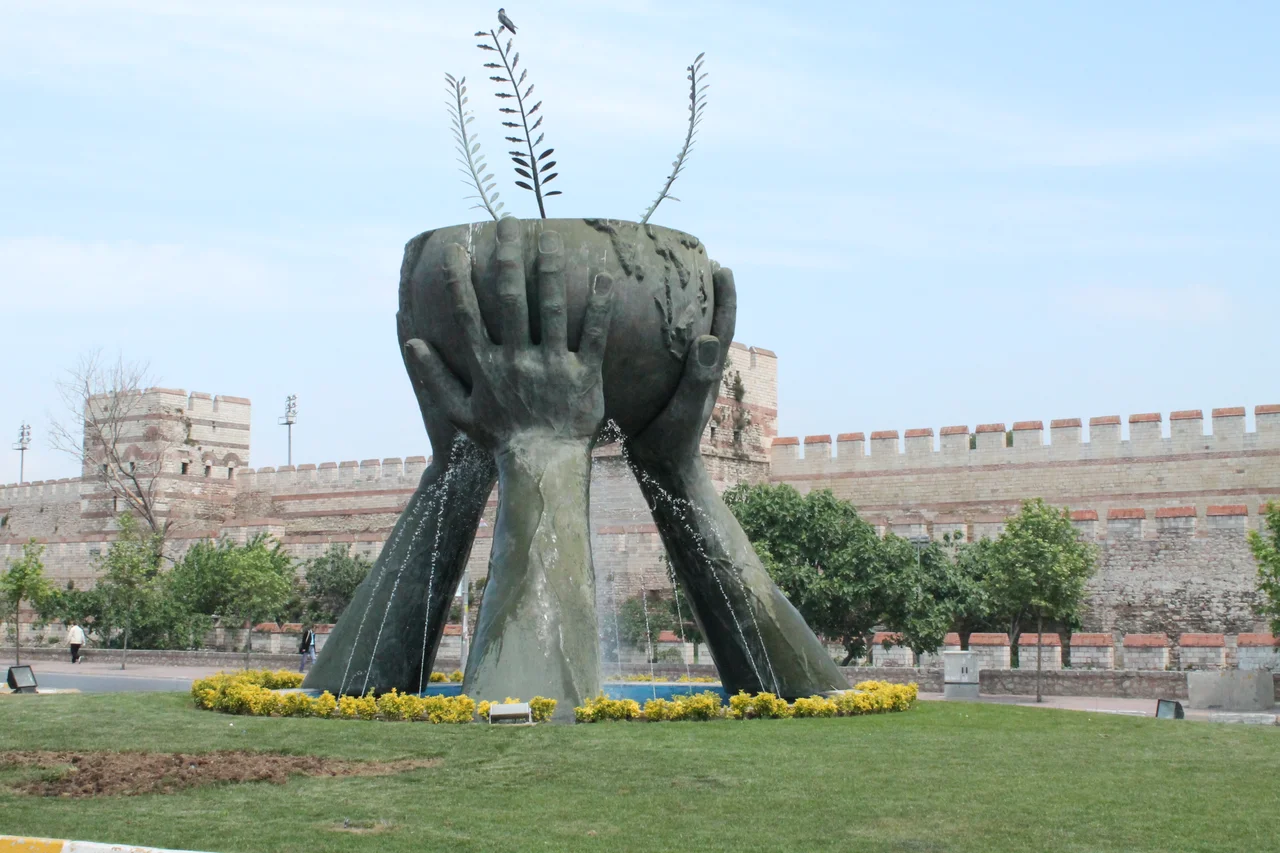

Belgradkapı
When Sultan Suleiman the Magnificent took Belgrade in 1521, he did not simply add a city to his empire. He transplanted it. Entire populations were uprooted from the Serbian capital and resettled across Constantinople, according to the Ottoman practice of sürgün—forced resettlement used to repopulate and reshape newly acquired territories. The gate through which some of those relocated people passed took the name of the city they had left. Five hundred years later, that gate still stands in the Theodosian walls, and the neighbourhood around it still carries the name Belgrade into the present.
A Conqueror's Geography
Suleiman's capture of Belgrade in 1521 was strategically decisive—it removed the key fortress blocking Ottoman expansion into Central Europe. But the sultan's method of consolidating conquered territories involved human engineering as much as military force. Populations from newly taken cities were systematically relocated to Constantinople, where their labour, skills, and numbers could serve imperial purposes. The Belgraders brought to Istanbul were settled in multiple locations: one group gave its name to the Belgrade Forest north of the city, another to the area around the gate in the land walls. Belgradkapı—Belgrade Gate—thus marked both a physical passage through the Theodosian fortifications and a place of memory for a displaced community. The gate itself is part of the great defensive walls built under the Byzantine emperor Theodosius II in the fifth century, walls that have been continuously present in Istanbul's landscape for over 1,600 years.
The Gate and the Walls
Belgradkapı sits in the Zeytinburnu district of western Istanbul, on both sides of the Belgrade Gate at the point where the Theodosian land walls approach the Sea of Marmara. These walls—stretching roughly six kilometres from the Golden Horn to the Marmara—are among the best-preserved examples of late Roman military architecture in the world. The Belgrade Gate is one of several lesser gates in the outer defensive circuit, less celebrated than the Golden Gate nearby but equally ancient. The neighbourhood that surrounds it is not a tourist district; it is an ordinary Istanbul quarter, the sort of place where the ancient and the modern coexist without either making a spectacle of itself. Restored sections of wall stand beside apartment buildings. The gate is there to be seen, but you have to be looking for it.
The Church with Disputed Icons
The quarter's most historically layered structure is the Church of Theotokos Belgradkapı, a small Greek Orthodox church that tells a story of overlapping communities and contested origins. The building—low, built of stone, with neither dome nor bell tower, its facade obscured by a surrounding wall—was designed by Greek architect Hadji Nikolaos and constructed by Greek masons. But its history is more tangled than its modest appearance suggests. Some historians argued that the church's ktetor, its founding patron, was also from Belgrade—pointing to Slavic Cyrillic inscriptions on the walls as evidence. Later research determined that the inscriptions dated to 1837 and were carved by a master named Siljan from Vrben, near Debar in what is now North Macedonia. The Debar craftsmen were among the most sought-after decorators of Orthodox churches across the Balkans in that era.
Icons, Scholarship, and Loss
The question of the church's icons consumed nineteenth- and twentieth-century scholars. The Serbian historian Stojan Novaković, who studied the lives of Belgrade descendants in Istanbul, believed that the church's icons originated from the Metropolitanate of Belgrade—carried from the Serbian capital when the population was relocated in 1521. The icons bore a date of 1539, which Novaković thought had been added later. In 1953, the architect Aleksandar Deroko surveyed the church and examined the icons. He found he could not confirm that they predated 1521 based on their style, and he noted a logical problem: if the icons had been brought from Belgrade, why would new ones have been needed only eighteen years after the relocation? Deroko, unable to resolve the question definitively, at least photographed the interior. Two years later, in 1955, the church was attacked during the Istanbul pogrom—a wave of organized violence targeting Istanbul's Greek, Armenian, and Jewish communities. The rioting mob broke in, set the building on fire, and destroyed the iconostasis, the icons, and all the relics. The photographs Deroko had taken were the last record. The church was slowly rebuilt over the following decade.
Memory in Mortar
Belgradkapı today is a quiet quarter where history accumulates without fanfare. The walls of Theodosius still stand. The Belgrade Gate still marks a passage through them. The church—rebuilt after 1955, bearing new icons in place of those destroyed—continues to hold services for a small congregation. The displaced Belgraders of 1521 left almost no direct traces in personal record; what remains is geographic naming, an architectural inheritance, and the ongoing scholarship that tries to reconstruct who they were and what they brought with them. In a city as layered as Istanbul, this is not unusual. Every gate has a story; every neighbourhood name encodes a history that the street itself no longer necessarily makes visible.
From the Air
Belgradkapı lies at approximately 41.000°N, 28.920°E, in the Zeytinburnu district near the southern end of the Theodosian land walls. At 2,000 feet, the long linear trace of the ancient walls is clearly visible running north to south, with the Sea of Marmara appearing at the southern end. The Golden Gate—once the triumphal entrance to Constantinople—stands about 600 meters to the southwest. Istanbul Airport (LTFM) is approximately 30 kilometers to the northwest. Flying along the Marmara coast from the west, the walls come into view as a continuous medieval earthwork threading through the modern city fabric.
Nearby Stories
- Kocaeli Peninsula 7.6 km away
- Second Battle of Çatalca 11 km away
- Istanbul's Rural Outskirts 14 km away
- MV Struma 20 km away
- HMAS AE2 36 km away
- Bursa 66 km away
- Sangarius Bridge 71 km away
- Januarius MacGahan 101 km away