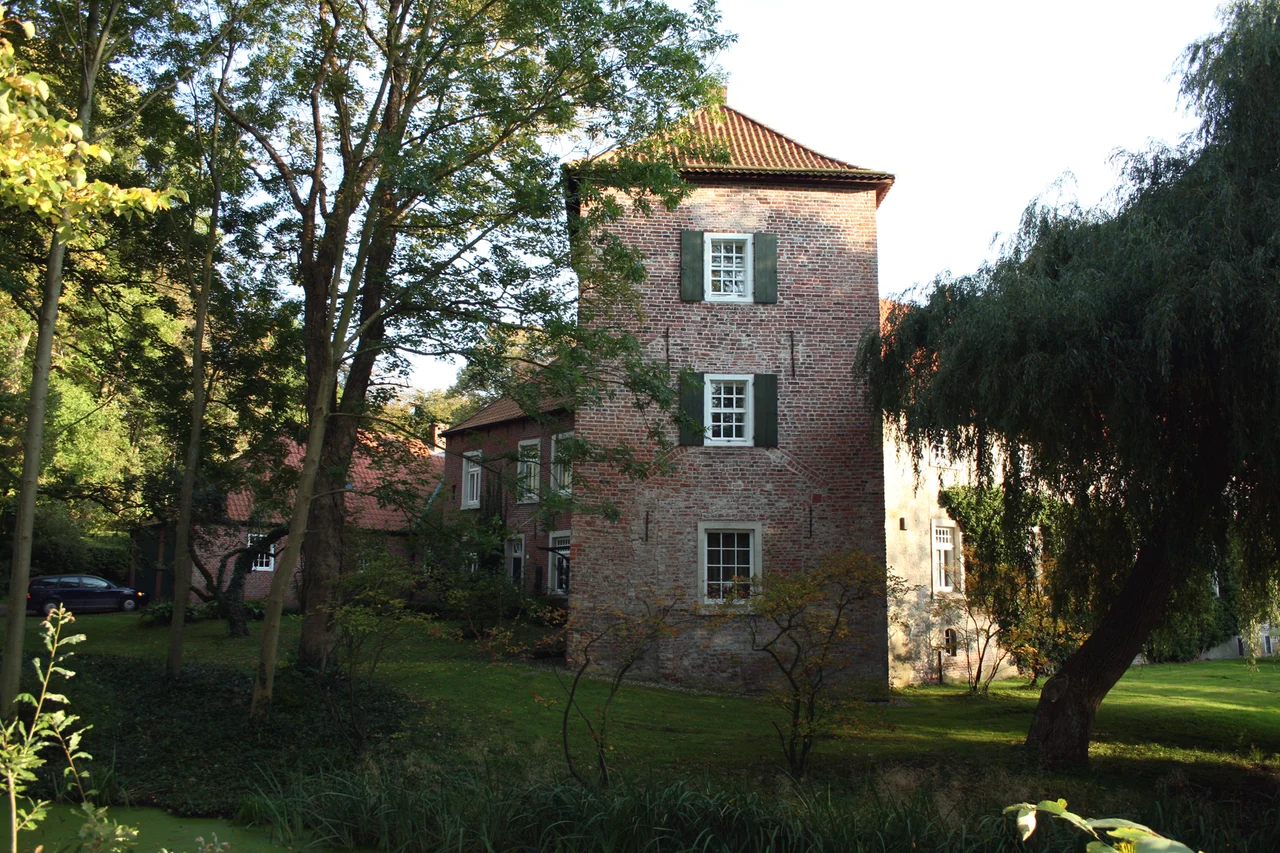

Berum Castle
On 17 April 1628, a 26-year-old count and a lieutenant of the imperial army got into an argument at Berum Castle. We do not know the cause - some quarrel about quarters, perhaps, or rations, or a slighted honor. What we know is that the lieutenant's blade went into Count Rudolph Christian's left eye, and that within hours East Frisia had lost its ruler. The army had been billeted in the castle as guests. That detail matters: the dynasty died in its own dining hall.
From Chieftain's Seat to Cirksena Stronghold
Berum Castle first surfaces in the historical record in 1310, already standing, already serving as the seat of a chieftain of the Norden area named Syrtza or Sytze. Nobody knows exactly when it was built, or how long the Syrtza family had been there before the document referred to them in passing. By the 15th century the castle had passed through inheritance to the Cirksena family - the dynasty that would consolidate East Frisia into a county and rule it for three centuries. In 1443 Count Ulrich I rebuilt the place as a three-winged château with a front castle bolted on. Two years later, on 1 June 1445, he held his wedding here. The bride was Theda Ukena, granddaughter of Focko Ukena - the very man Ulrich had fought a war against. The marriage was a peace treaty written in flesh.
Renaissance Walls, a Swedish Princess
In the late 16th century Count Edzard II decided the medieval pile needed updating. He pushed the walls outward, dug new moats, and finished the renovation in 1591 with a spire stabbing up over the East Frisian flatland. After his death, his widow took over the project. Catherine Vasa of Sweden was a daughter of King Gustav I - the man who had founded modern Sweden as an independent kingdom - and she had grown up in a kind of grandeur that made the Cirksena efforts look provincial. Catherine extended the castle further, added a chapel, and established a tradition that would last more than a century: Berum became the dower house of the dynasty, the place where Cirksena widows retired in comfort and authority.
A Treaty and a Tragedy
On 28 January 1600 the Treaty of Berum was signed inside these walls, and East Frisia bought the Lordships of Esens, Stedesdorf and Wittmund from the County of Rietberg - a real-estate transaction that completed the county's territorial shape. Twenty-eight years later, the Thirty Years' War rolled through. Imperial general Matthias Gallas billeted his troops in the castle, and the argument that killed Count Rudolph Christian erupted. Officially it was an accident. Practically, it was the kind of accident that happens when a small dynasty hosts an army that does not particularly respect it. Later in the century, between 1690 and 1699, the widowed Princess Christine Charlotte renovated everything again. Contemporary chroniclers called the result one of the most magnificent princely palaces in Germany.
What Prussia Left Standing
Prussia took over East Frisia in 1744, and Prussia had no use for a widow's residence in the marsh. The castle decayed. In 1764 the main building was knocked down and its furniture auctioned off. What survives today is the front castle - a long brick range attached to the defensive wall - a brick gate tower, and the Baroque gate passage, flanked by columns whose pediments still carry Princess Christine Charlotte's coat of arms. The exterior wall and the outer moat remain, and the remains of a 1712 Baroque garden lie to the south. The whole compound is privately owned now and runs as a guesthouse. In 2006, German Federal President Horst Köhler spent his summer vacation here. Six centuries of counts, queens, treaties and tragedies, and now you can book a room.
From the Air
Located at 53.60°N, 7.30°E in the Berum district of Hage, East Frisia. The surviving brick gatehouse and front range are visible from low altitude, set among the flat farmland north of Aurich. Nearest airfield: Norden-Norddeich (EDWS) about 8 km to the west. Best viewed from 1,500-3,000 ft on clear days, with the rectangular outline of the old moat still legible in the surrounding ground.
Nearby Stories
- SM U-30 3 km away
- Lewenborg 4.4 km away
- Wittmund (district) 6.2 km away
- Rheiderland 6.9 km away
- Wangerooge Island Railway 9.3 km away
- Bad Zwischenahn 20 km away
- Alpha Ventus Offshore Wind Farm 25 km away
- HVDC DolWin2 28 km away