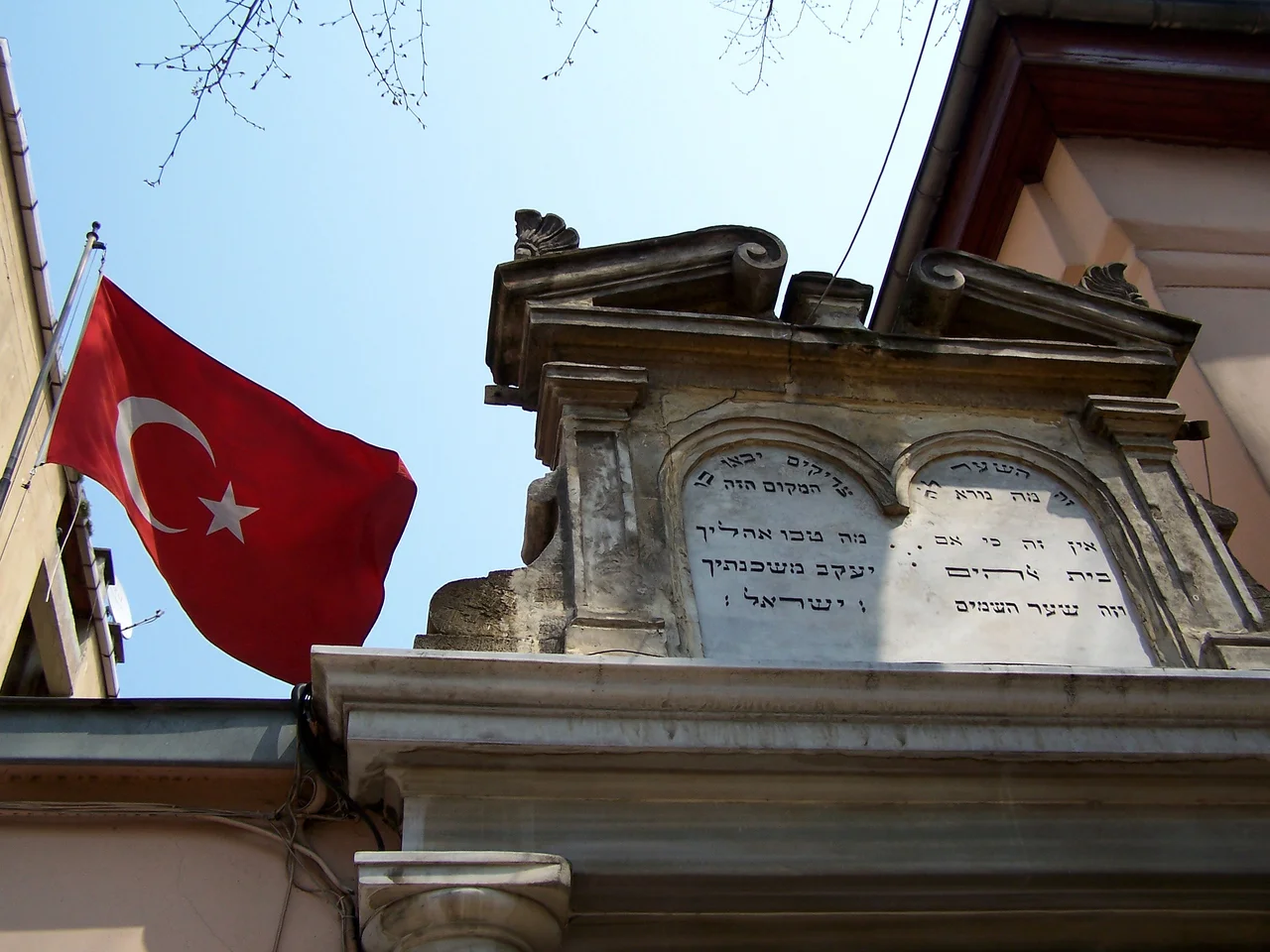

Bet Yaakov Synagogue
On Icadiye Street in Kuzguncuk, on the Asian side of the Bosphorus, there is a synagogue that opens its doors on Shabbat for a congregation whose members mostly live elsewhere. They come back because Kuzguncuk is where their families came from—where Sephardic Jews settled, built a community, and prayed together for generations before dispersing across Istanbul and beyond. The Bet Yaakov Synagogue holds the space they left, and on Saturday mornings, some of them still return.
Where the Sephardim Settled
Kuzguncuk sits on the Asian shore of the Bosphorus, a neighbourhood of painted wooden houses and plane-tree-shaded streets that is often described as one of the most picturesque in Istanbul. Its Jewish history is old. A tombstone in the neighbourhood dates Jewish presence in Kuzguncuk to 1562—roughly seventy years after the expulsion of the Jews from Spain in 1492, when Sultan Bayezid II opened Ottoman lands to the exiled Sephardim. The Kuzguncuk neighbourhood was among the first places where the Ottoman authorities settled these new arrivals. Over the following centuries, the community grew and built institutions: schools, charitable organizations, and synagogues. At its height, Kuzguncuk's Jewish population was large enough to support multiple houses of worship.
A Synagogue with Two Histories
The date most commonly associated with the Bet Yaakov Synagogue is 1878—when, by the accepted account, the building was constructed. But the record is more complicated than a single date suggests. Research has uncovered documentation showing that as early as 1862, the Ottoman Sultan granted permission for the synagogue's renovation. Renovation implies a pre-existing structure: the building may be older than 1878, the earlier date marking a repair or rebuilding rather than an original construction. The synagogue is known by several names. To the formal record it is Bet Yaakov—House of Jacob. To local memory it is also Kehilla Santral, the Central Synagogue, and Kal de Abaşo—the Lower Synagogue in Ladino, the Judeo-Spanish language carried from the Iberian Peninsula and spoken by Istanbul's Sephardic communities for centuries. These multiple names are themselves a kind of history: they mark the layers of community, language, and institutional life that accumulated here.
Inside the Sanctuary
The interior of the Bet Yaakov Synagogue contains what visitors describe as a remarkable mural depicting the geography of the Land of Israel—said to have been created by a Persian calligrapher. Whether this attribution is precisely accurate, the mural is unusual for an Ashkenazi or Sephardic house of prayer, and it speaks to the particular cultural mixing that characterized Ottoman Jewish communities, which drew from Persian, Turkish, Arabic, and Spanish intellectual traditions alongside Hebrew religious scholarship. The wooden Torah ark—the cabinet that holds the Torah scrolls—was restored and preserves the ornamental carving of the period in which it was built. The synagogue was also painstakingly restored in recent decades, returning it to something like what its oldest surviving congregants remember from their childhoods.
A Community in Diaspora
The Jewish community of Kuzguncuk declined significantly over the course of the twentieth century. The pressures were multiple: the 1942 Varlık Vergisi, a discriminatory wealth tax that fell disproportionately on non-Muslim minorities and forced many families to liquidate assets or emigrate; the violence of the 1955 Istanbul pogrom, which targeted Jewish, Greek, and Armenian properties across the city; and the broader demographic shifts that came with emigration to Israel, Europe, and the Americas in the post-war decades. By the end of the century, few Jewish families remained in Kuzguncuk itself. The synagogue remained, maintained by a foundation established for that purpose. The congregants who gather for Shabbat services are often the grandchildren or great-grandchildren of families who lived on these streets, returning not only to pray but to sustain a connection to a place that shaped them, even if they themselves grew up somewhere else.
What Kuzguncuk Holds
Kuzguncuk today is home to two synagogues: Bet Yaakov and the nearby Bet Nissim on Yakup Street. Together they represent what remains of a Jewish communal infrastructure that once served thousands. The neighbourhood itself has changed considerably, but it retains a reputation for historical diversity—Greek Orthodox, Armenian, Muslim, and Jewish communities lived here in proximity for generations, and evidence of that coexistence is still visible in the architecture. Walking Icadiye Street today, you pass houses of prayer belonging to different traditions within the same few blocks. The Bet Yaakov Synagogue, on Shabbat mornings, adds to that texture. The congregation is small. The building is well maintained. The families who come are keeping something alive that would be easy to let go.
From the Air
The Bet Yaakov Synagogue sits at approximately 41.036°N, 29.030°E in Kuzguncuk on the Asian shore of the Bosphorus, roughly 5 kilometers north of the first Bosphorus Bridge. At 2,000 feet, the neighbourhood is visible as a wedge of lower-rise buildings between the Bosphorus waterfront and the wooded hillside of Çamlıca rising behind it. Directly across the strait, the European shore of Beşiktaş is clearly visible—the crossing is less than a kilometre wide at this point. Istanbul Airport (LTFM) is approximately 40 kilometers to the northwest; Sabiha Gökçen Airport (LTFJ) lies about 20 kilometers to the southeast.
Nearby Stories
- Kocaeli Peninsula 7.6 km away
- Second Battle of Çatalca 11 km away
- Istanbul's Rural Outskirts 14 km away
- MV Struma 20 km away
- HMAS AE2 36 km away
- Bursa 66 km away
- Sangarius Bridge 71 km away
- Januarius MacGahan 101 km away