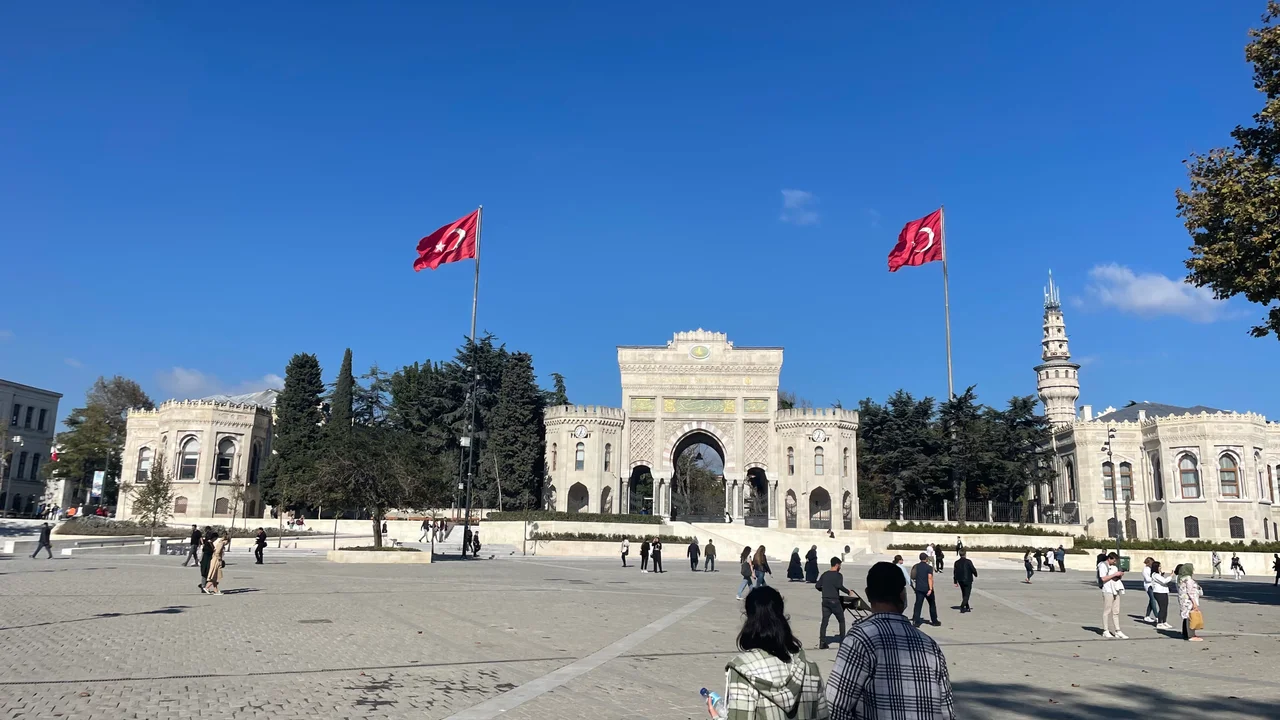

Beyazıt Square
The square has been called Freedom Square since 1926, but almost no one uses that name. Everyone calls it Beyazıt, after the mosque that anchors its western edge — and that quiet insistence on an older identity tells you something about this place. Beyazıt Square has been at the center of Istanbul's public life for more than sixteen centuries, outlasting empires, changing names, absorbing moments of grandeur and grief with the even patience of stone.
Ruins Beneath the Pavement
Long before the Ottomans arrived, this ground was the Forum of Theodosius — one of the great public squares of the late Roman world, also known as the Forum Tauri. It was begun by Constantine the Great and expanded under Emperor Theodosius I in the late 4th century, filling with columns, triumphal arches, and the bustle of a capital city. Almost nothing of that forum survives above ground; the traces lie buried beneath the square's current paving. But the site's importance was never forgotten. When the Ottoman sultans chose where to build their mosque and university complex in the early 16th century, they chose here — on the same ground, in the same central position, because powerful cities rarely abandon their axes.
The Mosque and Its Medrese
The Bayezid II Mosque, completed around 1506, anchors the western side of the square with quiet authority. It was one of the first great imperial mosques of the Ottoman period in Istanbul — a deliberate architectural statement by Sultan Bayezid II that Ottoman Constantinople was now a world capital in its own right. Facing it across the plaza is the mosque's medrese, which served for many years as the Museum of Calligraphy. In 2022 it was still under restoration after years of closure. The mosque's courtyard, with its ablution fountain and shaded portico, offers a respite from the noise of the square beyond — a moment of stillness purchased by the architecture.
The University Gate and the Tower Above
On the opposite side of the square, Istanbul University's main entrance presents itself through a monumental Neo-Renaissance arch — designed by the French architect Marie-Auguste Antoine Bourgeois and unmistakably 19th-century in its ambitions. Through that gate, visible above the rooflines, rises the Beyazıt Tower: a fire-watch tower built in the early 19th century, its red and white banded stone a familiar element of the Istanbul skyline. Between the gate and the mosque stands the Beyazıt State Library, founded in 1884 and thoroughly renovated in 2006 by the Tabanlıoğlu architectural firm. During that renovation, workers uncovered the remains of a Byzantine church beneath the building — one more layer in a site that seems to have a new floor every time anyone digs.
A Stage for History
Beyazıt Square has never been a neutral space. It has absorbed the full weight of Istanbul's modern history, including its most painful episodes. In 1915, twenty Armenian activists were hanged there in what became known as the 20 Hunchakian gallows. In 1969, political protests ended in bloodshed in events called Bloody Sunday. In 1978, a bomb and gun attack killed seven students leaving Istanbul University — the Beyazıt massacre. The square's official name, Freedom Square, sits against that history with an irony the city has never quite resolved. These events are not hidden; they are simply part of what the place holds.
Renewed but Still Itself
In 2021, the city approved a comprehensive urban redesign by architects Ali Kural and Deniz Çalış Kural. Implementation began in July 2021, and in October 2022, Mayor Ekrem İmamoğlu opened the redesigned square to the public. The project extended pedestrian space, improved accessibility to universal standards, added new seating terraces and two coffee houses, and introduced a rethought lighting scheme for evenings. Existing trees were preserved; new plantings joined them. The tram line — which connects Beyazıt to the adjacent Grand Bazaar and the broader Fatih district — kept running through it all. The square feels lighter now, more deliberately public. But stand in it long enough, watching the pigeons and the students and the tourists, and you feel the weight of sixteen centuries pressing up through the pavement.
From the Air
Beyazıt Square sits at approximately 41.011°N, 28.968°E on Istanbul's European side, in the Fatih district. From the air, it is identifiable by the dome and two minarets of the Bayezid II Mosque immediately to the west, and the open expanse of the plaza itself. The Beyazıt Tower — red and white striped, rising from the university grounds — provides a useful visual reference at low altitude. The Grand Bazaar is directly adjacent to the east. Nearest major airport is Istanbul Airport (LTFM), roughly 35 km to the northwest. Approach from the northwest along the Marmara coast gives a clear view of the historic peninsula, with Beyazıt visible as a cluster of Ottoman domes about halfway between the shoreline and the old city walls.
Nearby Stories
- Kocaeli Peninsula 7.6 km away
- Second Battle of Çatalca 11 km away
- Istanbul's Rural Outskirts 14 km away
- MV Struma 20 km away
- HMAS AE2 36 km away
- Bursa 66 km away
- Sangarius Bridge 71 km away
- Januarius MacGahan 101 km away