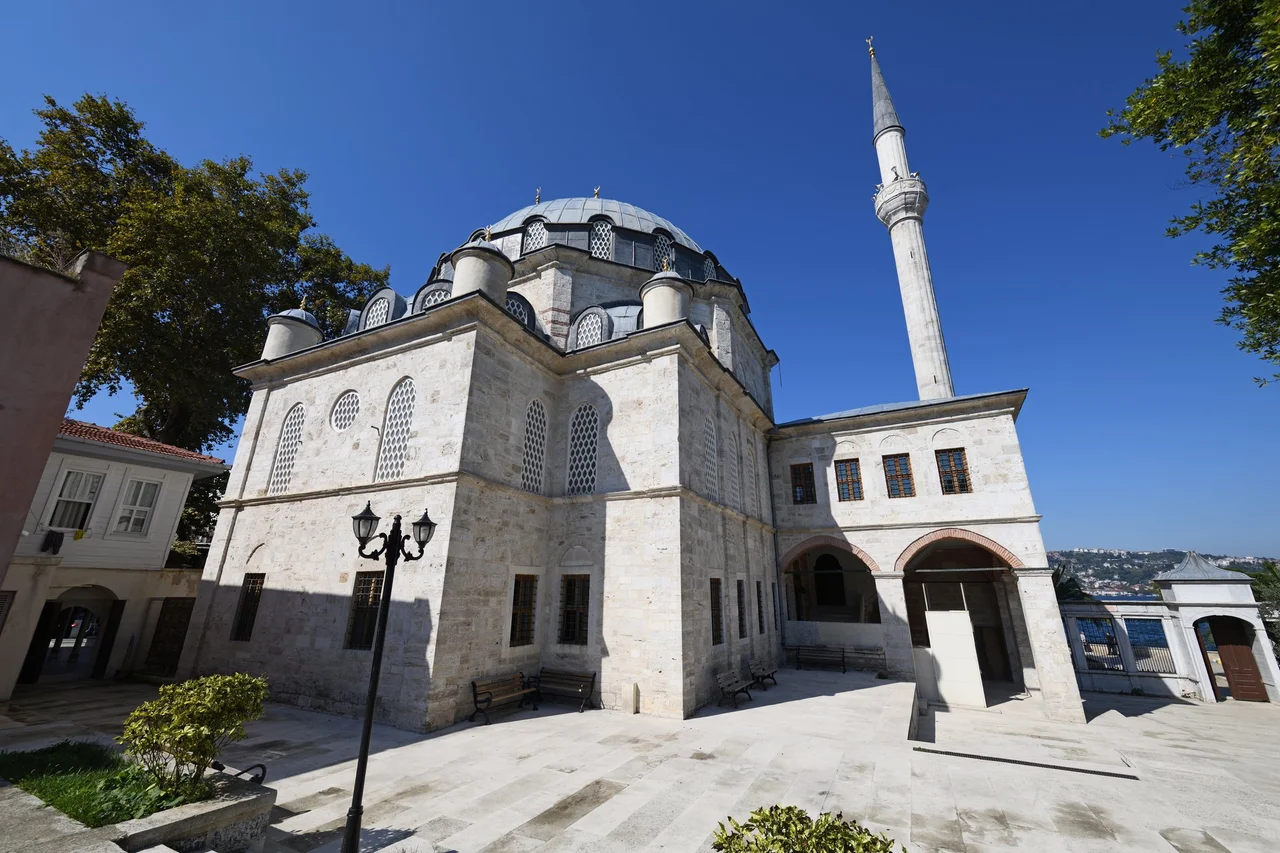

Beylerbeyi Mosque
Most mosques in Istanbul present their grandest face to the street or the courtyard. The Beylerbeyi Mosque faces the Bosphorus. That choice, made in 1777 when Sultan Abdul Hamid I commissioned it on the Asian shore, was not accidental — and it turned out to be quietly revolutionary. In the history of Ottoman sacred architecture, Beylerbeyi marks the moment when the mosque and the sultan's private quarters stopped being separate concerns and became, deliberately, one.
A Mosque Dedicated to a Mother
Abdul Hamid I reigned from 1774 to 1789, a period when the Ottoman Empire was opening itself to European artistic influence and the Baroque style was taking root in Istanbul's building programs. He commissioned Beylerbeyi Mosque in 1777–1778 on the site of the demolished Istavroz Palace, and dedicated it to his mother, Rabia Şermi Kadın. The architect is uncertain — possibly Mehmed Tahir, the chief imperial architect of the time, or possibly Edirneli Agop Ağa — but the vision is clear: a prayer space integrated with the waterfront, designed as much to be seen from boats crossing the Bosphorus as to be entered from the street. Around the same time, Abdülhamid was renovating the Imperial Hall at Topkapı Palace, and the decorative sensibility of the two projects echoes each other closely.
Mahmud II Adds His Mark
When Mahmud II renovated the mosque in 1820–1821, he changed it substantially. The original building had a single minaret and a wooden dome — handsome but modest. Mahmud's intervention introduced the two symmetrical minarets that now frame the façade and added elements in the Empire style fashionable during his reign. Art historian Doğan Kuban has argued that the mosque's appearance today owes more to Mahmud II than to its original builder. The renovation also added a clock room and a fountain to the complex's existing amenities, which already included a hammam, a primary school, and two fountains built under Abdülhamid I. The mosque became what grand mosques typically were in this tradition: not just a place of prayer but a neighborhood institution.
The Royal Apartment at the Front Door
What makes Beylerbeyi architecturally significant is its front façade. Rather than the traditional courtyard or portico, the entrance side is dominated by a wide, two-story pavilion — the sultan's loge and royal apartment, integrated directly into the mosque's body. Earlier Ottoman imperial mosques had placed such pavilions at the side or rear, as appendages. Here the royal space came forward, forming the public face of the building. This configuration influenced the design of later imperial mosques in Istanbul, making Beylerbeyi something of a turning point in the tradition. The prayer hall inside follows a more conservative plan: a single dome 14.5 metres in diameter, a marble mihrab projecting from the back wall under a semi-dome, and a U-shaped gallery at the entrance level supporting the sultan's loge above. That loge has a Baroque style and features a naturalistic landscape painting on its back wall, probably added in the 19th century.
Tiles Old and New
Step inside and the interior decoration rewards attention. The columns supporting the entrance gallery have Corinthian-like capitals that deliberately echo monuments from the reign of Mahmud I — a visual reference back to the beginning of the Baroque period in Ottoman architecture. The mihrab is carved marble. But the tiles are the most layered element: a mix of local and imported work, including reused Iznik tiles and Kütahya tiles from the 16th and 17th centuries. Whether the current decoration is original or accumulated over time through successive renovations is debated. What's clear is that the mosque's interior reflects the same openness to outside influence that characterized the broader Ottoman Baroque period — collecting, adapting, synthesizing.
A View from the Water
The Beylerbeyi neighbourhood today is a quiet stretch of the Asian shore, its narrow streets climbing away from the waterfront. Ferries and the occasional tanker pass close enough that passengers can see the mosque's façade clearly — which was exactly the point. The Bosphorus view that Abdul Hamid I planned for still works. The two minarets rise above the roofline, the dome sits behind them, and the mosque's presence on the shoreline remains what it was intended to be: a declaration, in stone and geometry, of imperial piety facing the water that connected the empire to the world.
From the Air
The Beylerbeyi Mosque sits at approximately 41.045°N, 29.046°E on the Asian shore of the Bosphorus, in the Üsküdar district of Istanbul. From the air, it is visible along the waterfront just south of the first Bosphorus Bridge (the 15 July Martyrs Bridge). Flying along the strait, the mosque's two minarets and dome are identifiable against the hillside behind. Recommended viewing altitude is 2,000–3,000 feet, approaching from the south along the Asian shore. The nearest major airport is Sabiha Gökçen International (LTFJ), approximately 25 km to the southeast. Istanbul Airport (LTFM) on the European side is roughly 45 km to the northwest.
Nearby Stories
- Kocaeli Peninsula 7.6 km away
- Second Battle of Çatalca 11 km away
- Istanbul's Rural Outskirts 14 km away
- MV Struma 20 km away
- HMAS AE2 36 km away
- Bursa 66 km away
- Sangarius Bridge 71 km away
- Januarius MacGahan 101 km away