
Beylerbeyi Palace
When Empress Eugénie of France passed through Istanbul in 1869 on her way to the opening of the Suez Canal, she stayed at Beylerbeyi Palace. She was so taken with a window in her guest room that she had a copy of it made for her bedroom at the Tuileries Palace in Paris. That detail — an Ottoman sultan's summer retreat leaving its mark on a French imperial palace — captures something essential about Beylerbeyi: it was designed to impress the world's most demanding guests, and it succeeded.
A Summer Palace on the Asian Shore
Sultan Abdülaziz commissioned Beylerbeyi Palace in the early 1860s, and it was completed between 1861 and 1865 on the Asian side of the Bosphorus, in the Beylerbeyi neighborhood of the Üsküdar district. The architect was Sarkis Balyan, one of the Balyan family of Armenian architects who shaped so much of 19th-century Ottoman Istanbul. He designed it in the Second Empire style — a French-influenced manner more restrained than the maximalist ambitions of Dolmabahçe Palace across the strait. The result is a white marble building that reads elegantly from the water: three stories including the basement, two bathing pavilions visible from the Bosphorus (one for the harem, one for the selamlık), and a façade that balances grandeur with something closer to grace.
The Guest Book
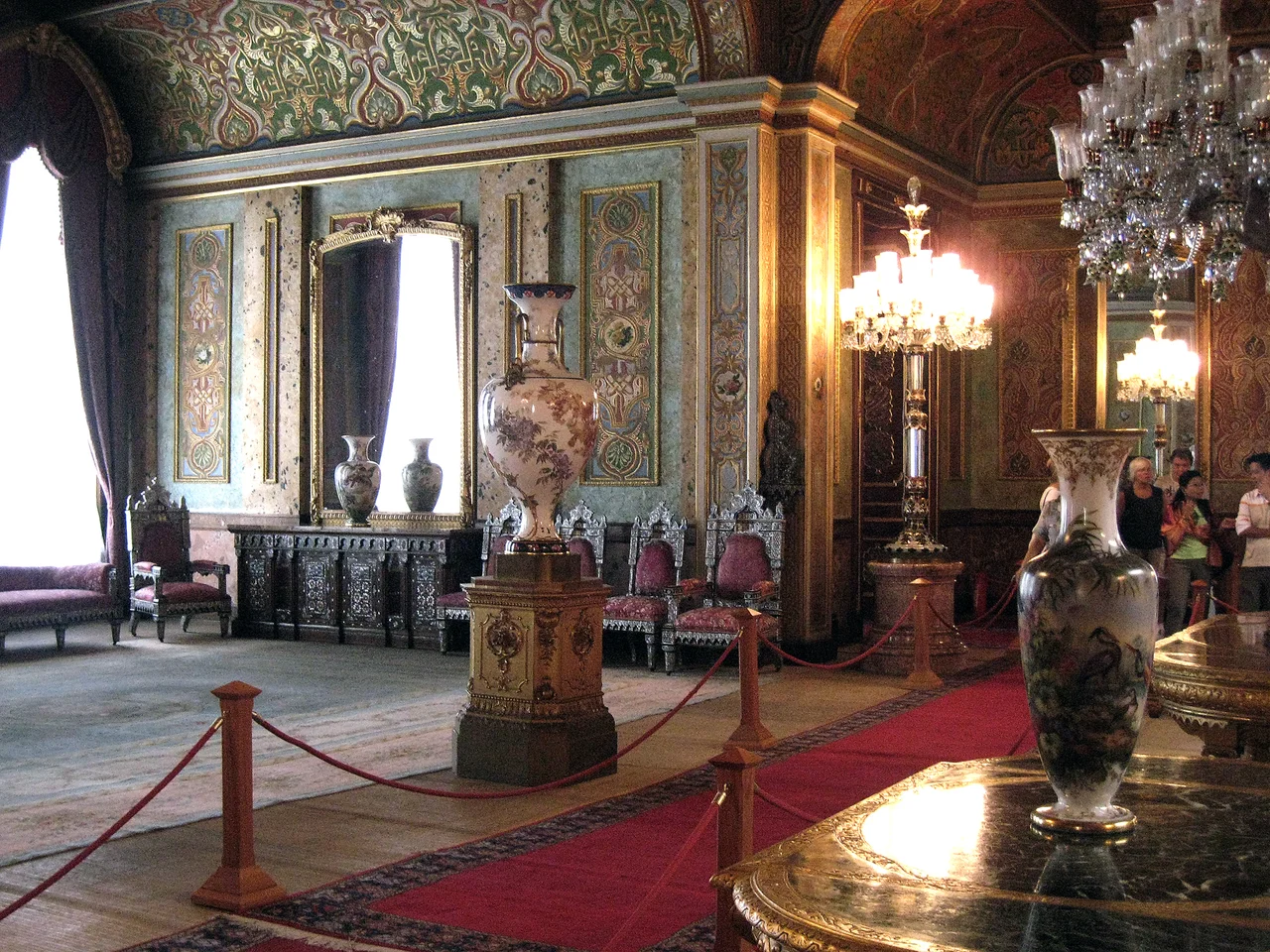
Beylerbeyi was designed partly as an official state guesthouse, and the roster of visitors reads like a diplomatic calendar of the late 19th century. Empress Eugénie came in 1869 on her way to Suez. Franz Joseph, Emperor of Austria-Hungary, was also a guest that year. Nicholas, King of Montenegro, visited in 1874. Edward, then the Prince of Wales and later King Edward VII of Britain, came with his wife Alexandra of Denmark. Wilhelm II, the German Emperor, added his name to the list. The palace was equipped to handle royalty: its 24 rooms and 6 halls were furnished with Turkish Hereke carpets, French Baccarat crystal chandeliers, Chinese and Japanese porcelain vases, and clocks crafted in Istanbul's Golden Horn dockyard alongside pieces from England and France. Egyptian straw mats covered the floors — a practical touch amid the splendor.
Inside and Outside at Once
What distinguished Beylerbeyi's interior design from a purely European palace was its deliberate blending. The architectural shell was Second Empire; the interior atmosphere was something more hybrid. Traditional Turkish domestic arrangements — the spatial logic of a refined Ottoman household — organized the rooms and halls even as Baccarat chandeliers hung above them and Yıldız porcelain shared display space with pieces from China. This fusion was not accidental. Ottoman court culture of the mid-19th century was actively negotiating between its own traditions and the European modes it was encountering more intensely than ever before. Beylerbeyi is a built record of that negotiation — neither fully Western nor purely Eastern, but something that belonged to its particular moment.
A Final Chapter
The palace's last Ottoman resident was its most melancholy. After Sultan Abdülhamid II was deposed in 1909, he was eventually transferred to Beylerbeyi — the gilded summer retreat becoming a comfortable but inescapable confinement. He spent the last six years of his life there and died at the palace in 1918. The summer residence that had welcomed emperors and empresses ended its dynastic life as a place of exile, which gives the building's current incarnation — a museum, open to the public — a certain historical weight. Visitors walk the same halls that once held the deposed sultan's footsteps, past the same chandeliers and carpets, looking out at the same Bosphorus view.
Best Seen from the Water
The palace is positioned to be viewed from the Bosphorus, and the water still provides the best perspective. The two bathing pavilions flanking the main building are visible from ferries heading between the European and Asian shores, and the white marble façade catches the light differently depending on the time of day and the angle of approach. For travelers who arrive by sea — or who simply take a Bosphorus ferry as most visitors to Istanbul do — Beylerbeyi announces itself exactly as Sarkis Balyan and Sultan Abdülaziz intended: as a building that belongs to the strait, as much as it belongs to the shore.
From the Air
Beylerbeyi Palace sits at approximately 41.043°N, 29.040°E on the Asian shore of the Bosphorus, just south of the 15 July Martyrs Bridge (the first Bosphorus Bridge). From the air, the white marble structure and its waterfront gardens are visible along the shoreline in the Üsküdar district. Recommended viewing altitude is 2,000–3,000 feet, approaching from the south along the Bosphorus or from the southeast inland. The nearest major airport is Sabiha Gökçen International (LTFJ), approximately 25 km to the southeast. Istanbul Airport (LTFM) on the European side is roughly 45 km to the northwest.
Nearby Stories
- Kocaeli Peninsula 7.6 km away
- Second Battle of Çatalca 11 km away
- Istanbul's Rural Outskirts 14 km away
- MV Struma 20 km away
- HMAS AE2 36 km away
- Bursa 66 km away
- Sangarius Bridge 71 km away
- Januarius MacGahan 101 km away