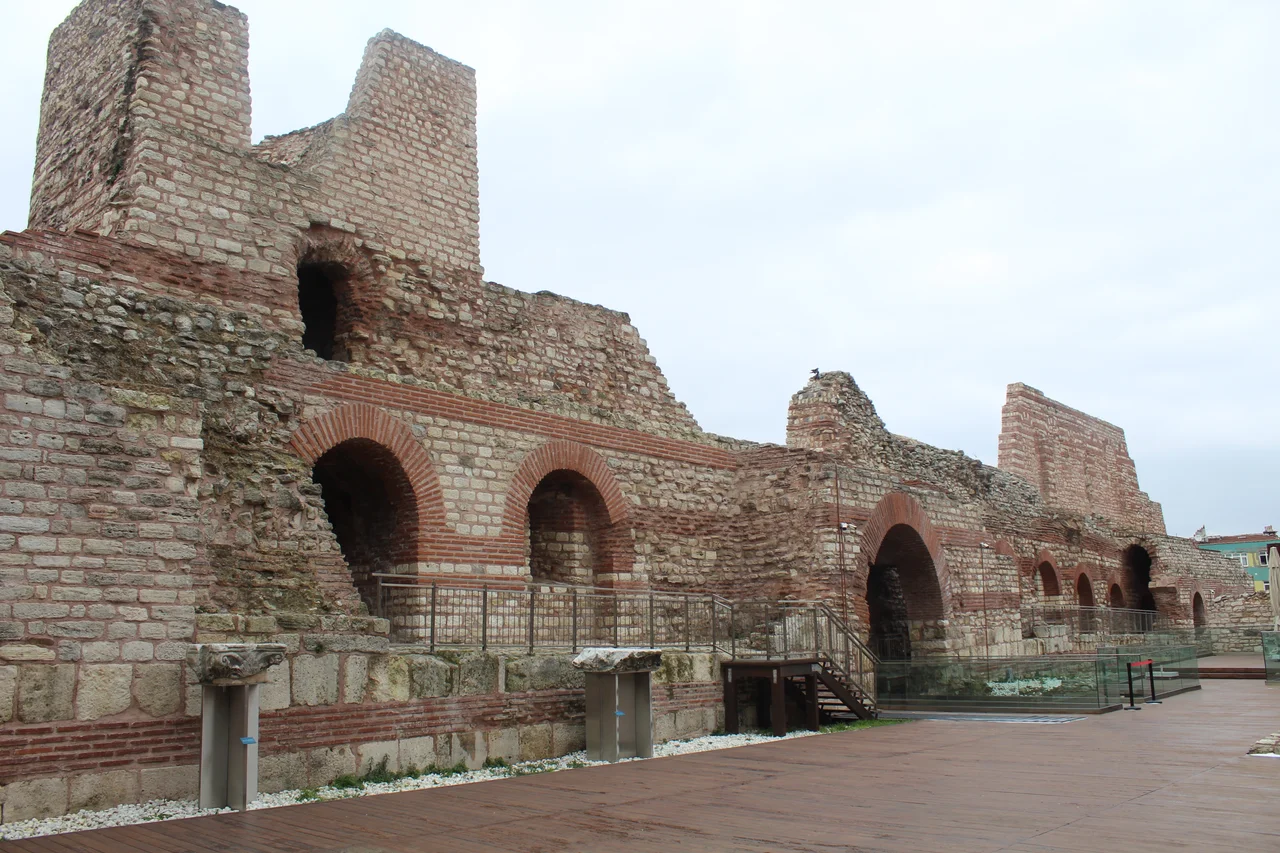

Blachernae
In the northwestern corner of Constantinople, where the city walls met the Golden Horn, there was a quarter unlike any other in the Byzantine world. Blachernae was technically a suburb — a word that undersells what it was. For most of the Byzantine Empire's life, it was the address of miracles, the seat of emperors, and the last defensible ground when everything else fell. It was where the empire kept its most sacred objects, built its most powerful walls, and ultimately lost its last fight.
What's in a Name
Nobody agrees on where the name Blachernae comes from, which is fitting for a place this old. One tradition, recorded by the 19th-century Greek historian Skarlatos Byzantios, holds that the district took its name from a species of fish — blakernai — caught by fishermen who once worked these shores. A religious document from 1351 supports this fish-market origin, stating the name derived from the Latin name of a species sold by Bosphorus fishermen. A very different theory emerged in 1920, when Romanian philologist Ilie Gherghel proposed that the name connected to the Vlachs — the Romanians of the medieval world, sometimes written as Blach or Blasi — suggesting a small Vlach community may have been influential enough in the area to give it their name. Both theories have scholarly adherents. Neither has been proven. The name is older than the records.
The Shrine That Made the Quarter
What gave Blachernae its enduring importance was not politics or geography, but faith. Around 450, Empress Pulcheria built the Church of St. Mary of Blachernae — the Panagia Blacherniotissa — at a sacred spring in the quarter. She reportedly brought relics of the Virgin Mary, including her veil and robe, to be housed there. Emperor Leo I expanded the church between 457 and 474. Emperor Justinian I renovated it in the 6th century. For the Byzantines, this was not simply a church but one of the holiest sites in the Christian world, a place of active miracle. When Constantinople faced sieges, the faithful processed around the walls carrying the Virgin's robe; Byzantine sources record that the city was saved. Whether by faith or by tactics, the defense held, and the shrine's reputation grew with each survival.
The Walls Within the Walls
Blachernae's position at the northwest edge of the city created a strategic problem. The great Theodosian Walls, built in the early 5th century, connected Constantinople to the rest of Thrace along their long inland line — but the quarter of Blachernae and its famous church initially lay outside them. Emperor Heraclius resolved this in 627 by building a new stretch of wall that enclosed the church within the city's defenses. This Blachernae wall section later became, paradoxically, the weakest point in Constantinople's famous defenses — its terrain was different, its construction more varied. The final Ottoman siege of 1453 would break through here.
Palace of the Last Emperors
From the late 11th century onward, Blachernae also became the preferred seat of the Byzantine emperors. The Blachernae Palace complex grew over centuries, added to by successive dynasties. It was here, rather than at the Great Palace in the city's center, that the later Byzantine court lived. After the Fourth Crusade sacked Constantinople in 1204, Latin emperors occupied Blachernae Palace. When the Byzantines recaptured the city in 1261, Blachernae remained the imperial seat. The last Byzantine emperors — the Palaiologoi dynasty — ruled from here during the long twilight of the empire, presiding over a shrinking domain from a palace that had once commanded a continent.
Ayazma: The Sacred Spring Today
The historic Blachernae area now belongs to the Istanbul neighborhood of Ayvansaray, a quiet district along the Golden Horn. The sacred spring associated with the Virgin Mary is still there, still visited. In Turkish it is called Ayazma — a name derived from the Greek hagiasma, meaning holy water. The word itself traces the arc of the city's history: a Greek term for a Greek sacred site, absorbed into Turkish usage, surviving in the language of a city that has changed its name, its faith, its rulers, and its language without ever quite forgetting what it was. Walk to the spring today, and you are standing where Empress Pulcheria stood in 450. The water still flows.
From the Air
The historic Blachernae quarter sits at approximately 41.034°N, 28.940°E in the Ayvansaray neighborhood of Istanbul, at the northwestern tip of the historic peninsula where the city's land walls meet the Golden Horn. From the air, the Theodosian Walls are visible running north-south toward the shore; the Blachernae section forms the northernmost corner of this line. The Golden Horn inlet is clearly visible to the east. Recommended viewing altitude is 2,000–3,000 feet, approaching from the northwest over the former Thracian hinterland for the clearest sense of the city's ancient defensive perimeter. The nearest major airport is Istanbul Airport (LTFM), approximately 30 km to the northwest on the European side.
Nearby Stories
- Kocaeli Peninsula 7.6 km away
- Second Battle of Çatalca 11 km away
- Istanbul's Rural Outskirts 14 km away
- MV Struma 20 km away
- HMAS AE2 36 km away
- Bursa 66 km away
- Sangarius Bridge 71 km away
- Januarius MacGahan 101 km away