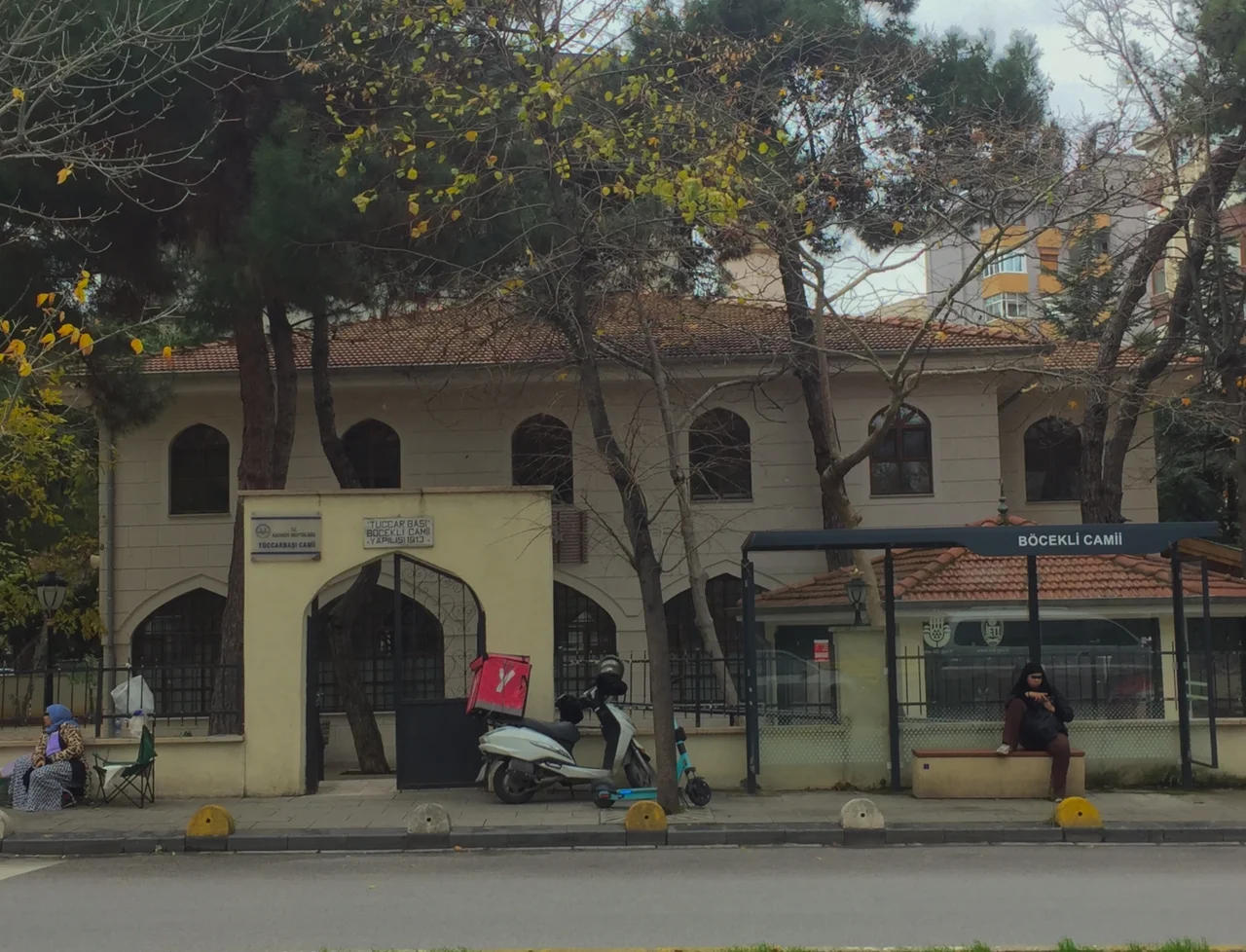

Böcekli Mosque
The mosque gets its name from a bug. Specifically, from the silkworm — böcek in Turkish, literally meaning insect or bug — and from the woman who bred them. Fatma Zehra was a silkworm cultivator in the Tüccarbaşı quarter of Sahrayıcedit, on Istanbul's Asian side. In 1913, she used what she had earned — or what she had saved — to build a mosque for her neighborhood. The building became known as the Böcekli Mosque: the Silkworm Mosque, or if you translate more bluntly, the Bug Mosque. Fatma Zehra is buried in its garden. The mosque she built still stands.
Fatma Zehra's Gift
Women who commissioned mosques in the Ottoman world were not unheard of — the Haseki Sultan complex in Fatih and the Turhan Valide Sultan mosque at Eminönü are among the grand examples — but most of the patrons of such foundations were imperial consorts or women of the court. Fatma Zehra was not. She was a silk producer, working in a trade that was then declining as European industrial production undercut traditional Ottoman sericulture. What drove her to commission a mosque for her neighborhood is not recorded. What remains is the building: cut stone on a rectangular plan, a wooden dome-like ceiling over the central space, a single minaret, and an interior decorated with multicolored floral, vegetal, and geometric motifs.
The building carries something of the quieter aesthetic of early 20th-century Istanbul mosque construction — neither grandiose nor plain, but thoughtfully ornamented. The calligraphic works inside are notable enough that at least one has been formally listed as stolen, a testament to the quality of what Fatma Zehra commissioned.
The Hamidiye Water Connection
Just west of the mosque — now on Sinan Street, across Bayar Avenue — stands a cast-iron fountain that was part of the Hamidiye water system, installed in the early 20th century. The Hamidiye network was one of the major infrastructure projects of the late Ottoman period, bringing fresh spring water from the forests north of the city to neighborhoods across Istanbul. Connecting a mosque to the water system was both practical and symbolic: water for ritual ablutions before prayer, water for the community around the prayer house.
The Böcekli Mosque Fountain, as it is called, is no longer in active use, but it remains in place as a physical artifact of the period when Fatma Zehra built her mosque and the Hamidiye system was extending its reach across the Asian side of the city. These two elements — the mosque and the fountain — mark a moment in Sahrayıcedit's history when the neighborhood was still taking shape.
A Neighborhood Mosque in Kadıköy
Sahrayıcedit is a district of Kadıköy, on Istanbul's Asian shore — a part of the city that has changed enormously since 1913. The broader area was then still semi-rural, its streets less densely built than the historic peninsula across the water. It has since become a fully urban neighborhood of apartments, shops, and the kind of dense residential texture that characterizes most of Istanbul's Asian side.
The mosque sits within this fabric. It is not a tourist destination in the way that the great imperial mosques of the historic peninsula are; it serves its neighborhood. Restorations in 1982 and again between 2015 and 2019 have maintained the structure. Fatma Zehra's grave remains in the garden — a quiet reminder that the person who chose to leave this building behind is not entirely absent from the place she created.
What a Name Carries
Naming a mosque after the trade of its founder is unusual. Most mosque names in Istanbul derive from founders' titles, neighborhoods, or religious attributes. The Böcekli Mosque is named, indirectly, after silkworms — creatures that produce something beautiful and valuable through patient, unremarked labor. There is a certain appropriateness in that. Fatma Zehra's work as a silk producer was the kind of work that sustained Ottoman textile industries from the ground up, far from the court and the grand bazaars.
The mosque she built is modest by the standards of Ottoman religious architecture. But it has endured for over a century, through two major restorations, through the transformation of the neighborhood around it, and through the political convulsions of the twentieth century. It still serves Friday prayers. Fatma Zehra's name is still attached to it. In the logic of pious endowment, that is exactly what she intended.
From the Air
The Böcekli Mosque stands in the Sahrayıcedit district of Kadıköy at approximately 40.98°N, 29.08°E, on Istanbul's Asian side. Approaching from the air at 2,000–4,000 feet, the Kadıköy district lies south of the Haydarpaşa rail terminus and the Kadıköy ferry pier — both useful navigation references. Sabiha Gökçen Airport (LTFJ) is roughly 20 km to the east. Istanbul Airport (LTFM) on the European side lies about 55 km to the northwest across the Bosphorus. The Marmara Sea coastline defines the southern limit of the Kadıköy district from the air, with Bağdat Caddesi visible as a long commercial corridor running eastward from the waterfront.
Nearby Stories
- Kocaeli Peninsula 7.6 km away
- Second Battle of Çatalca 11 km away
- Istanbul's Rural Outskirts 14 km away
- MV Struma 20 km away
- HMAS AE2 36 km away
- Bursa 66 km away
- Sangarius Bridge 71 km away
- Januarius MacGahan 101 km away