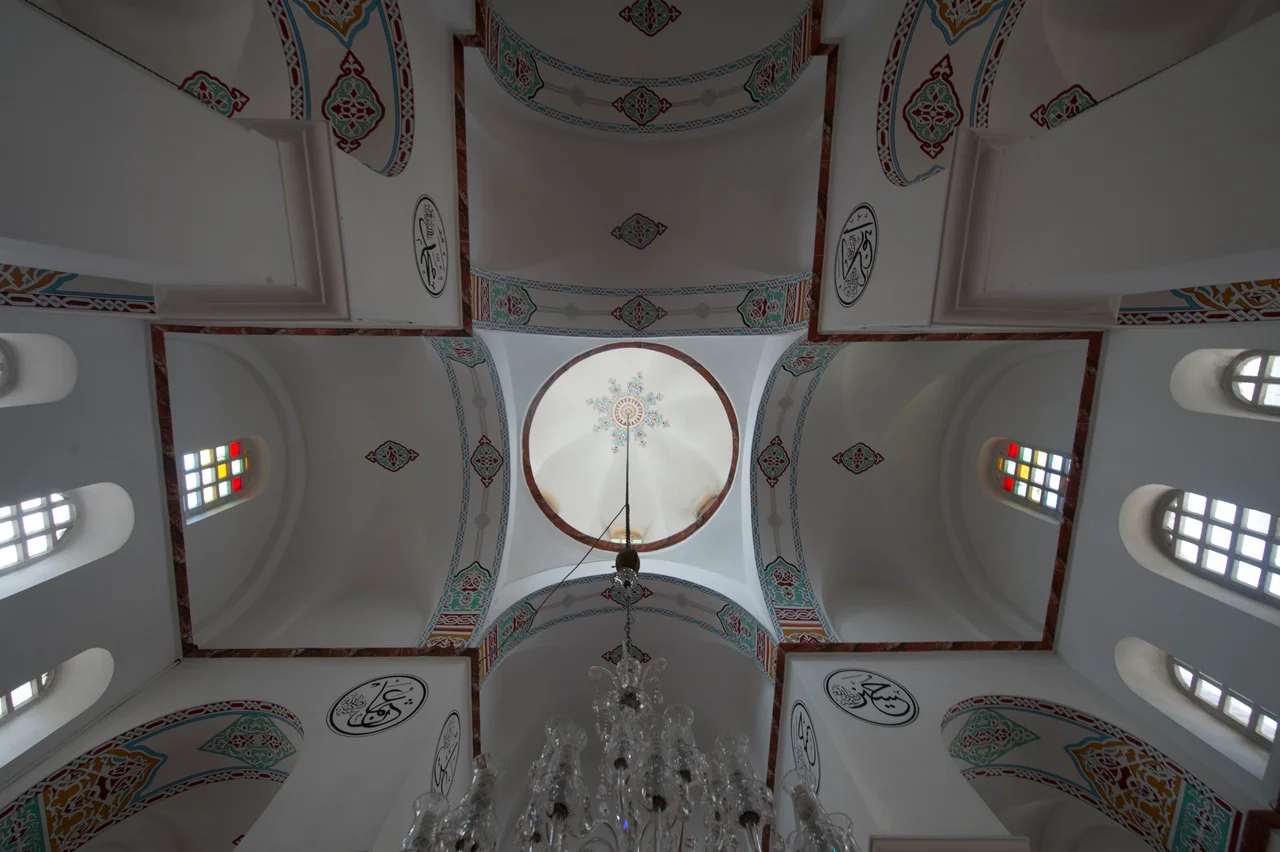

Bodrum Mosque
Before 920, Romanos Lekapenos was not yet emperor — he was a droungarios, a naval commander, and a man who had bought a house near the Sea of Marmara on the edge of Constantinople's ninth district. The place was called Myrelaion: the place of myrrh. He cannot have imagined, when he purchased that house, that he would one day rule the Byzantine Empire — or that the building he would construct there to hold his family's dead would survive more than a thousand years, outlast his dynasty, outlast the empire itself, and today host Friday prayers a few hundred meters from Istanbul's Grand Bazaar.
The Emperor Who Built on a Rotunda
Romanos I Lekapenos was a political usurper who became, against considerable odds, one of Byzantium's more capable rulers. He seized power as regent for the young Constantine VII, made himself co-emperor, and ruled from 920 to 944. His ambitions at Myrelaion were imperial in scale: he intended to build a palace to rival the nearby Great Palace of Constantinople — the seat of Byzantine power — and to establish a family shrine that would redefine imperial burial traditions.
The site he chose had a hidden asset. Beneath it lay a massive fifth-century rotunda, 41.8 meters in external diameter — the second largest circular structure in the ancient world after the Roman Pantheon. By Romanos's time, the rotunda was out of use. He converted it into a cistern, covering its interior with a vaulted system supported by at least 70 columns. Then, above this buried infrastructure, he built a church in the Byzantine cross-in-square form: a nine-meter-sided building with an umbrella dome, arched windows in the drum, and four side naves covered by barrel vaults.
A Church for the Dead
Romanos built the Myrelaion church specifically as a burial place for his family — a private dynastic chapel of a kind that was new to Byzantine practice. In doing so, he broke with a tradition stretching back six centuries: since the time of Constantine I, Byzantine emperors had been buried in the Church of the Holy Apostles. Romanos chose a different path, one that began with his wife Theodora, buried at Myrelaion in December 922, and continued with his eldest son and co-emperor Christopher, who died in 931.
Romanos himself did not live out his reign in glory. Deposed in 944 by his own sons, he was sent to the island of Prote, where he died as a monk in June 948. His body was brought back to Myrelaion and buried in the church he had built. There is a kind of austere justice in the sequence: the man who had turned a palace into a nunnery and a cistern into a crypt ended up in the crypt himself, among the people he had loved and sometimes outmaneuvered. Later, the palace he built was indeed converted into a nunnery, as he had directed before his death.
Fire, Crusade, and Conversion
The Myrelaion's long life was not peaceful. In 1203, during the disastrous Fourth Crusade, the shrine was ravaged by fire. The Latin occupation of Constantinople that followed (1204–1261) left the building abandoned. It was repaired after the Byzantine restoration under the Palaiologos dynasty, and the substructure — the old cistern beneath — was converted into a burial chapel.
Then came 1453, and everything changed. After the Ottoman conquest of Constantinople, the Myrelaion was converted into a mosque around the year 1500 by Grand Vizier Mesih Paşa, during the reign of Sultan Bayezid II. The building took its new name from the Turkish word bodrum — meaning subterranean vault or basement — a reference to the ancient cistern beneath. Fires damaged it again in 1784 and 1911, after which it was abandoned for decades. The modern restoration in 1986 returned it to use as a mosque. The cistern below, restored in 1990, served briefly as a shopping space before its current function: a place where women come to pray.
Architecture: What Survives and Why It Matters
The Bodrum Mosque's significance is partly historical, partly typological. The Myrelaion is one of the earliest examples of the cross-in-square church plan — the form that became dominant in middle Byzantine religious architecture and spread across Orthodox Christendom. The building's nine-meter sides and umbrella dome became a template.
Constructed entirely of brick on alternating brick-and-stone foundation courses, the building features half-cylindrical exterior buttresses, an umbrella dome on a windowed drum, and barrel-vaulted side naves. Inside, four Ottoman-period piers replaced the original columns; windows, oeil-de-boeuf openings, and arches flood the space with light. A restoration in 1964–65 replaced most of the exterior masonry. The substructure — the 70-column cistern beneath — retains more of its original character: austere, massive, and dark.
Laleli Today
Laleli is one of the older districts on Istanbul's historic peninsula, known today for its textile wholesale market, budget hotels, and position between the Grand Bazaar and Aksaray. The Bodrum Mosque opens for daily prayers. Visitors who find their way to it are sometimes surprised by how small and unassuming it looks from the outside — a brick building wedged between concrete apartment blocks. What the exterior doesn't convey is the depth: the thousand-year history layered beneath, the cistern beneath the cistern, the emperor who wanted to be buried here and was.
From the Air
The Bodrum Mosque stands in the Laleli neighborhood of Istanbul's Fatih district at approximately 41.01°N, 28.96°E, on the historic peninsula — the European side of Istanbul. From the air at 3,000–5,000 feet, the peninsula's dense Ottoman-Byzantine cityscape is visible, with the Blue Mosque and Hagia Sophia domes rising to the east and the Grand Bazaar's distinctive rooftop grid slightly to the northwest. The Bodrum Mosque lies in a dense residential and commercial block one kilometer west of the Great Palace ruins. Istanbul Airport (LTFM) is roughly 35 km to the northwest; Sabiha Gökçen (LTFJ) is approximately 50 km to the east across the Bosphorus. The Sea of Marmara defines the southern shore of the historic peninsula from altitude.
Nearby Stories
- Kocaeli Peninsula 7.6 km away
- Second Battle of Çatalca 11 km away
- Istanbul's Rural Outskirts 14 km away
- MV Struma 20 km away
- HMAS AE2 36 km away
- Bursa 66 km away
- Sangarius Bridge 71 km away
- Januarius MacGahan 101 km away