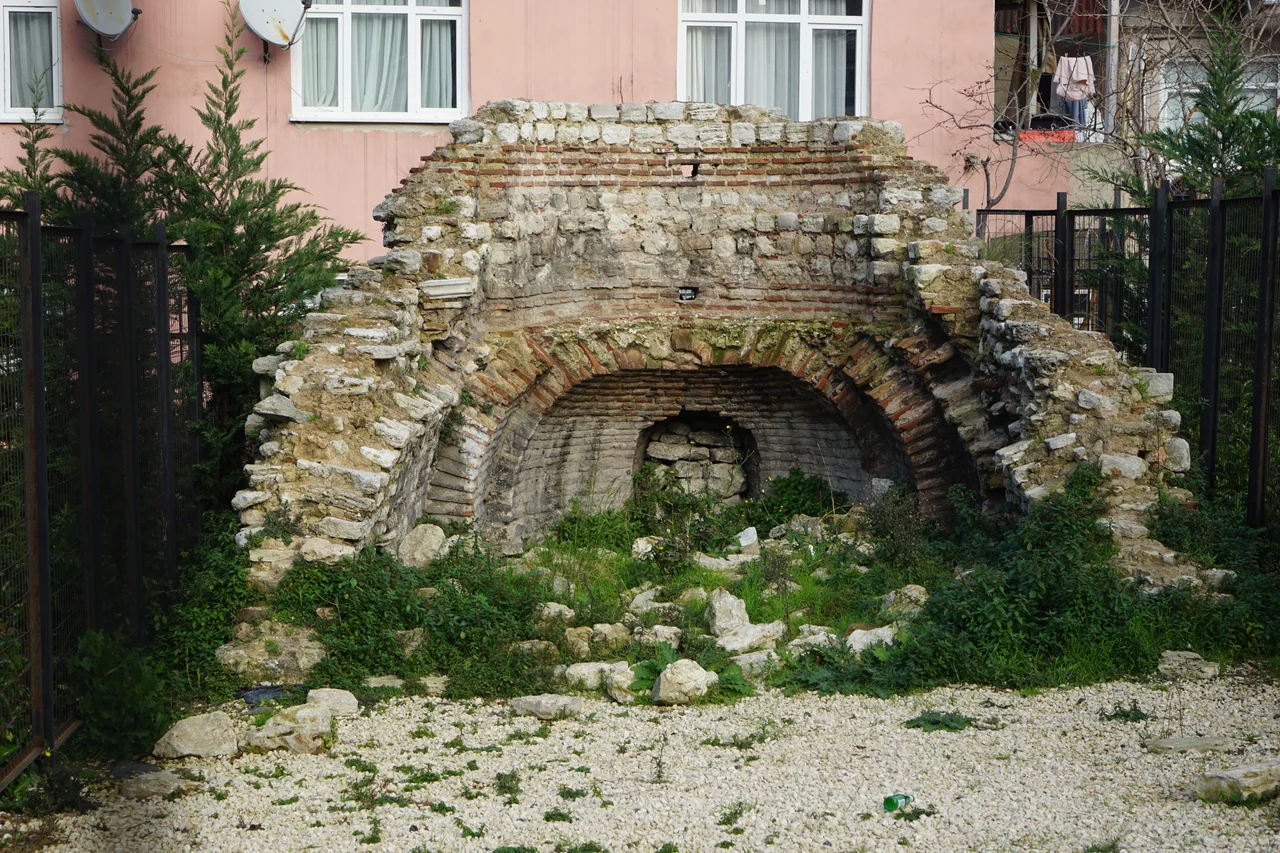

Bogdan Saray
Most embassies announce themselves. The Moldavian legation to the Ottoman Porte announced itself with a crypt. Tucked into the slope of Istanbul's sixth hill overlooking the Golden Horn, the building known as Boğdan Sarayı — the Palace of Bogdania, using the Ottoman name for Moldavia — is less a palace than a whisper: a two-storey Byzantine chapel barely 6 meters wide, now mostly sunk below ground level, its dome gone and its stones slowly returning to the earth. Yet for several centuries this modest structure linked two very different worlds, serving as the church of the Moldavian hospodar's legation to the most powerful empire on earth.
A Chapel Without a Name
Nobody knows what the building was originally called. Erected during the Byzantine era on the slope below the great monastery of St. John the Baptist in the Rock — one of the largest monasteries in Constantinople, known in Greek as Hagios Ioannis Prodromos en ti Petra — the small structure's original dedication has been lost to time. Scholars debate its origins: some attribute it to an earlier Byzantine period, others to a Palaiologan foundation of the fourteenth century, the dynasty's last flowering before the Ottoman conquest. What is certain is that the chapel is small — with sides of just 6.20 meters by 3.50 meters, it could never have been the main church of any monastery. Its north-south orientation, unusual for Byzantine religious buildings that nearly always faced east, suggests it may have served as a funerary chapel rather than a house of worship in the conventional sense. Walls perpendicular to the structure, traces of which survive, hint at a larger complex that has since vanished entirely.
The Craftsmanship of a Fading Empire
The building's brickwork tells its own story of a civilization at work. Courses of three or four rows of white stone alternate with a single row of red brick, creating a chromatic pattern — warm ochre against pale cream — that is characteristic of late Byzantine construction. Above the lower level, a dome rested on pendentives supported by two transverse arches, and the northern end terminated in a polygonal apse decorated with exterior niches. Below, a barrel-vaulted crypt mirrored the chapel above, providing the kind of underground burial space typical of funerary structures from this period. The geometry is precise and the craftsmanship confident, the work of builders who knew their materials well, even if the empire they served was contracting by the decade. A drawing made in 1877 by the scholar A.G. Paspates shows the chapel still standing to its full height from the northeast — a glimpse of something that has since nearly disappeared.
The Moldavian Connection
After the Ottoman conquest of 1453, the building acquired a new identity. The Moldavian principality, though nominally autonomous, maintained close ties with the Ottoman Porte and kept a legation in Constantinople to manage those relations. The chapel became the legation's church, dedicated to St. Nicholas of Myra and known in the Greek of the community as Agios Nikólaos tou Bogdansarághi. The name Bogdan Sarayı — Palace of Bogdania — came from the Ottoman Turkish term for Moldavia. The hospodar's representatives, far from their Carpathian homeland, prayed here in a Byzantine building that predated the Ottoman city around them by generations. It was an arrangement that captured something essential about Istanbul's layered history: a Greek chapel serving Moldavian diplomats in an Ottoman city, on a hill once thick with Byzantine monasteries.
What Remains
By the time researchers turned serious attention to the building, it was already largely gone. As of 2012, the parts above ground had almost entirely disappeared, leaving only the subterranean crypt as a surviving element. The site sits in the Fatih district, the old walled city of Constantinople, where centuries of habitation have buried, rebuilt, and erased the physical record of the Byzantine world beneath the Ottoman and then the modern Turkish city. Bogdan Saray is one of dozens of such fragments — structures that scholars piece together from a 19th-century drawing here, a course of distinctive brickwork there, a record in a monastic chronicle. It never drew the crowds of Hagia Sophia or the Chora Church. It was always a small, peripheral building, important mainly to those who knew what they were looking for.
From the Air
Bogdan Saray sits at approximately 41.030°N, 28.942°E on the sixth hill of the historic peninsula of Istanbul, near Fatih. From the air at 3,000–5,000 feet heading southwest from Istanbul Airport (LTFM), the Golden Horn inlet is clearly visible below — the chapel site lies on the southern slope of the hill above its western shore. The minarets of the Fatih Mosque serve as the nearest prominent landmark to the east. For approaches from the Asian side, Sabiha Gökçen Airport (LTFJ) lies approximately 35 km southeast across the Bosphorus. Visibility is typically good in summer but morning haze over the Golden Horn can reduce contrast in autumn.
Nearby Stories
- Kocaeli Peninsula 7.6 km away
- Second Battle of Çatalca 11 km away
- Istanbul's Rural Outskirts 14 km away
- MV Struma 20 km away
- HMAS AE2 36 km away
- Bursa 66 km away
- Sangarius Bridge 71 km away
- Januarius MacGahan 101 km away