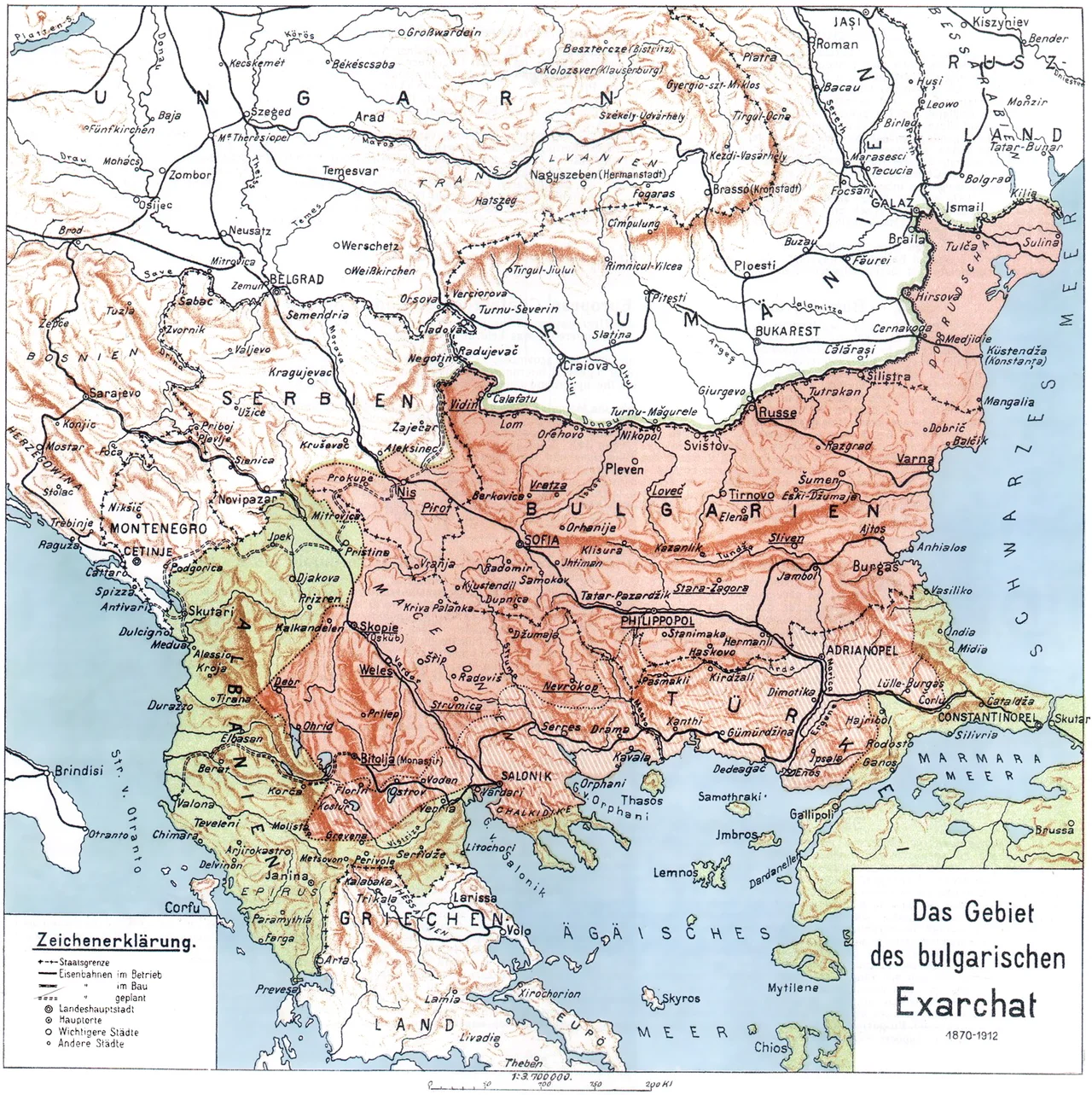

Bulgarian Exarchate
In the Ottoman system, your religion determined your legal identity. Orthodox Christians — whether Bulgarian, Greek, Romanian, or Serbian — were all grouped into the Rum millet, the Orthodox community, and placed under the authority of the Ecumenical Patriarch in Constantinople, a position dominated by Greek clergy known as the Phanariots. For Bulgarian-speaking communities across the Balkans, this meant worshipping in a church they did not control, taught by clergy who often could not speak their language, governed by an institution that served a different national culture. The struggle to change this arrangement lasted decades. When it finally succeeded, in 1870, the new Bulgarian Exarchate was not merely a religious organization. It became the institutional core around which the modern Bulgarian nation assembled itself.
A Monk's Book Starts a Movement
It began, as so many national movements do, with a piece of writing. In 1762, a monk named Paisius of Hilendar — born around 1722 in Bansko, a town in southwestern Bulgaria — completed a short historical work called Istoriya Slavyanobolgarskaya, "History of the Slav-Bulgarians." It was the first sustained argument that Bulgarians had a distinct history, culture, and language worth preserving, and that their subjugation to Greek clerical authority was neither natural nor inevitable. Paisius circulated his manuscript by hand. It could not be printed — there was no Bulgarian printing press — but it was copied and passed from reader to reader across the Bulgarian lands. The example inspired others: Saint Sophroniy of Vratsa (1739–1813), Abbot Spiridon Gabrovski, Abbot Yoakim Karchovski, Abbot Kiril Peychinovich — a generation of monks and teachers who sustained the awakening Paisius had sparked. By the 1820s, discontent with Greek clerical dominance was flaring openly in Bulgarian dioceses. By the 1850s, it had become a purposeful campaign.
The Argument That Could Not Be Won Any Other Way
The Bulgarian leaders who petitioned the Patriarchate for reform through the 1850s and 1860s faced a structural problem: the Ottoman state identified nationality with religious community, and the community for Orthodox Christians was the Rum millet, under the Patriarch. If Bulgarians wanted Bulgarian schools, Bulgarian liturgy, and clergy who spoke their language, they needed an autonomous church. There was no other path. The struggle intensified throughout the 1860s under leaders including Neofit Bozveli and Ilarion Stoyanov, and by the end of the decade, Greek clergy had been ousted from most Bulgarian bishoprics. The Ottoman government, seeking to calm the disturbances, decided to act. On February 27, 1870, Sultan Abdülaziz issued a firman — an imperial decree — establishing the Bulgarian Exarchate. The new institution would serve the dioceses of Bulgaria and any additional diocese where at least two-thirds of Orthodox Christians voted to join. The firman envisaged broad autonomy while leaving the Exarchate nominally under the Ecumenical See — not full independence, but close.
Schism and Excommunication
The Ecumenical Patriarchate did not accept this quietly. The first Bulgarian Exarch, Antim I, was elected in 1872, and on a dramatic day that year — in the Bulgarian St. Stephen Church in Constantinople, which the Patriarch had ordered closed — Antim I and other Bulgarian hierarchs who had been barred from all priestly ministries celebrated a liturgy and declared autocephaly: the full self-governance of the Bulgarian Church. The Patriarchal Synod responded by defrocking Antim I and excommunicating the others. The subsequent Council in Constantinople in September 1872, attended by the Patriarchs of Alexandria, Antioch, and Jerusalem, formally declared the Bulgarian Exarchate schismatic and its adherents excommunicated. The charge: the Exarchate had introduced ethnophyletism — the subordination of Orthodoxy to ethnic nationalism — which the council condemned as heresy. The schism would last 73 years, until 1945, when the Ecumenical See finally recognized Bulgarian autocephaly.
A Church That Built a Nation
Despite the schism, the Exarchate grew. Under the second Exarch, Joseph I, it expanded its church and school network aggressively across the Bulgarian Principality, Eastern Rumelia, Macedonia, and the Adrianople Vilayet. By the eve of the Balkan Wars in 1912, the Exarchate administered seven dioceses with prelates in the Ottoman Macedonian territories alone, along with 1,218 parishes, 1,310 parish priests, 1,331 churches, 73 monasteries, and 1,373 schools with 78,854 pupils — a parallel educational and cultural system reaching into every corner of Bulgarian community life. The 1879 Tarnovo Constitution formally established the Bulgarian Orthodox Church as the national religion of the new Bulgarian state. What the founders of the Exarchate had created, in fighting for an autonomous church, was the organizational structure of a modern nation. School networks, cultural institutions, community registers — all of it built under the roof of a church that the Patriarch in Constantinople had declared illegitimate.
Loss, Exile, and Recognition
The Balkan Wars of 1912–1913 stripped the Exarchate of much of what it had built. Serbian and Greek forces expelled Exarchist clergy and teachers, closed schools and churches — affecting 641 schools and 761 churches in areas under their control. Bulgarian-language use was prohibited; communities that had flourished under Exarchate administration were dismantled. In the Adrianople region, the entire Thracian Bulgarian population faced ethnic cleansing at the hands of Young Turk forces. Exarch Joseph I transferred his offices from Istanbul to Sofia in 1913 and died two years later, a few months before Bulgaria entered World War I on the losing side. The Treaty of Neuilly-sur-Seine in 1919 cost the Exarchate its remaining dioceses in Macedonia and Aegean Thrace. For three decades the Bulgarian Orthodox Church had no regular head. Recognition came only in 1945, when the Ecumenical Patriarch finally acknowledged Bulgarian autocephaly. In 1953, the Bulgarian Patriarchate was restored. The institution born in a contested church on the banks of the Golden Horn in 1870 had outlasted empires, wars, and three-quarters of a century of ecclesiastical exile.
From the Air
The Bulgarian Exarchate's founding church — the Bulgarian St. Stephen Church — stands at approximately 41.032°N, 28.950°E on the southern bank of the Golden Horn in the Balat district of Fatih. From the air at 3,000–5,000 feet, the Golden Horn inlet curves clearly below; the small but distinctive three-domed iron church is visible on the waterfront between the Balat and Fener neighborhoods. Istanbul Airport (LTFM) lies approximately 30 km to the northwest on the European side. For flight context from the Asian shore, Sabiha Gökçen Airport (LTFJ) lies roughly 40 km to the southeast. The historic peninsula, with its dense skyline of minarets and the visible band of the old Byzantine land walls to the west, provides orientation for the approach.
Nearby Stories
- Kocaeli Peninsula 7.6 km away
- Second Battle of Çatalca 11 km away
- Istanbul's Rural Outskirts 14 km away
- MV Struma 20 km away
- HMAS AE2 36 km away
- Bursa 66 km away
- Sangarius Bridge 71 km away
- Januarius MacGahan 101 km away