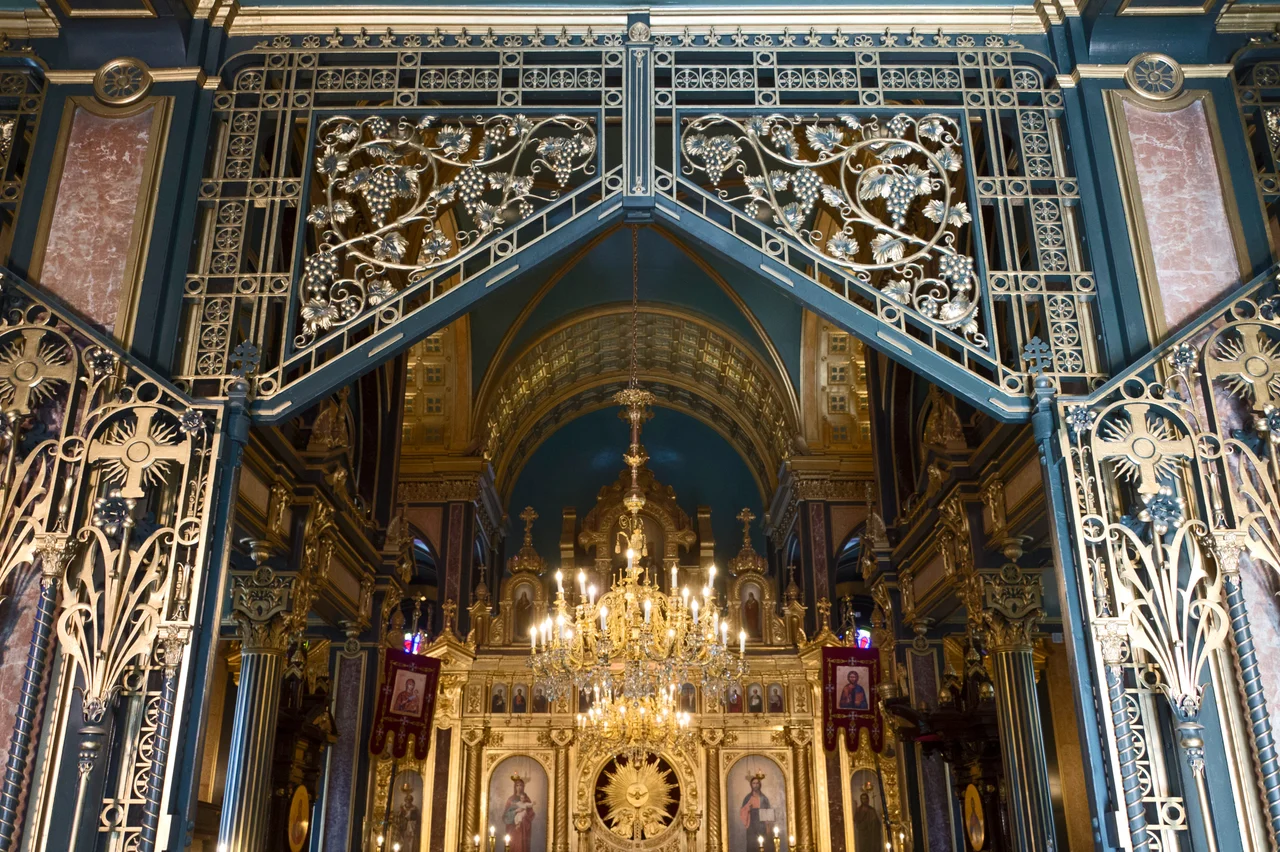

Bulgarian St. Stephen Church
Everything about the Bulgarian St. Stephen Church should not work. The ground at the water's edge of the Golden Horn is too soft for a heavy stone building — soft enough that the architects chose iron instead of concrete as the primary material. The community it was built for was a minority within a minority, Bulgarian Orthodox Christians in an Ottoman city whose official church hierarchy did not recognize their autonomy. And the building itself was fabricated in Vienna, disassembled, loaded onto ships, floated down the Danube and through the Black Sea, unloaded at Istanbul, and bolted back together on the far side of Europe. It worked. The church completed in 1898 stands today as one of the world's few surviving prefabricated cast iron churches, a three-domed Neo-Byzantine structure of considerable elegance gleaming on the Golden Horn.
Wood Before Iron
There was a church here before this one. In 1849, a small wooden building was inaugurated on the shore between the Balat and Fener neighborhoods, using a house donated by the Bulgarian-Greek statesman Stefan Bogoridi, reorganized as a place of worship. It became an important gathering point for the Bulgarian National Revival — the movement for Bulgarian cultural and ecclesiastical independence from the Greek-dominated Phanar Patriarchate. The Ottoman royal decree of February 28, 1870, establishing the Bulgarian Exarchate and granting Bulgarians an autonomous Orthodox church, was first read aloud in this wooden church. It was a moment of singular importance for Bulgarian national history: the decree that effectively created the institutional framework of the modern Bulgarian nation was proclaimed here, on the banks of the Golden Horn, in a modest wooden building that would eventually burn down.
Iron from Vienna
When the wooden church was lost to fire, the community faced a practical problem: the ground was too wet and unstable for heavy stone construction. The solution was a structural iron frame, a technology that was, by the 1890s, well understood — the Eiffel Tower had been completed in 1889. The architect chosen was Hovsep Aznavur, an Ottoman Armenian working in Istanbul. An international competition to produce the prefabricated cast iron components was won by the Austrian firm R. Ph. Waagner. Between 1893 and 1896, Waagner's workshop in Vienna fabricated the 500 tons of iron elements — wall panels, columns, arches, domes, decorative flourishes — and then the pieces were loaded onto ships. They traveled down the Danube to the Black Sea and then south through the Bosporus to Istanbul. After a year and a half of assembly, the church was complete. On September 8, 1898, Exarch Joseph I inaugurated it. Every piece is attached to every other piece by nuts, bolts, rivets, or welding. The building has no mortar.
What Iron Can Do
Standing inside, the surprise is how warm it feels. Cast iron is not a material most people associate with sacred architecture — it suggests factories, bridges, railway stations, the pragmatic infrastructure of the industrial age. But the Bulgarian St. Stephen Church is proof that iron can be made to sing. The building is a three-domed cross-shaped basilica; the altar faces the Golden Horn. A 40-meter belfry rises above the narthex, housing six bells cast in Yaroslavl. The interior carries an elaborate iconostasis, and the decorative language is confidently Neo-Byzantine, with Neo-Baroque details woven in. The chromatic effect of the iron exterior — intricate surface patterns that stone could have produced but at far greater cost and weight — shows what the material, in skilled hands, can achieve. St. Stephen belongs to a small 19th-century tradition of iron churches: the British, who patented corrugated iron in 1829, exported portable iron churches to their colonies. Gustave Eiffel designed iron churches sent to the Philippines and Peru. St. Stephen outlasted most of them.
Renovation and Return
By the early 21st century, the church needed serious attention. A restoration project began in 2011 under Bulgarian-Turkish cooperation and cost more than 15 million euros. The scale of international commitment the project attracted says something about the building's symbolic weight: in 2018, on the occasion of the church's 120th anniversary, Turkish President Recep Tayyip Erdoğan and Bulgarian Prime Minister Boyko Borisov attended the inauguration of the renovated church together. The dome had been gold-plated in 2010, funded by the Bulgarian community of Plovdiv. The restoration brought the structural elements back to sound condition and gave the building back its presence on the Golden Horn. The Bulgarian community in Istanbul — small today, as it has been for most of the 20th century — still worships here. The church remains the most visible monument to their long presence in this city.
From the Air
The Bulgarian St. Stephen Church stands at approximately 41.032°N, 28.950°E on the southern bank of the Golden Horn in the Balat neighborhood of Fatih. From the air at 2,000–4,000 feet, the three copper domes are visible against the water, with the belfry rising clearly above the surrounding low-rise fabric of the old neighborhood. The Golden Horn itself — a curved inlet running roughly east-west — is the primary navigational reference from the air. Istanbul Airport (LTFM) lies approximately 30 km to the northwest; standard arrival routes over the European side of the city pass within clear viewing distance of the Golden Horn. Sabiha Gökçen Airport (LTFJ) serves the Asian shore, approximately 38 km to the southeast. Morning light from the east illuminates the church's eastern facade and catches the gold-plated dome particularly well.
Nearby Stories
- Kocaeli Peninsula 7.6 km away
- Second Battle of Çatalca 11 km away
- Istanbul's Rural Outskirts 14 km away
- MV Struma 20 km away
- HMAS AE2 36 km away
- Bursa 66 km away
- Sangarius Bridge 71 km away
- Januarius MacGahan 101 km away