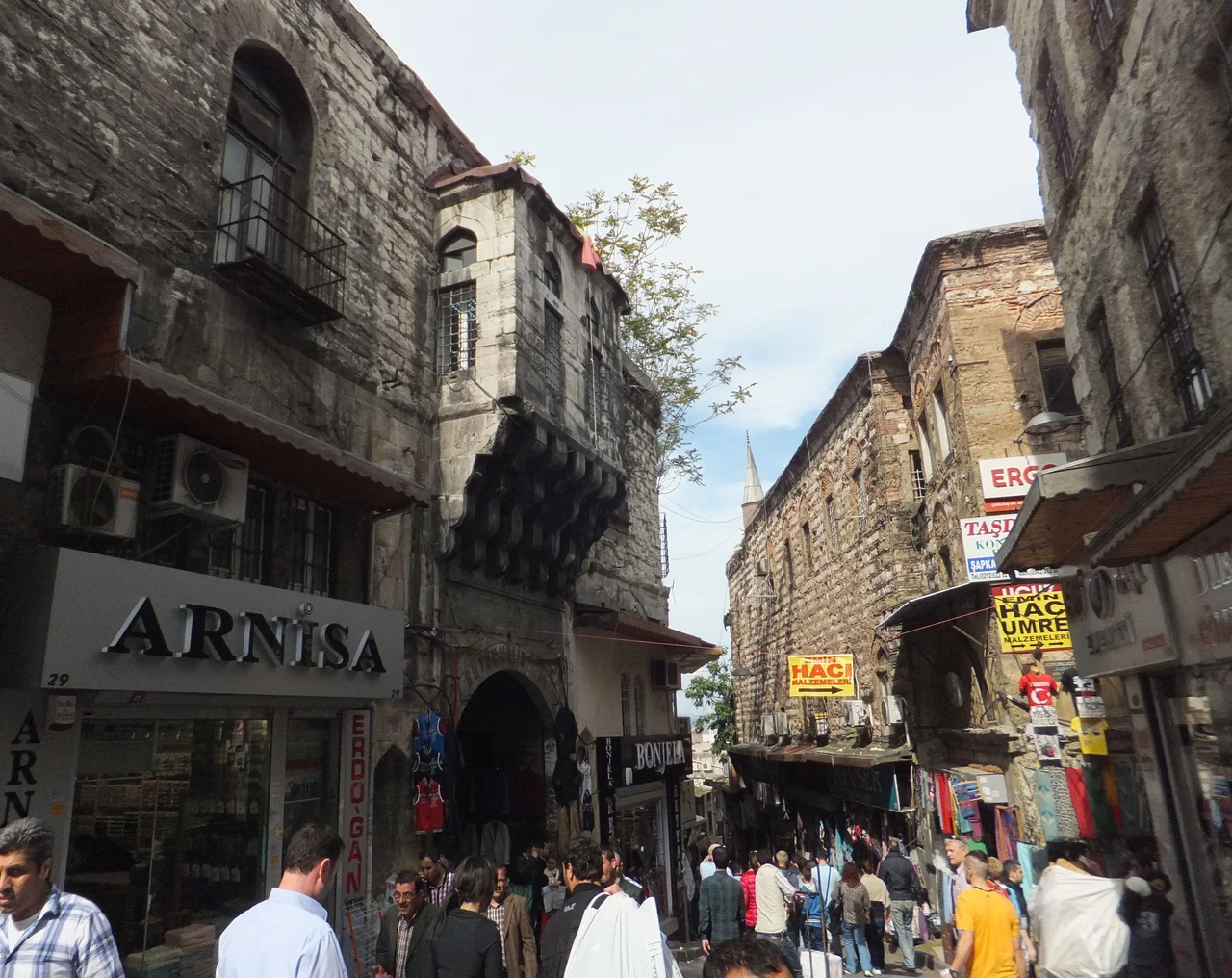

Büyük Valide Han
Kösem Sultan did not live to see it finished. She commissioned the Büyük Valide Han — the Great Valide Han — as a pious endowment in 1651, its revenues destined to fund the upkeep of the Çinili Mosque she had founded in Üsküdar. But Kösem, the Greek-born consort of Sultan Ahmed I and regent to two sultans, was assassinated in a palace coup in September 1651, before construction was complete. The han was finished without her. It went on to become the largest caravanserai in Istanbul: a vast complex of three courtyards, roughly 98 by 168 meters, on a hillside near the Grand Bazaar that had once been the site of the palace of Cerrah Mehmed Pasha. In its prime, it could accommodate around 3,000 merchants.
The Architecture of Commerce
A han is an Ottoman urban caravanserai, designed to serve the needs of long-distance merchants in a city. Lodging, storage, workshops, and trading offices occupied the same complex, organized around internal courtyards where animals could be stabled and goods unloaded. The Büyük Valide Han is the grandest surviving example in Istanbul. Its main courtyard is approximately 55 meters per side — a substantial open space surrounded by two-storey arcades. On the ground floor: storerooms and animal quarters. On the upper floor: the merchant lodgings, reached by external staircases. Two additional smaller courtyards extend the complex to the east and west. The whole thing is built in the characteristically plain Ottoman commercial style, with none of the decorative elaboration of a mosque or palace. Its power is in its scale. Walking through the main gate into the central courtyard, the size of the enterprise becomes clear — this was not a waystation but a small city of commerce.
The Iranian Mosque at the Center
The most unexpected feature of the Büyük Valide Han is the small mosque that occupies the center of its main courtyard. It is a Twelver Shi'a (Jafari) mosque, established to serve the large community of Iranian merchants who lodged in the han — one of the most significant Shi'a places of worship in Istanbul. The original structure burned down in 1947 and was rebuilt in 1951. It remains open for Shi'a observances today, though only on certain occasions. The presence of the mosque is a reminder of how cosmopolitan the han's commercial world was: Sunni Ottoman city, Shi'a Iranian mosque, merchants from across the Islamic world and beyond, all conducting business under the same arcades. The waqf system — the pious endowment that financed the complex — tied its revenues to the Çinili Mosque in Üsküdar, making the commercial activity of the han a form of permanent charitable giving.
Buried History Beneath the Stones
The site has older stories embedded within it. The northeastern section of the han incorporates the remains of a Byzantine structure known as the Tower of Eirene, a remnant of the city that preceded the Ottoman conquest of 1453. Istanbul is full of such layering: the Byzantine infrastructure absorbed into, built over, or simply continuing to exist beneath Ottoman construction. The han itself stands on a hillside in the Mercan district, a short walk from the Grand Bazaar — not physically inside the covered bazaars, but part of the same commercial ecosystem. The street it faces, Çakmakçılar Yokuşu (Flint-Makers' Hill), was once lined with specialist craftsmen supplying the trade flowing through both the han and the bazaar. Today the workshop tradition persists: coppersmiths and craft ateliers still operate in the upper galleries, and a tea house occupies the central courtyard.
From Waqf to Ruin to Persistence
The han was built through the waqf system — Kösem Sultan's endowment meant that the complex's revenues were legally dedicated to maintaining her mosque in Üsküdar for as long as it stood. This mechanism gave Ottoman charitable institutions a kind of permanence: they were not dependent on individual goodwill but on a legal structure. In practice, many hans declined as Ottoman commercial networks shifted and as more modern forms of business accommodation became available. The Büyük Valide Han suffered fires, neglect, and the general attrition of centuries. Of the estimated 210 to 366 rooms and perimeter spaces it once contained, roughly 115 rooms and 40 shops remain active today. What is remarkable is not its decline but its survival. The complex still functions as a working courtyard: workshops occupied, the mosque periodically in use, the tea house open. A building from 1651, in continuous if reduced use, in one of the world's most layered cities.
From the Air
The Büyük Valide Han sits at approximately 41.014°N, 28.968°E in the Mercan neighborhood of Fatih, inland from the Golden Horn on the historic peninsula. From the air at 3,000–5,000 feet, the landmark references are the Grand Bazaar complex a few hundred meters to the west and the domes of the Nuruosmaniye Mosque just beyond it. The han's three courtyards are not easily distinguishable from altitude but the dense commercial urban fabric of the Kapalıçarşı district, with its characteristic roofscape, identifies the area clearly. Istanbul Airport (LTFM) lies approximately 32 km to the northwest; Sabiha Gökçen Airport (LTFJ) on the Asian shore lies roughly 30 km to the southeast across the Bosporus. The Bosporus itself is visible to the east from moderate altitude, with the 15th July Martyrs Bridge marking the crossing at the city's waist.
Nearby Stories
- Kocaeli Peninsula 7.6 km away
- Second Battle of Çatalca 11 km away
- Istanbul's Rural Outskirts 14 km away
- MV Struma 20 km away
- HMAS AE2 36 km away
- Bursa 66 km away
- Sangarius Bridge 71 km away
- Januarius MacGahan 101 km away