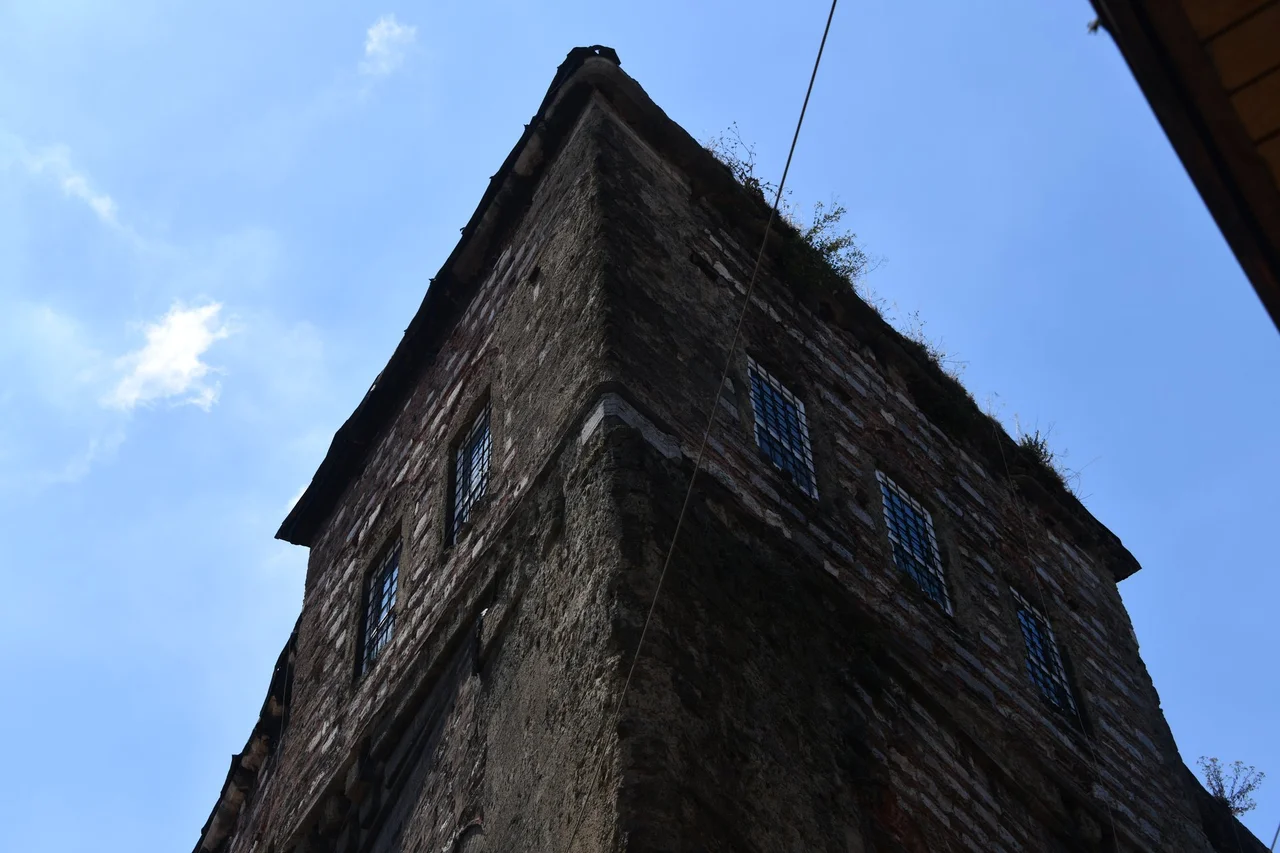

Büyük Yeni Han
Somewhere in the labyrinth between the Grand Bazaar and the Golden Horn, you step off Mercan Caddesi through an arched portal and the city noise falls away. Three tiers of stone galleries rise around a courtyard that stretches nearly ninety metres end to end, and for a moment the scale stops you. This is the Büyük Yeni Han — the Great New Inn — completed in 1764 on the orders of Sultan Mustafa III, and it still carries the quiet authority of a building that once organized the financial life of an empire.
A Palace Built for Commerce
The han is not a mosque or a palace in any ceremonial sense, yet Sultan Mustafa III treated it with the same seriousness he gave to public religious works. Ottoman architecture in the eighteenth century had absorbed European Baroque influences, and the Büyük Yeni Han shows it: the building's northern facade curves gently along an uneven street, a sophisticated solution that also created space for extra windows to light the interior. A stone birdhouse — a detail repeated in other Ottoman Baroque structures of the era — once decorated the northeast corner alongside a mashallah inscription, though only part of the birdhouse survives today. Across the lane, the smaller Küçük Yeni Han (the Small New Inn) rose at the same time by the same sultan's command, the two buildings forming a coordinated commercial district. A small mosque integrated into the Küçük Yeni Han's upper floors served workers at both.
Moneychangers and Merchants
Land for the new building was assembled starting in 1761 through a careful series of property exchanges with existing waqfs — the Islamic endowment foundations that controlled much of Istanbul's real estate. One documented transaction, dated August 2–11, 1761, traded a 523-square-metre plot belonging to the waqf of Çavuşbaşı Ali Agha for various properties scattered across the city. The han's most notable occupants were the sarrafs — non-Muslim and foreign moneychangers whose role was growing rapidly in eighteenth-century Ottoman financial life. Their presence was not incidental. As the empire navigated complex international credit markets, the sarrafs became indispensable intermediaries, and the Büyük Yeni Han gave them a prestigious address in the heart of Istanbul's commercial district, directly connected to the Grand Bazaar's network of trade.
Inside the Long Courtyard
The courtyard stretches almost rectangularly between its gallery walls, though anyone who looks closely notices the plan is slightly irregular: the architect had to fit the structure into a crooked urban plot, so the courtyard narrows from about fifteen metres at its wider northern end to twelve and a half metres at the south. Around the whole perimeter, three levels of arched galleries stack neatly, each giving access to rooms that once numbered somewhere between 150 and 164, depending on the source. The rooms themselves preserve faint traces of painted ceilings — small landscape scenes, architectural vignettes — characteristic of the Ottoman Baroque period's embrace of European decorative motifs. In the nineteenth century, a plain stone structure was added mid-courtyard, bisecting the space into two. It reduced the drama of the original interior, but the galleries on either side still evoke what this place must have felt like when every room was occupied.
A District of Hands
The Büyük Yeni Han sits in a historic market district that has operated continuously since Mehmet II founded the first bedesten in the mid-fifteenth century. That original covered market seeded an entire ecosystem of commercial buildings — workshops, warehouses, lodging houses, and hans like this one — that gradually filled the blocks between the Grand Bazaar and Eminönü on the Golden Horn's shore. A han served multiple functions simultaneously: it offered lodging for merchants arriving from other cities or countries, secure storage for goods, space for artisan workshops, and offices for conducting deals. The Büyük Yeni Han is the second largest historic caravanserai surviving in Istanbul. The oldest, the Kürkçü Han, stands directly to the east. Together they anchor a neighbourhood where, for five centuries, the business of the world passed through on foot, by cart, and — in those painted ceiling vignettes — by imagination.
What the Stone Remembers
Walk through today and the han is quieter than it would have been in 1764 — fewer merchants, fewer sarrafs — but it still functions as a commercial building, its ground-floor shops facing the street, its interior galleries occupied in ways that would not entirely have surprised Mustafa III. The stone itself has proved more durable than the empire that raised it. The galleries still stand. The courtyard, even divided, still holds its proportions. The mashallah inscription persists at the northeast corner. Buildings of this scale and ambition were once common across Ottoman cities; most are gone. The Büyük Yeni Han is a rarity: a grand public investment in commerce, largely intact, still earning its name.
From the Air
The Büyük Yeni Han sits at approximately 41.013°N, 28.969°E in the historic Eminönü district of Istanbul, between the Grand Bazaar and the Golden Horn waterway. Approaching from the west at 3,000 feet, the Golden Horn's distinctive inlet is the primary navigation landmark; the Bosphorus Strait appears to the east. The Grand Bazaar's large roofed complex is visible from altitude just south of the han's location. Nearest major airport is Istanbul Airport (LTFM), approximately 35 km to the northwest. From cruising altitude on approach to LTFM from the south, the historic peninsula with its mosques and ancient walls provides clear orientation. Hagia Sophia's dome and the Blue Mosque's minarets mark the peninsula's tip roughly 1.5 km southeast of the han.
Nearby Stories
- Kocaeli Peninsula 7.6 km away
- Second Battle of Çatalca 11 km away
- Istanbul's Rural Outskirts 14 km away
- MV Struma 20 km away
- HMAS AE2 36 km away
- Bursa 66 km away
- Sangarius Bridge 71 km away
- Januarius MacGahan 101 km away