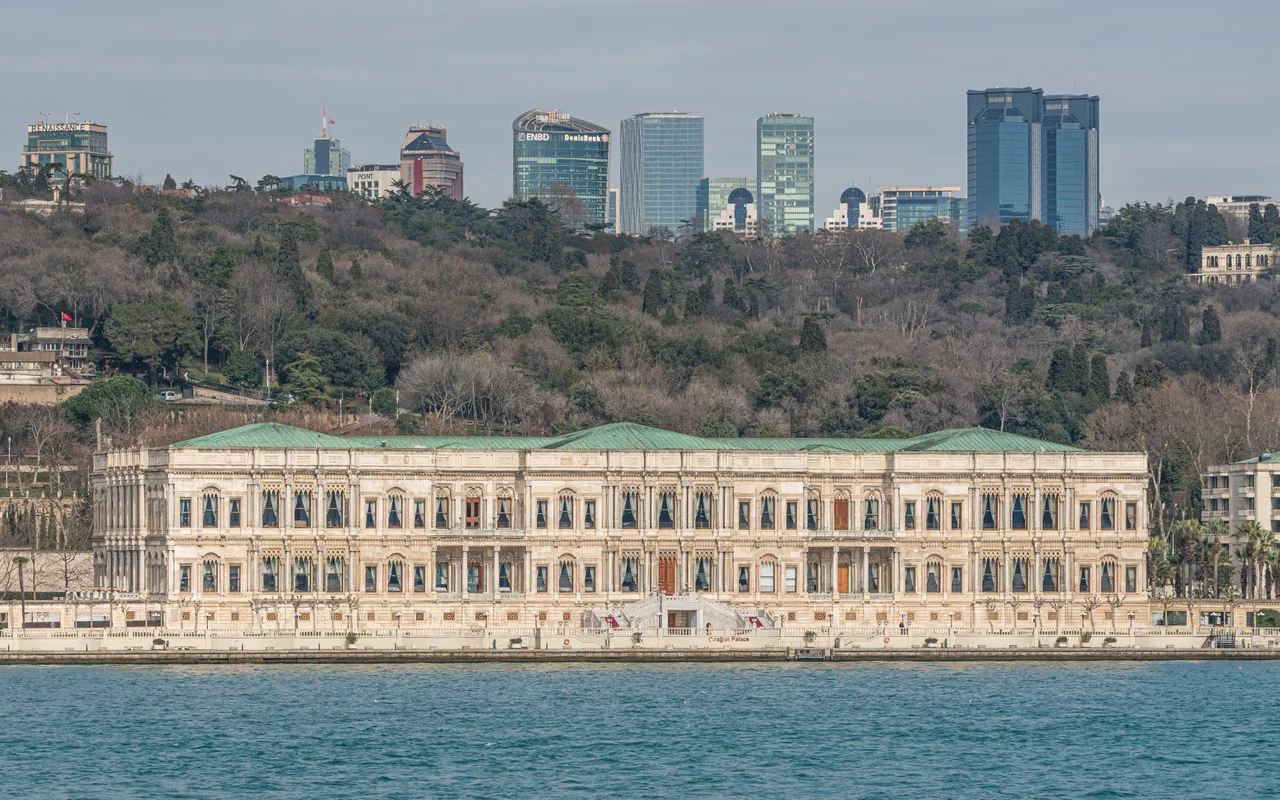

Çırağan Palace
Sultan Abdulaziz built his palace on the European shore of the Bosphorus, between Beşiktaş and Ortaköy, and did not live long enough to enjoy it. Construction began in 1863 and the outer shell was finished in 1867, but the interior decoration continued until 1872. Four years later, Abdulaziz was deposed. He was found dead in the palace on 30 May 1876 — the circumstances remain disputed — before he had lived in it for any real length of time. Three sultans, a prison, a parliament, a fire, and a luxury hotel chain would follow.
Built by the Balyans
The architect was Nigoğayos Balyan, a member of the Armenian Balyan family whose dynasty dominated Ottoman palace architecture across the nineteenth century. Construction was carried out by his sons Sarkis and Hagop Balyan, who worked on several other major Istanbul commissions during the same era. The Balyans worked in a style that blended Western neoclassical and Baroque influences with Ottoman sensibilities — an approach that suited the Tanzimat-era sultans who wanted palaces that would signal modernity and refinement to European visitors. The Çırağan Palace's outer walls were built of colorful marble; the inner walls and roof were wood. A marble bridge connected the palace to Yıldız Palace on the hill above it. A high garden wall screened the complex from the street. It was the last palace built in the Ottoman tradition of each sultan commissioning his own rather than living in his predecessors' residences — a tradition that ended here.
The Unlucky Succession
After Abdulaziz was found dead, the throne passed to his nephew Murad V, who moved into the palace. He reigned for ninety-three days. Abdul Hamid II, his brother, had Murad declared mentally ill and deposed — and then, in one of the stranger arrangements in Ottoman palace history, kept Murad confined in Çırağan Palace under house arrest for the remainder of his life. Murad V died there on 29 August 1904, having spent nearly twenty-eight years as a prisoner in a building his predecessor had commissioned as a statement of imperial power. The palace had briefly housed the two most recent former sultans simultaneously: the dead one who built it, and the living one who was not permitted to leave it.
Parliament, Then Flames
On November 14, 1909, during the constitutional reforms of the Second Constitutional Era, Sultan Mehmed V permitted the Ottoman Parliament to hold its sessions in the Çırağan Palace. The experiment lasted less than two months. On January 19, 1910, a fire broke out and swept through the interior. The wooden inner structure burned completely. Only the marble outer walls remained standing. The shell sat empty for decades afterward. The palace's grounds served an unlikely second life: the garden was converted into a football stadium, called Şeref Stadı, used by the Beşiktaş football club. The ornate marble facade looked on while matches were played in the yard below.
Restored and Reopened
In 1987, a Japanese corporation purchased the ruined palace. Restoration work began on the surviving marble walls, and a modern hotel complex was constructed in the adjacent garden. The hotel building opened in 1990; the restored palace itself opened in 1992, operating as the Çırağan Palace Kempinski. The palace portion functions as luxury suites. A renovation in 2007 brought the interiors closer to the original Baroque character and soft color palette. The marble bridge to Yıldız Palace still stands. The Bosphorus still runs past the palace's waterfront terrace, as it did when Abdulaziz was laying its foundations — the strait carrying the same traffic it has always carried, indifferent to which empire owns the buildings on its shore.
What the Water Sees
Standing at the Çırağan Palace today, what strikes you is the continuity of the setting rather than the discontinuity of the history inside. The Bosphorus is the constant: it flows north to south between Europe and Asia, shimmering and grey-green, as it did when this was an imperial residence, a prison, a ruin, and a football pitch. The palace's marble walls, built to last by the Balyan family, have outlasted their four purposes with equanimity. Inside, guests eat in rooms that once held parliamentary sessions. The sultan's vision — a palace grand enough to face the Bosphorus with confidence — was realized, then lost, then recovered in a different register. The water that Abdulaziz commissioned these views to frame never changed at all.
From the Air
Çırağan Palace sits at approximately 41.043°N, 29.015°E on the European shore of the Bosphorus, between the Beşiktaş and Ortaköy neighborhoods of Istanbul. From the air, the Bosphorus Strait is the dominant landmark — a narrow waterway clearly visible from cruising altitude, connecting the Black Sea to the north with the Sea of Marmara to the south. The palace's marble facade faces the water directly; the Yıldız district rises on the hillside immediately behind. The Bosphorus Bridge (15 July Martyrs Bridge) crosses the strait approximately 2 km to the south, providing a clear aerial landmark. Nearest major airport is Istanbul Airport (LTFM), approximately 30 km northwest on the European shore. On approach from the north, the Bosphorus defines the entire eastern edge of European Istanbul, with the palace visible on its western bank.
Nearby Stories
- Kocaeli Peninsula 7.6 km away
- Second Battle of Çatalca 11 km away
- Istanbul's Rural Outskirts 14 km away
- MV Struma 20 km away
- HMAS AE2 36 km away
- Bursa 66 km away
- Sangarius Bridge 71 km away
- Januarius MacGahan 101 km away