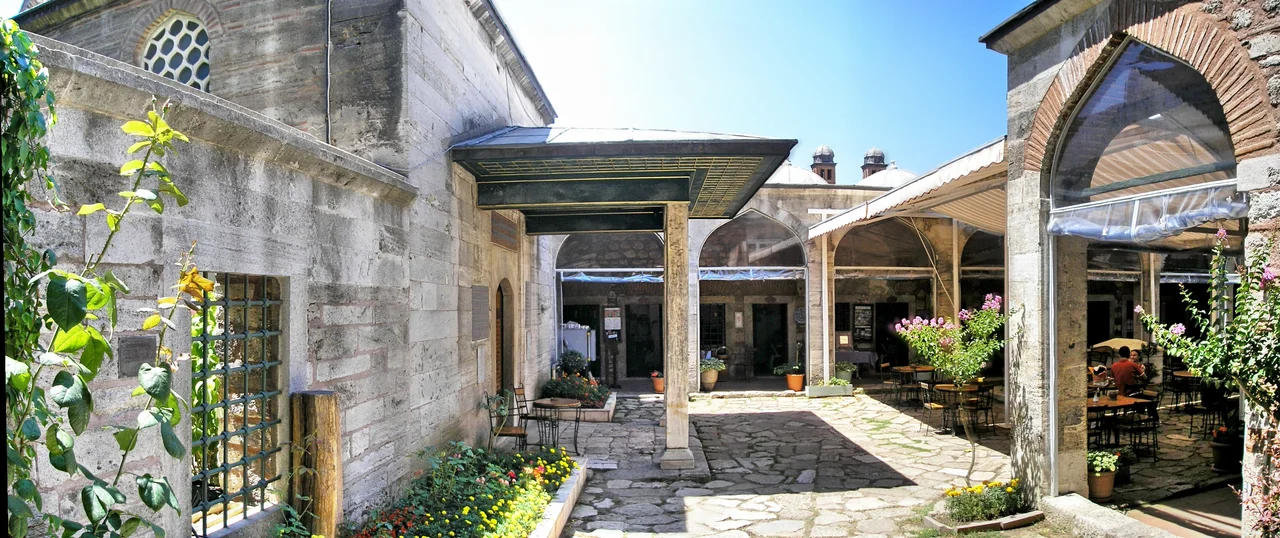

Caferağa Medrese
You descend a short flight of stairs from a narrow street in Sultanahmet, and the city's noise diminishes. In a courtyard ringed by stone arches, someone is practising calligraphy. A ceramicist works at a wheel in one of the small rooms around the perimeter. The scent of green tea drifts from a corner restaurant. This is the Caferağa Medrese, built in 1559 by Mimar Sinan — the Ottoman Empire's greatest architect — and it sits so close to Hagia Sophia that the great dome fills the sky above the roofline. Four and a half centuries of history press lightly on a place that has never really stopped being used.
Sinan's Smallest Commission
Mimar Sinan built more than 300 structures during his long career under sultans Suleiman the Magnificent, Selim II, and Murad III — mosques, bridges, caravanserais, aqueducts. The Caferağa Medrese is among his smaller works: a theological college commissioned by Cafer Agha, chief of the white eunuchs in the imperial household, during the reign of Suleiman the Magnificent (1520–1566). Sinan's touch is evident in the proportions of the courtyard, the rhythm of the arched cells arranged around it, and the way the space manages to feel both functional and serene. A medrese was above all a place of learning — students lived and studied in the rooms around the central courtyard — and Sinan designed for that purpose without ornamentation that would distract from it.
From Theology to the Crafts of the Hand
For centuries the medrese served its original function, then fell into the disuse that claimed many Ottoman-era institutions after the Turkish Republic replaced the traditional religious education system with secular schools. By 1989, the Turkish Cultural Service Foundation had taken on the task of restoring the building and giving it new life. The solution was elegant: rather than converting it to a museum or a cafe, the foundation transformed the fifteen former classroom cells into teaching studios. Today, students learn calligraphy, ceramics, mosaic work, jewelry making, and other traditional arts in the same small stone rooms where scholars once memorised the Quran. The annual end-of-year exhibition, in which students display work pre-selected by their teachers, has become a genuine cultural event.
Inside the UNESCO Boundary
The Caferağa Medrese occupies a remarkable address. It sits within Istanbul's Sultanahmet district, which UNESCO designated a World Heritage Site in 1985 alongside a handful of other historic areas of the city. Hagia Sophia, the Topkapi Palace walls, the hippodrome — the medrese is neighbour to all of them. Visitors who know to look for the stairs off the small side street find a courtyard that offers something the major monuments don't: the experience of a historic Ottoman building that is actively, practically in use. The restaurant inside serves Turkish food. The classrooms host students. The place breathes.
The Living Craft Tradition
What the Caferağa Medrese teaches is not nostalgia. Ottoman calligraphy, Iznik-style ceramics, and traditional jewelry represent art forms with long technical lineages that require apprenticeship to transmit. A student learning calligraphy here works with the same reed pens and carbon inks that Ottoman scribes used, following scripts — Diwani, Naskh, Thuluth — that carry centuries of refinement. The ceramics students work with motifs that trace directly back to the great Iznik kilns of the sixteenth century. The medrese has become, without any fanfare, one of the places where these traditions are kept genuinely alive rather than merely displayed. Sinan would likely have found that a reasonable use of a building.
From the Air
The Caferağa Medrese sits at approximately 41.010°N, 28.979°E in the Sultanahmet district of Istanbul, European side. It is immediately northeast of Hagia Sophia — the vast dome and four minarets of that structure are the unmistakeable visual anchor from the air. At 2,000–3,000 feet, the entire historic peninsula is visible: the Blue Mosque to the south, Topkapi Palace extending to the northeast, and the Golden Horn waterway to the north. Istanbul Airport (LTFM) is the nearest major airport, approximately 35 km to the northwest. (Atatürk Airport, LTBA, closed to commercial flights in 2019.) Approach from the Bosphorus offers the clearest view of the Sultanahmet roofline.
Nearby Stories
- Kocaeli Peninsula 7.6 km away
- Second Battle of Çatalca 11 km away
- Istanbul's Rural Outskirts 14 km away
- MV Struma 20 km away
- HMAS AE2 36 km away
- Bursa 66 km away
- Sangarius Bridge 71 km away
- Januarius MacGahan 101 km away