.jpg)
Çamlıca Mosque
Every measurement in the Grand Çamlıca Mosque carries meaning. The main dome rises 72 metres — one metre for each of the 72 nations that have historically resided in Istanbul. It spans 34 metres across, because 34 is the licence plate number of the city of Istanbul. Four of the six minarets stand 107.1 metres high, commemorating the Seljuk victory at the Battle of Manzikert in 1071. This is a building that speaks in numbers, and the numbers are speaking about identity — Ottoman, Islamic, Turkish, Istanbullu — with a directness that leaves nothing to inference.
A Mosque Built in Numbers
The Grand Çamlıca Mosque, completed and first opened on 7 March 2019 and officially inaugurated on 3 May 2019 by President Recep Tayyip Erdoğan, occupies the crest of Çamlıca Hill in the Üsküdar district on Istanbul's Asian side. With a capacity of 63,000 worshippers — expandable to 100,000 in emergency conditions — it became Turkey's largest mosque at inauguration. Six minarets mark it as only the third mosque in Turkey to carry that many; the first was the Sultanahmet (Blue) Mosque in Istanbul, the second the Sabancı Merkez Mosque in Adana. The minarets are visible from much of central Istanbul, rising above the hill's skyline in a silhouette that the city absorbed quickly and irreversibly.
Designed by Women, for Everyone
The mosque's architects were Bahar Mızrak and Hayriye Gül Totu, who approached the commission with the explicit goal of creating what they described as a 'female-friendly' mosque. Their design incorporated practical features that many mosques lack: a separate space for women to perform ablutions before prayer, a dedicated elevator to the women's prayer areas, and a childcare facility. These may sound like modest provisions, but in the context of mosque design they represent a considered effort to ensure that worship is genuinely accessible to women rather than accommodated as an afterthought. The aesthetic choices — the use of light, colour, glass, ornamentation, and calligraphy described by the construction association's president as intended to make visitors feel more spiritual — came alongside these functional decisions rather than in tension with them.
The Architecture of Reference
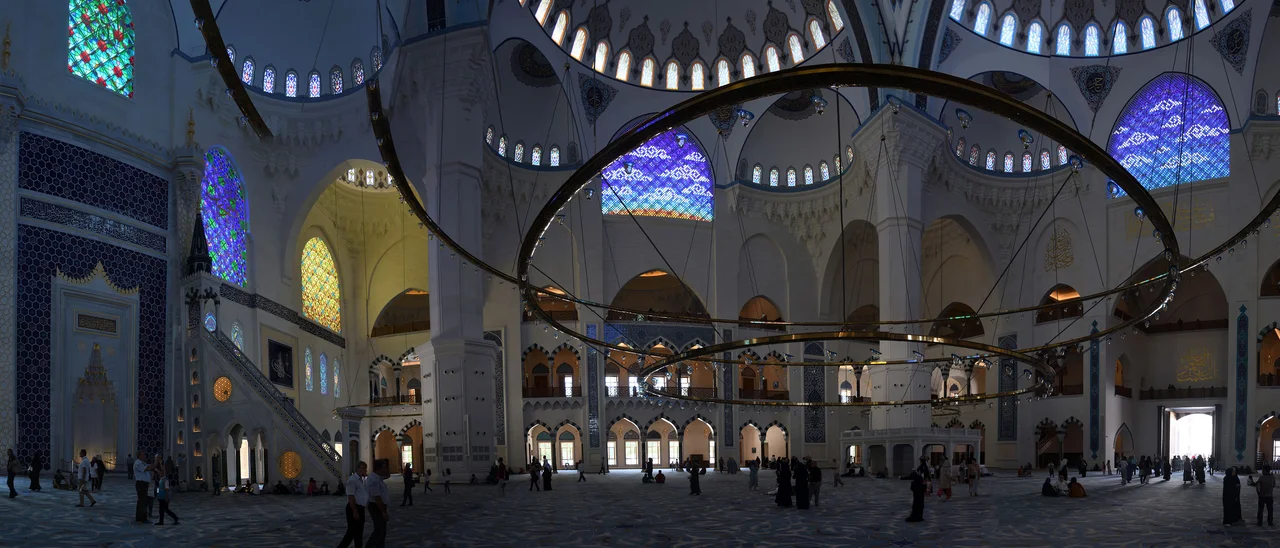
The design draws from classical Ottoman architecture and specifically from the work of Mimar Sinan, the sixteenth-century master whose mosques — Süleymaniye, Selimiye, Şehzade — defined the Ottoman imperial style for centuries. The main dome, 72 metres high and 34 metres in diameter, sits within a spatial grammar that any Ottoman-era worshipper would recognise: the cascade of semi-domes, the encircling gallery, the mihrab oriented toward Mecca. Around the mosque, the complex expands to include an art gallery covering 3,500 square metres, a library occupying 3,000 square metres, a conference hall, and — since April 2022 — a Museum of Islamic Civilisations. The hill beneath carries all of it.
Ambition and Its Critics
Large projects attract large arguments, and Çamlıca Mosque generated its share. Constructed as one of several major megaprojects undertaken by the AK Party government during the latter half of the 2010s, the mosque became a focal point for debates about secularism, scale, and what kind of statements a government makes through architecture. Critics, including commentary from Rudaw, a Kurdish media network, argued the project ran counter to Turkey's tradition of secularism. Supporters saw it as a restoration of Istanbul's skyline to an Ottoman grandeur the city had lost. Both readings contain something real. The mosque now stands, visited by millions, visible from across the water — a structure that, whatever one makes of its politics, changed the silhouette of one of the world's great cities.
From the Air
The Grand Çamlıca Mosque sits at approximately 41.034°N, 29.070°E atop Çamlıca Hill in Üsküdar on Istanbul's Asian side. The six minarets and large dome are unmistakeable from the air — the structure is one of the most prominent landmarks on the Asian shore and visible from much of central Istanbul. Sabiha Gökçen International Airport (LTFJ) lies approximately 20 km to the southeast. From 3,000–5,000 feet on approach from the Bosphorus, the mosque complex sits visually between the Çamlıca Tower (369 m) to its northwest and the Asian residential hills extending south. Take care of the tower height (369 m) when flying at low altitudes around this area.
Nearby Stories
- Kocaeli Peninsula 7.6 km away
- Second Battle of Çatalca 11 km away
- Istanbul's Rural Outskirts 14 km away
- MV Struma 20 km away
- HMAS AE2 36 km away
- Bursa 66 km away
- Sangarius Bridge 71 km away
- Januarius MacGahan 101 km away